. 2015 Mar;3(1):014003.
doi: 10.1088/2050-6120/3/1/014003.

Resolution improvement by 3D particle averaging in localization microscopy

Affiliations

Resolution improvement by 3D particle averaging in localization microscopy

Jordi Broeken et al. Methods Appl Fluoresc. 2015 Mar.

Abstract

Inspired by recent developments in localization microscopy that applied averaging of identical particles in 2D for increasing the resolution even further, we discuss considerations for alignment (registration) methods for particles in general and for 3D in particular. We detail that traditional techniques for particle registration from cryo electron microscopy based on cross-correlation are not suitable, as the underlying image formation process is fundamentally different. We argue that only localizations, i.e. a set of coordinates with associated uncertainties, are recorded and not a continuous intensity distribution. We present a method that owes to this fact and that is inspired by the field of statistical pattern recognition. In particular we suggest to use an adapted version of the Bhattacharyya distance as a merit function for registration. We evaluate the method in simulations and demonstrate it on three-dimensional super-resolution data of Alexa 647 labelled to the Nup133 protein in the nuclear pore complex of Hela cells. From the simulations we find suggestions that for successful registration the localization uncertainty must be smaller than the distance between labeling sites on a particle. These suggestions are supported by theoretical considerations concerning the attainable resolution in localization microscopy and its scaling behavior as a function of labeling density and localization precision.


Figures
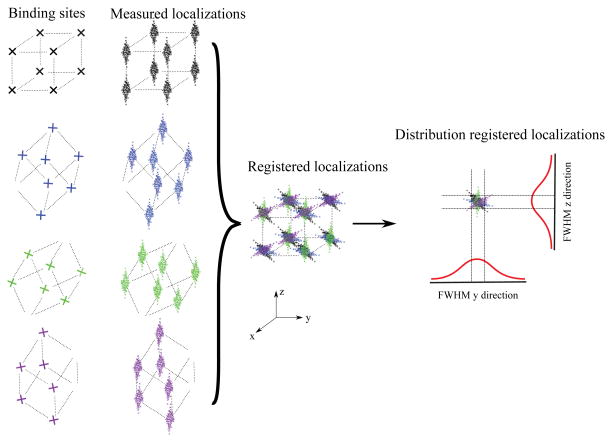
Figure 1
Figure 1
Illustration of our simulation setup. A cube with up to eight occupied binding sites and edge length of 100 nm is used as a model particle. The cube is randomly rotated in 3D before adding localizations obeying the respectively localization uncertainties.
Figure 2
Figure 2
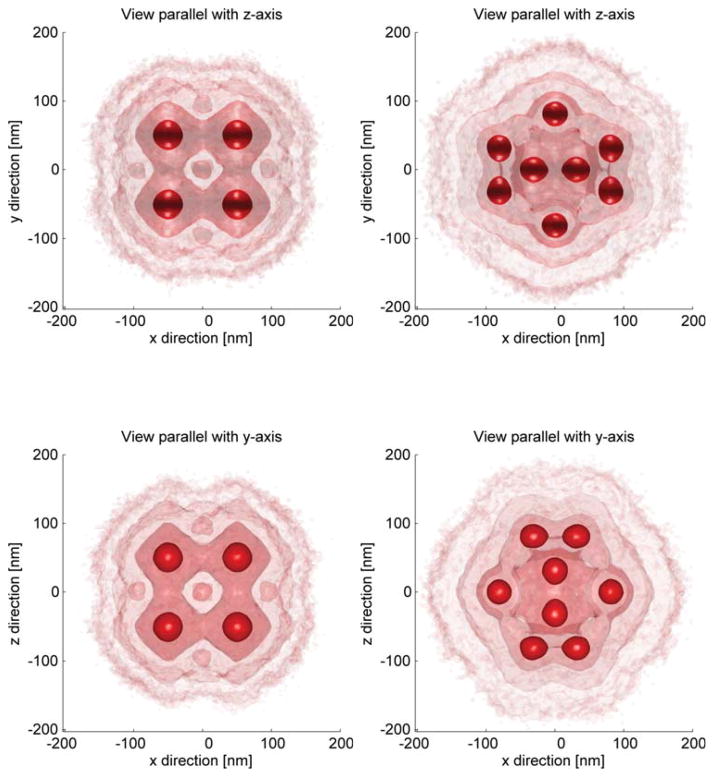
Multiple iso-surface renderings of cube (8 binding sites) and icosahedron (12 binding sites) test particle after registration of 103 individual particle. Initial lateral localization uncertainty was 10 nm and axial was 40 nm. Top row: xy views on a 3D surface rendering of the registration, bottom row xz view.
Figure 3
Figure 3
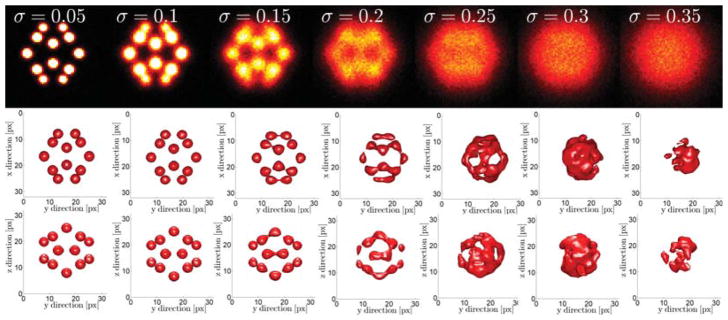
Registration performance as a function of the ratio of lateral localization precision and the distance between binding sites for an icosahedron. Axial localization uncertainty is four times as worse as the lateral one. The icosahedron is tilted with respect to the axis such that all 12 binding sites are visible. Top row: sum projections on the xy-plane. Middle row: 3D iso-surface rendering viewed in the xy-plane, bottom row: view from the yz-plane.
Figure 4
Figure 4
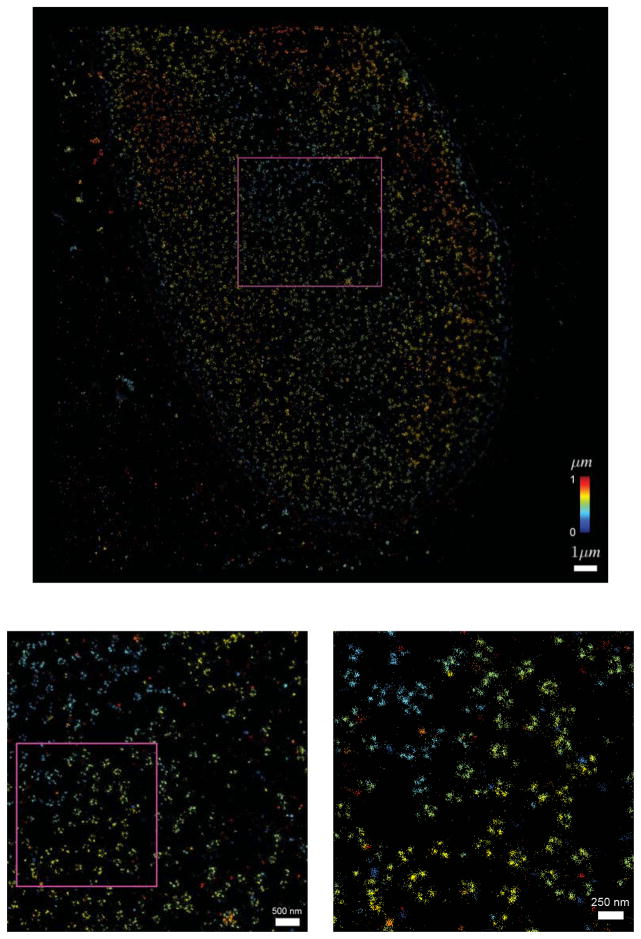
3D super-resolution histrogram of a HeLa cell nucleus, NUP133 labeled with Alexa647, color indicates axial depth. Scale bar a) equals 1μm. Scale bar b) equals 500 nm. Scale bar c) equals 250 nm.
Figure 5
Figure 5
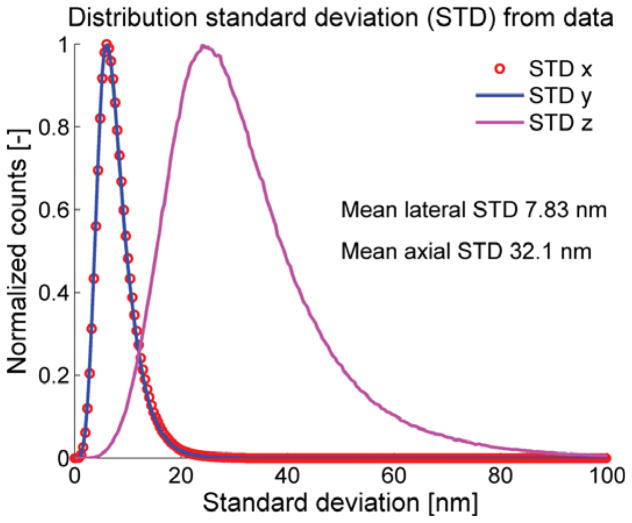
Distribution of localization uncertainties from all ~ 3.5 · 106 localizations from 8756 NPCs. The values are computed from the data via the Fisher-information matrix [28, 29].
Figure 6
Figure 6
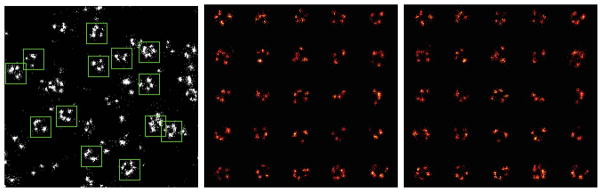
Registration pipeline (all xy-projections). a) A zoom in of the actual localization data. The green squares (size 120 nm) indicate automatically detected regions of interest (ROI) containing NPC structures, b) Cut out from ROIs before registrations, c) The same NPCs as in b) but now after registration.
Figure 7
Figure 7
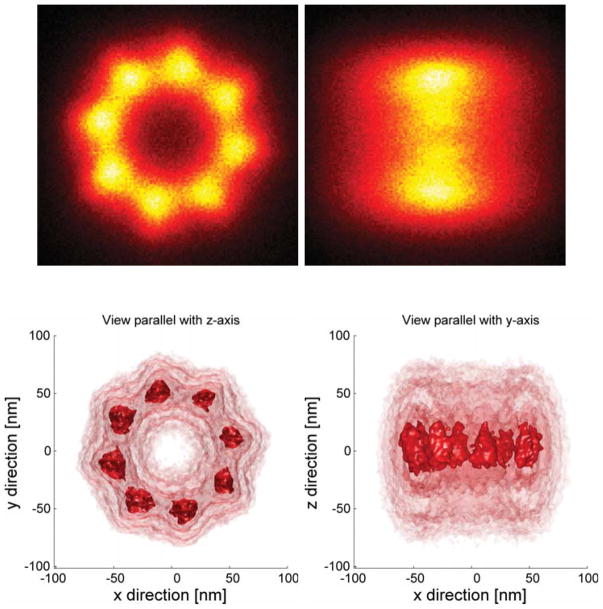
Average NPC reconstruction from 8756 individual NPCs. a) Projection of the data onto the xy-plane. b) Projection of the data onto the xz-plane. c,d) Multiple iso-surface renderings seen from the xy and xz plane respectively.
Figure 8
Figure 8
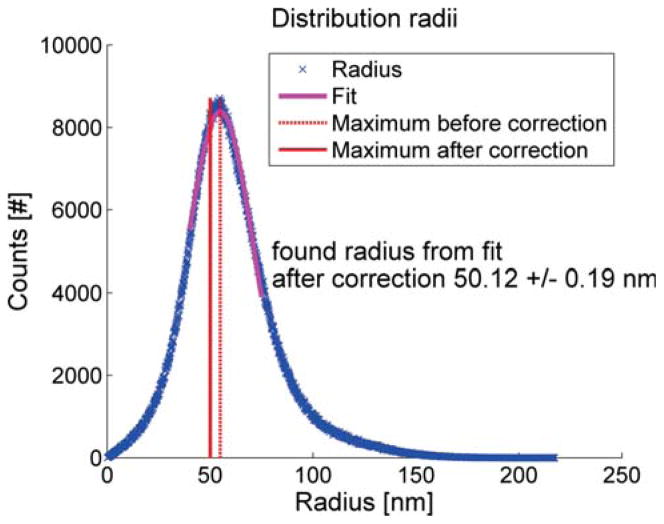
Rotational projection of the distribution of registered localization. Estimated radius of the average NPC is 50.12 ± 0.19 nm. A slight bias of the peak position from the rotational average of the distribution is corrected for [36].
Figure 9
Figure 9
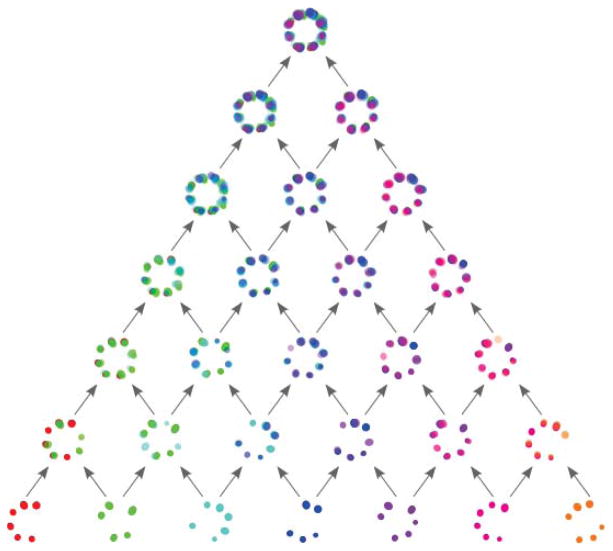
Illustration of a pyramid registration scheme. Pairs of particles are registered to each other and combined to form the next layer of the pyramid. The process is repeated until one particle remains which is the final average. This procedure scales quadratically with the number of particles.

References

    1. Lidke KA, Rieger B, Jovin TM, Heintzmann R. Superresolution by localization of quantum dots using blinking statistics. Optics Express. 2005;13(18):7052–7062. - PubMed
    1. Betzig E, Patterson GH, Sougrat R, Lindwasser OW, Olenych S, Bonifacino JS, Davidson MW, Lippincott-Schwartz J, Hess HF. Imaging intracellular fluorescent proteins at nanometer resolution. Science. 2006;313:1643–1645. - PubMed
    1. Rust MJ, Bates M, Zhuang XW. Sub-diffraction-limit imaging by stochastic optical reconstruction microscopy (STORM) Nature Methods. 2006;3(10):793–795. - PMC - PubMed
    1. Hess ST, Girirajan TPK, Mason MD. Ultra-high resolution imaging by fluorescence photoactivation localization microscopy. Biophysical Journal. 2006;91(11):4258–4272. - PMC - PubMed
    1. Egner A, Geisler C, von Middendorff C, Bock H, Wenzel D, Medda R, Andresen M, Stiel AC, Jakobs S, Eggeling C, Schönle A, Hell SW. Fluorescence nanoscopy in whole cells by asynchronous localization of photoswitching emitters. Biophysical Journal. 2007;93(9):3285–3290. - PMC - PubMed

LinkOut - more resources