


Circulating tumour cells and outcome in non-metastatic colorectal cancer: a prospective study
- PMID: 25867263
- PMCID: PMC4402459
- DOI: 10.1038/bjc.2015.88
Circulating tumour cells and outcome in non-metastatic colorectal cancer: a prospective study
Abstract
Background: Circulating tumour cells (CTC) in the blood have been accepted as a prognostic marker in patients with metastatic colorectal cancer (CRC). Only limited data exist on the prognostic impact of CTC in patients with early stage CRC using standardised detection assays. The aim of this study was to elucidate the role of CTC in patients with non-metastatic CRC.
Methods: A total of 287 patients with potentially curable CRC were enrolled, including 239 patients with UICC stage I-III. CTC were measured in the blood using the CellSearch system preoperatively and on postoperative days 3 and 7. The complete patient group (UICC I-IV) and the non-metastatic cohort (UICC I-III) were analysed independently. Patients were followed for 28 (0-53) months. Prognostic factors for overall and progression-free survival were analysed using univariate and multivariate analyses.
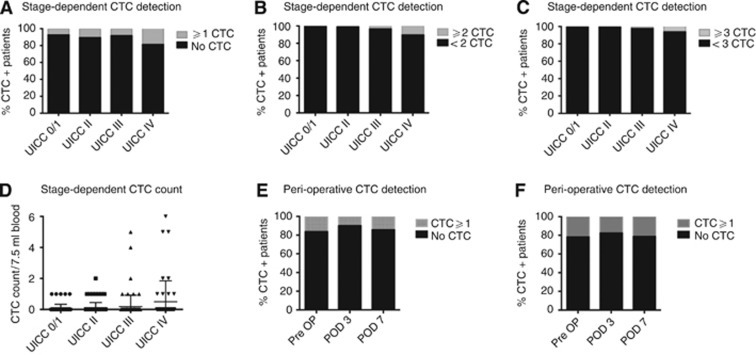
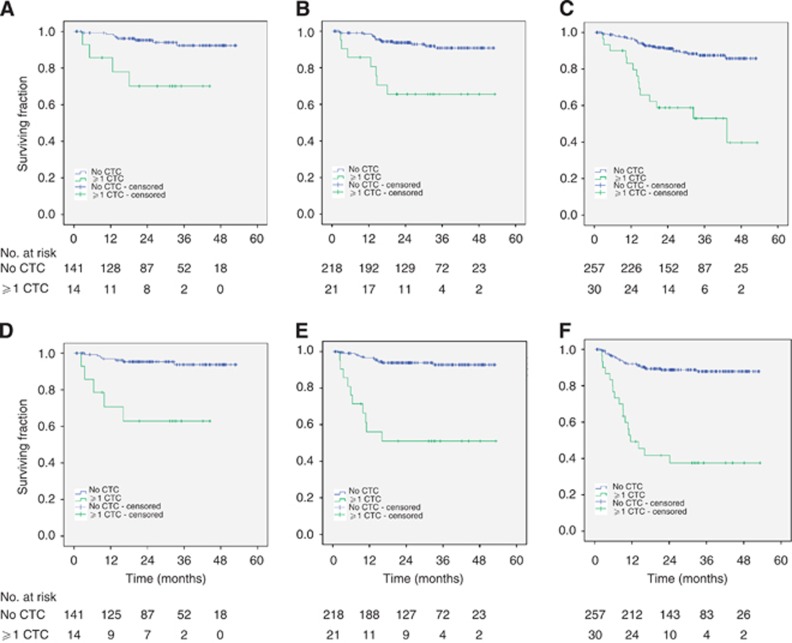
Results: CTC were detected more frequently in patients with metastatic disease. No clinicopathological variables were associated with CTC detection in non-metastatic patients. CTC detection (⩾1 CTC per 7.5 ml blood) in the blood was significantly associated with worse overall survival (49.8 vs 38.4 months; P<0.001) in the non-metastatic group (UICC I-III), as well as in the complete cohort (48.4 vs 33.6 months; P<0.001). On multivariate analysis CTC were the strongest prognostic factor in non-metastatic patients (hazard ratio (HR) 5.5; 95% confidence interval (CI) 2.3-13.6) as well as in the entire study group (HR 5.6; 95% CI 2.6-12.0).
Conclusions: Preoperative CTC detection is a strong and independent prognostic marker in non-metastatic CRC.
Figures
References
-
- AJCC . AJCC Publisher, Springer: New York, USA; 2010. AJCC Cancer Staging Manual, 7th edn.
-
- Allard WJ, Matera J, Miller MC, Repollet M, Connelly MC, Rao C, Tibbe AGJ, Uhr JW, Terstappen LWMM. Tumor cells circulate in the peripheral blood of all major carcinomas but not in healthy subjects or patients with nonmalignant diseases. Clin Cancer Res. 2004;10:6897–6904. - PubMed
-
- Allen-Mersh TG, McCullough TK, Patel H, Wharton RQ, Glover C, Jonas SK. Role of circulating tumour cells in predicting recurrence after excision of primary colorectal carcinoma. Br J Surg. 2007;94:96–105. - PubMed
-
- Brenner H, Chang-Claude J, Jansen L, Knebel P, Stock C, Hoffmeister M. Reduced risk of colorectal cancer up to 10 years after screening, surveillance, or diagnostic colonoscopy. Gastroenterology. 2014;146:709–717. - PubMed
-
- Coget J, Borrini F, Susman S, Sabourin J-C. Colorectal carcinomas in 2013: the search for powerful prognostic markers is still on the go! Cancer Biomarkers. 2014;14:145–150. - PubMed
Publication types
MeSH terms
Substances
LinkOut - more resources
Full Text Sources
Other Literature Sources
Medical
Molecular Biology Databases
