


Barriers and facilitators to engagement of vulnerable populations in HIV primary care in New York City
- PMID: 25867774
- PMCID: PMC4559146
- DOI: 10.1097/QAI.0000000000000577
Barriers and facilitators to engagement of vulnerable populations in HIV primary care in New York City
Abstract
Background: Engagement in HIV care helps to maximize viral suppression, which in turn, reduces morbidity and mortality and prevents further HIV transmission. With more HIV cases than any other US city, New York City reported in 2012 that only 41% of all persons estimated to be living with HIV (PLWH) had a suppressed viral load, whereas nearly three-quarters of those in clinical care achieved viral suppression. Thus, retaining PLWH in HIV care addresses this central goal of both the US National HIV/AIDS Strategy and Governor Cuomo's plan to end the AIDS epidemic in New York State.
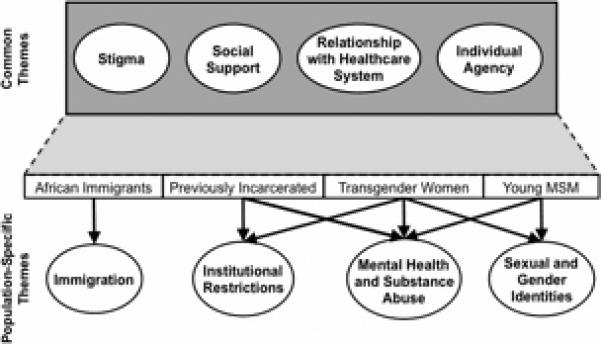
Methods: We conducted 80 in-depth qualitative interviews with PLWH in 4 New York City populations that were identified as being inconsistently engaged in HIV medical care: African immigrants, previously incarcerated adults, transgender women, and young men who have sex with men.
Results: Barriers to and facilitators of HIV care engagement fell into 3 domains: (1) system factors (eg, patient-provider relationship, social service agencies, transitions between penal system and community), (2) social factors (eg, family and other social support; stigma related to HIV, substance use, sexual orientation, gender identity, and incarceration), and (3) individual factors (eg, mental illness, substance use, resilience). Similarities and differences in these themes across the 4 populations as well as research and public health implications were identified.
Conclusions: Engagement in care is maximized when the social challenges confronted by vulnerable groups are addressed, patient-provider communication is strong, and coordinated services are available, including housing, mental health and substance use treatment, and peer navigation.
Figures
References
-
- Castilla J, Del Romero J, Hernando V, Marincovich B, Garcia S, Rodriguez C. Effectiveness of HAART in reducing heterosexual transmission of HIV. J Acquir Immune Defic Syndr. 2005;40(1):96–101. - PubMed
-
- Marks G, Crepaz N, Senterfitt JW, Janssen RS. Meta-analysis of high-risk sexual behavior in persons aware and unaware they are infected with HIV in the United States: implications for HIV prevention programs. J Acquir Immune Defic Syndr. 2005;39(4):446–453. - PubMed
-
- Cohen MS, Gay C, Kashuba AD, Blower S, Paxton L. Narrative review: antiretroviral therapy to prevent the sexual transmission of HIV-1. Ann Intern Med. 2007;146:591–601. - PubMed
-
- Giordano TP, Gifford AL, White AC, Jr., et al. Retention in care: A challenge to survival with HIV infection. Clin Infect Dis. 2007;44:1493–1499. - PubMed
Publication types
MeSH terms
Grants and funding
LinkOut - more resources
Full Text Sources
Medical
