


Molecular sensors and modulators of thermoreception
- PMID: 25868381
- PMCID: PMC4594430
- DOI: 10.1080/19336950.2015.1025186
Molecular sensors and modulators of thermoreception
Abstract
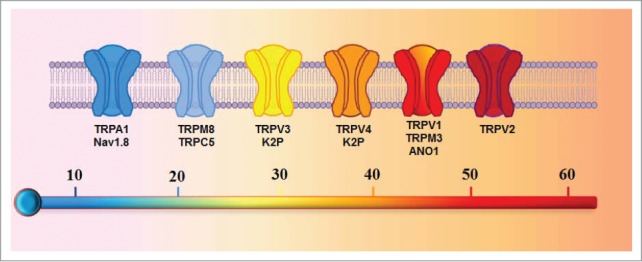
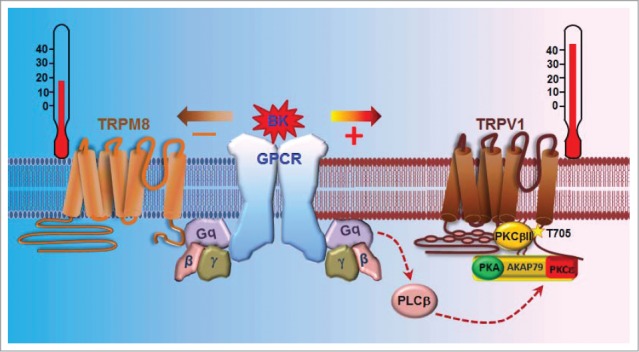
The detection of temperature is one of the most fundamental sensory functions across all species, and is critical for animal survival. Animals have thus evolved a diversity of thermosensory mechanisms allowing them to sense and respond to temperature changes (thermoreception). A key process underlying thermoreception is the translation of thermal energy into electrical signals, a process mediated by thermal sensors (thermoreceptors) that are sensitive to a specific range of temperatures. In disease conditions, the temperature sensitivity of thermoreceptors is altered, leading to abnormal temperature sensation such as heat hyperalgesia. Therefore, the identification of thermal sensors and understanding their functions and regulation hold great potential for developing novel therapeutics against many medical conditions such as pain.
Keywords: TRP ion channels; pain; somatosensory transduction; temperature; thermoreception.
Figures
References
-
- Caterina MJ, Schumacher MA, Tominaga M, Rosen TA, Levine JD, Julius D. The capsaicin receptor: a heat-activated ion channel in the pain pathway. Nature 1997; 389: 816–24; PMID:9349813; http://dx.doi.org/ 10.1038/39807 - DOI - PubMed
-
- Barbagallo B, Garrity PA. Temperature sensation in Drosophila. Curr Opin Neurobiol 2015; 34C: 8–13; PMID:25616212; http://dx.doi.org/ 10.1016/j.conb.2015.01.002 - DOI - PMC - PubMed
-
- Cesare P, McNaughton P. A novel heat-activated current in nociceptive neurons and its sensitization by bradykinin. Proc Natl Acad Sci U S A 1996; 93: 15435–9; PMID:8986829; http://dx.doi.org/ 10.1073/pnas.93.26.15435 - DOI - PMC - PubMed
-
- Caterina MJ, Leffler A, Malmberg AB, Martin WJ, Trafton J, Petersen-Zeitz KR, Koltzenburg M, Basbaum AI, Julius D. Impaired nociception and pain sensation in mice lacking the capsaicin receptor. Science 2000; 288: 306–13; PMID:10764638; http://dx.doi.org/ 10.1126/science.288.5464.306 - DOI - PubMed
-
- Davis JB, Gray J, Gunthorpe MJ, Hatcher JP, Davey PT, Overend P, Harries MH, Latcham J, Clapham C, Atkinson K, et al.. Vanilloid receptor-1 is essential for inflammatory thermal hyperalgesia. Nature 2000; 405: 183–7; PMID:10821274; http://dx.doi.org/ 10.1038/35012076 - DOI - PubMed
Publication types
MeSH terms
Grants and funding
LinkOut - more resources
Full Text Sources
Other Literature Sources
