


Limb remote ischemic per-conditioning in combination with post-conditioning reduces brain damage and promotes neuroglobin expression in the rat brain after ischemic stroke
- PMID: 25868435
- PMCID: PMC4923706
- DOI: 10.3233/RNN-140413
Limb remote ischemic per-conditioning in combination with post-conditioning reduces brain damage and promotes neuroglobin expression in the rat brain after ischemic stroke
Abstract
Purpose: Limb remote ischemic per-conditioning or post-conditioning has been shown to be neuroprotective after cerebral ischemic stroke. However, the effect of combining remote per-conditioning with post-conditioning on ischemic/reperfusion injury as well as the underlying mechanisms are largely unexplored.
Methods: Here, adult male Sprague Dawley rats were subjected to middle cerebral artery occlusion (MCAO). The limb ischemic stimulus was immediately applied after onset of focal ischemia (per-conditioning), followed by repeated short episodes of remote ischemia 24 hr after reperfusion (post-conditioning). The infarct volume, motor function, and the expression of neuroglobin (Ngb) were measured at different durations after reperfusion.
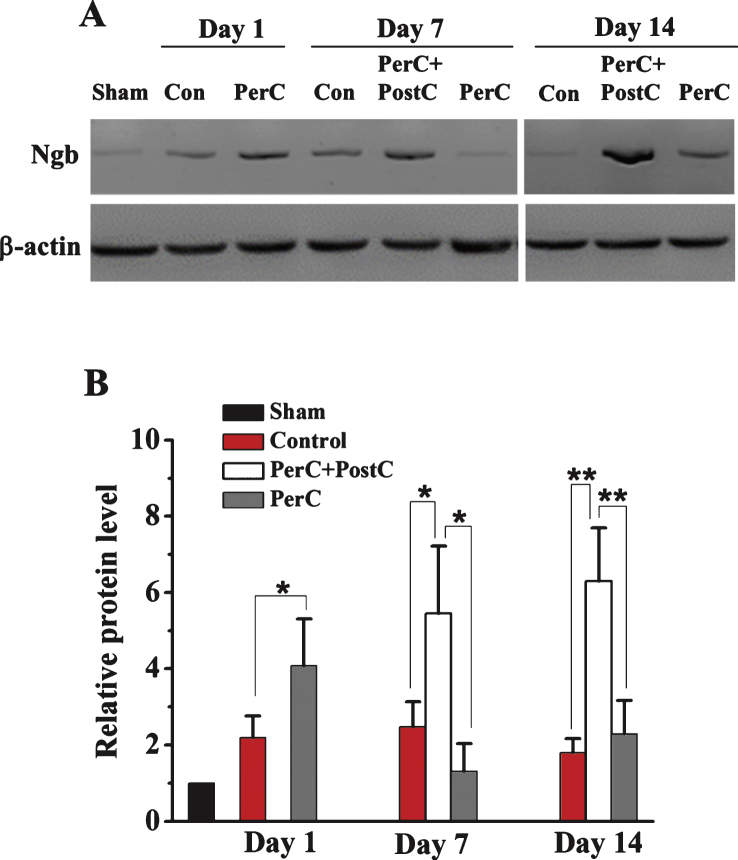
Results: We found that a single episode of limb remote per-conditioning afforded short-term protection, but combining repeated remote post-conditioning during the 14 days after reperfusion significantly ameliorated cerebral ischemia/reperfusion injury. Interestingly, we also found that ischemic per- and post-conditioning significantly increased expression of Ngb, an oxygen-binding globin protein that has been demonstrated to be neuroprotective against stroke, at peri-infarct regions from day 1 to day 14 following ischemia/reperfusion.
Conclusion: Our results suggest that the conventional per-conditioning combined with post-conditioning may be used as a novel neuroprotective strategy against ischemia-reperfusion injury, and Ngb seems to be one of the important players in limb remote ischemia-mediated neuroprotection.
Keywords: Ischemia; neuroglobin; remote conditioning; stroke.
Figures



References
-
- Belayev L, Alonso OF, Busto R, Zhao W, Ginsberg MD. Middle cerebral artery occlusion in the rat by intraluminal suture. Neurological and pathological evaluation of an improved model. (),; discussion. Stroke. 1996;27(9):1616–1622. discussion 23. - PubMed
-
- Botker HE, Kharbanda R, Schmidt MR, Bottcher M, Kaltoft AK, Terkelsen CJ, Munk K, Andersen NH, Hansen TM, Trautner S, Lassen JF, Christiansen EH, Krusell LR, Kristensen SD, Thuesen L, Nielsen SS, Rehling M, Sorensen HT, Redington AN, Nielsen TT. Remote ischaemic conditioning before hospital admission, as a complement to angioplasty, and effect on myocardial salvage in patients with acute myocardial infarction: A randomised trial. Lancet. 2010;375((9716)):727–734. - PubMed
-
- Burmester T, Weich B, Reinhardt S, Hankeln T. A vertebrate globin expressed in the brain. Nature. 2000;407((6803)):520–523. - PubMed
-
- Gidday JM. Cerebral preconditioning and ischaemic tolerance. Nat Rev Neurosci. 2006;7((6)):437–448. - PubMed
Publication types
MeSH terms
Substances
LinkOut - more resources
Full Text Sources
Medical
