Review
. 2015 Dec:119:262-8.
doi: 10.1016/j.biochi.2015.03.021. Epub 2015 Apr 11.

Origin and evolution of metabolic sub-cellular compartmentalization in eukaryotes

Affiliations
Review

Origin and evolution of metabolic sub-cellular compartmentalization in eukaryotes

Toni Gabaldón et al. Biochimie. 2015 Dec.

Abstract

A high level of subcellular compartmentalization is a hallmark of eukaryotic cells. This intricate internal organization was present already in the common ancestor of all extant eukaryotes, and the determination of the origins and early evolution of the different organelles remains largely elusive. Organellar proteomes are determined through regulated pathways that target proteins produced in the cytosol to their final subcellular destinations. This internal sorting of proteins can vary across different physiological conditions, cell types and lineages. Evolutionary retargeting - the alteration of a subcellular localization of a protein in the course of evolution - has been rampant in eukaryotes and involves any possible combination of organelles. This fact adds another layer of difficulty to the reconstruction of the origins and evolution of organelles. In this review we discuss current themes in relation to the origin and evolution of organellar proteomes. Throughout the text, a special focus is set on the evolution of mitochondrial and peroxisomal proteomes, which are two organelles for which extensive proteomic and evolutionary studies have been performed.

Keywords: Compartments; Eukaryotes; Evolution; Organelles.


Figures

Fig. 1
Fig. 1
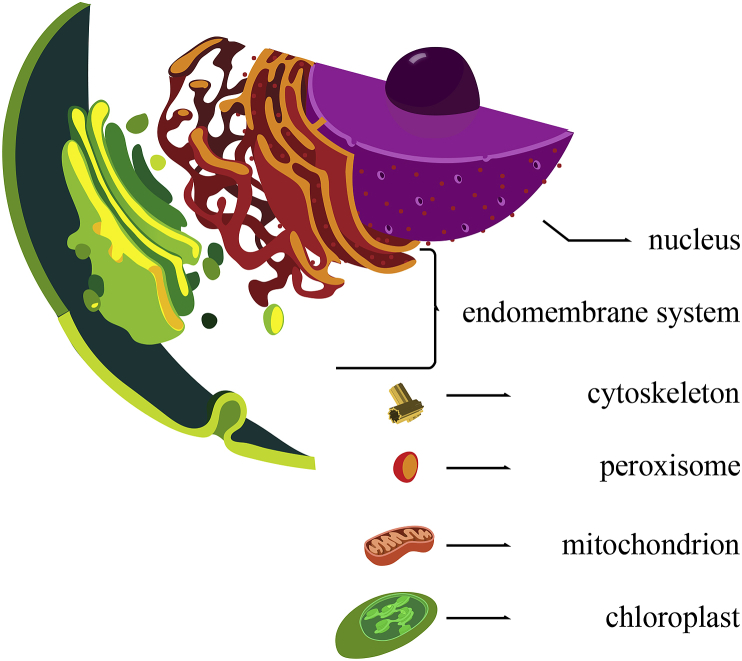
Eukaryotic compartments. Schematic representation of a generalized eukaryotic cell showing the main compartments. For simplicity, and because there is agreement on their common origin, we have grouped into the single category “endomembrane system” the endoplasmic reticulum, Golgi apparatus, lysosomes, vacuoles, vesicles, and endosomes. Main hypotheses regarding the origins of these organelles are reviewed in Table 1. Figure has been modified from wikipedia.
Fig. 2
Fig. 2
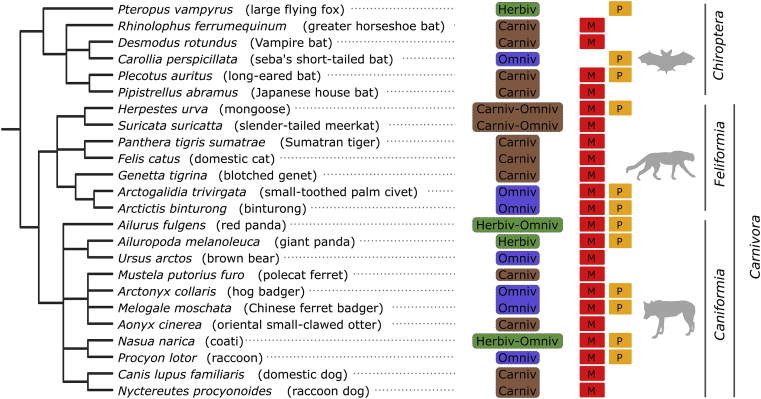
Subcellular retargeting of AGT in relation to diet. NCBI taxonomy tree of 24 species indicating the relation between the subcellular distribution of alanine:glyoxylate aminotransferase (AGT) in liver cells and their diet. M: mitochondrial, P: peroxisomal. Carniv: carnivorous, Omniv:omnivorous, Herbiv: herbivorous, Carniv–Omniv: mainly carnivorous, but some plant material eaten, Herbiv–Omniv:mainly herbivorous, but some animal material eaten. Adapted from Ref. . ETE was used for tree visualization .
Fig. 3
Fig. 3
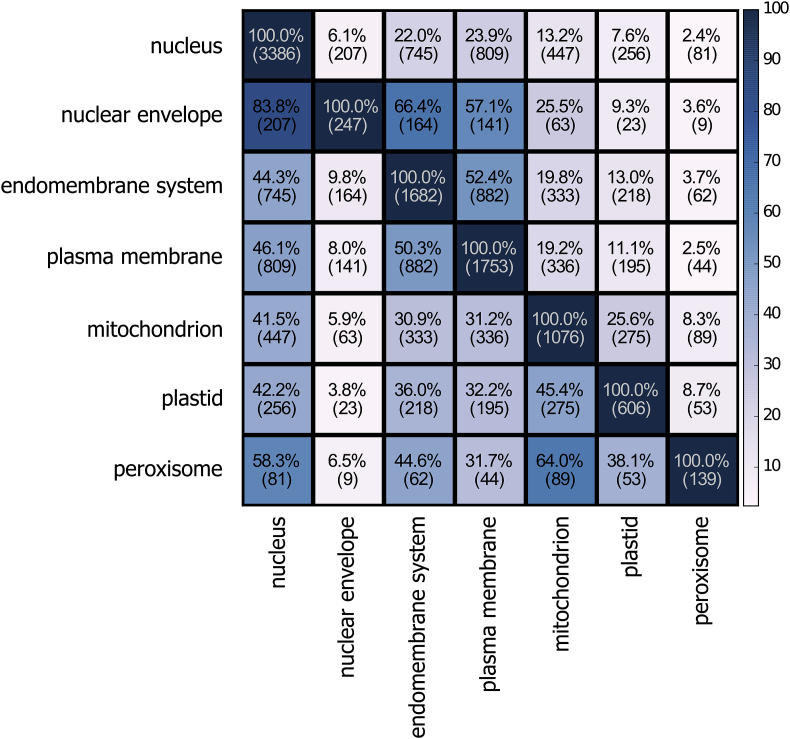
Degree of retargeting between the different eukaryotic compartments. The frequency of co-occurrence of different organellar location within the same protein family is indicated as a heatmap. The count (in parentheses) indicates the number of proteins from the same family targeted to both organelles (alternatively in different species, or dually-targeted in the same species). Percentages refer to the fraction of protein families targeted to both organelles compared to the overall size of the proteome of a given organelle (in the diagonal), in a row-wise manner. Notably, almost 2/3 of the peroxisomal proteome comprises protein families with members that localize in mitochondria. Retargeting was evaluated by looking at the co-occurrence of the various localizations within the same protein families. We defined the families by combining phylogenetic trees from two phylomes containing mostly model organisms (PhylomeIDs 500 and 502) and fusing trees with overlapping sequences based on UPGMA clustering . Subsequently, for any possible pair of two compartments, we counted the number of times that two distinct experimentally-based annotations of subcellular localization co-occurred in the same family and plotted in a heat-map the counts and the percentage over the total number of families in that organelle. For a term to be considered for a protein family, at least 2 annotated proteins with the given term were required. Only annotation terms based on actual experiments were considered.

References

    1. Woese C.R., Kandler O., Wheelis M.L. Towards a natural system of organisms: proposal for the domains Archaea, Bacteria, and Eucarya. Proc. Natl. Acad. Sci. U. S. A. 1990 Jun;87(12):4576–4579. - PMC - PubMed
    1. Martin W., Koonin E.V. A positive definition of prokaryotes. Nature. 2006 Aug 24;442(7105):868. - PubMed
    1. Bazylinski D.A., Frankel R.B. Magnetosome formation in prokaryotes. Nat. Rev. Microbiol. 2004 Mar;2(3):217–230. - PubMed
    1. Nickelsen J., Rengstl B., Stengel A., Schottkowski M., Soll J., Ankele E. Biogenesis of the cyanobacterial thylakoid membrane system–an update. FEMS Microbiol. Lett. 2011 Feb;315(1):1–5. - PubMed
    1. Santarella-Mellwig R., Pruggnaller S., Roos N., Mattaj I.W., Devos D.P. Three-dimensional reconstruction of bacteria with a complex endomembrane system. PLoS Biol. 2013;11(5):e1001565. - PMC - PubMed

Publication types

MeSH terms

LinkOut - more resources