Review
. 2015 Aug;12(8):1852-66.
doi: 10.1016/j.hrthm.2015.04.014. Epub 2015 Apr 11.

J-wave syndromes: Brugada and early repolarization syndromes

Affiliations
Review

J-wave syndromes: Brugada and early repolarization syndromes

Charles Antzelevitch et al. Heart Rhythm. 2015 Aug.

Abstract

A prominent J wave is encountered in a number of life-threatening cardiac arrhythmia syndromes, including the Brugada syndrome and early repolarization syndromes. Brugada syndrome and early repolarization syndromes differ with respect to the magnitude and lead location of abnormal J waves and are thought to represent a continuous spectrum of phenotypic expression termed J-wave syndromes. Despite two decades of intensive research, risk stratification and the approach to therapy of these 2 inherited cardiac arrhythmia syndromes are still undergoing rapid evolution. Our objective in this review is to provide an integrated synopsis of the clinical characteristics, risk stratifiers, and molecular, ionic, cellular, and genetic mechanisms underlying these 2 fascinating syndromes that have captured the interest and attention of the cardiology community in recent years.

Keywords: Cardiac arrhythmias; Early repolarization; Inherited cardiac arrhythmias syndromes; J wave; ST-segment elevation; Sudden cardiac death; Ventricular fibrillation; Ventricular tachycardia.


Figures

Figure 1
Figure 1
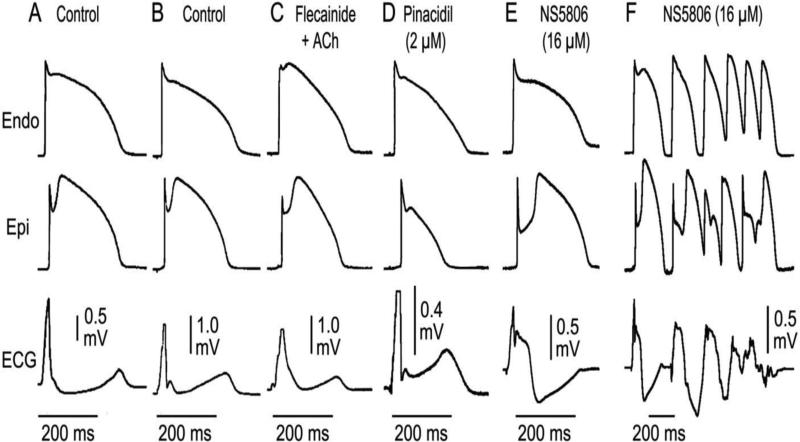
Mechanisms underlying the different manifestations of the early repolarization pattern in the ECG. Each panel shows transmembrane action potentials simultaneously recorded from the epicardial and endocardial regions of an arterially-perfused canine left ventricular wedge preparation together with a transmural ECG. Under the conditions indicated, the transmural voltage gradients created by the appearance of an action potential notch in epicardium but not endocardium gives rise to an elevated J wave onset, JO, (A),as distinct J wave (B), slurring to the terminal part of the QRS (C), a distinct J wave together with a ST elevation (D), a gigantic J wave appearing as an ST segment elevation (E). It is under these conditions that we see the development of polymorphic VT (F).Modified from , with permission.
Figure 2
Figure 2
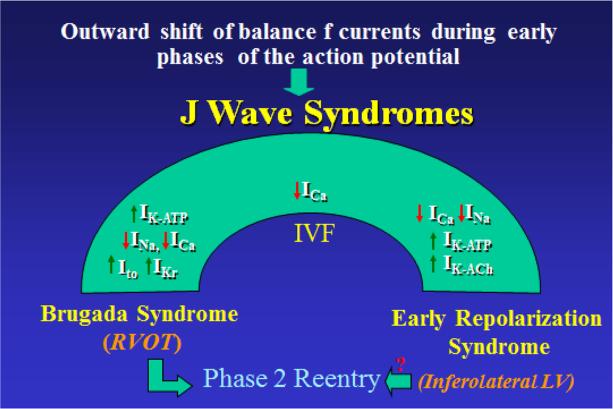
J wave Syndromes. Schematic depicts our working hypothesis that an outward shift in repolarizing current due to a decrease in sodium or calcium channel currents or an increase in Ito, IK-ATP, IKr or IK-ACh, or other outward currents can give rise to accentuated J waves associated with the BrS, Early Repolarization Syndrome and some forms of IVF. The particular phenotype depends on what part of the heart is principally affected and which ion channels are involved. Accentuation of thee J waves in the right ventricular outflow tract (RVOT) gives rise to BrS, whereas accentuation in the infero-lateral left ventricle (LV) gives rise to ERS.
Figure 3
Figure 3
Heterogeneities in the appearance of the epicardial action potential second upstroke gives rise to fractionated epicardial electrogram (EG) activity and concealed phase 2 reentry gives rise to high frequency late potentials in the setting of Brugada syndrome (BrS). A: Shown are right precordial lead recordings, unipolar and bipolar EGs from the right ventricular outflow tract of a BrS patient. B: ECG, action potentials from endocardium (Endo) and two epicardial (Epi) sites, and a bipolar epicardial EG (Bipolar EG) all simultaneously recorded from a coronary-perfused right ventricular wedge preparation treated with the Ito agonist NS5806 (5 μM) and the calcium channel blocker verapamil (2 μM) to induce the Brugada phenotype. Basic cycle length=1000 ms. C: Bipolar EGs recorded from the epicardial and endocardial surfaces of the RVOT in a patient with BrS. The epicardial EG displays fractionated electrogram activity as well as a high frequency late potential late potential (130 msec delay). D: Bipolar electrograms recorded from the epicardium and endocardium of a coronary-perfused wedge model of BrS, together with AP recordings from an endocardial and two epicardial sites and a transmural ECG. The clinical data are modified from Nademanee et al. and the experimental data are from Szel and co-workers , with permission).
Figure 4
Figure 4
Radiofrequency ablation of the epicardial surface abolishes the BrS ECG and suppresses arrhythmogenesis in coronary-perfused canine right ventricular wedge model of BrS. Transmembrane action potentials (AP) were simultaneously recorded from one endocardial (Endo) and two epicardial (Epi) sites together with epicardial bipolar electrograms (EG) and a transmural pseudo-ECG. The epicardial bipolar EGs were recorded at 10-1000 Hz bandwidth (black trace), and were simultaneously band-pass filtered at 30-200Hz, 50-200Hz and 100-200Hz (green traces). Column 1: Control. Column 2: Recorded 45 min after the addition of the Ito-agonist NS5806 (4μM) to the coronary perfusate. Column 3: Recorded 45 min after the concentration of NS5806 was raised to 8μM. High and low frequency late potentials (LP) are apparent in the EG recordings resulting from progressive delay in the appearance of the second upstroke of the Epi AP secondary to accentuation of the AP notch. Column 4: Recorded 15 min after the addition of the ICa-blocker verapamil (1μM) to the coronary perfusate. Column 5: Recorded after 40 min of exposure to verapamil (1μM). Loss of the AP dome at Epi1 but not Epi2 gives rise to a phase 2 reentrant beat, which precipitates polymorphic VT. Column 6: Recorded 2h after radiofrequency ablation of the epicardial surface, and 1h after reintroduction of the provocative agents to the perfusate (in the same concentration as before ablation). APs are now recorded from the deep subepicardium- midmyocardium (Mid1, Mid2) instead of the epicardial surface. Ablation markedly suppressed the BrS phenotype and abolished all arrhythmic activity. Modified from , with permission.
Figure 5
Figure 5
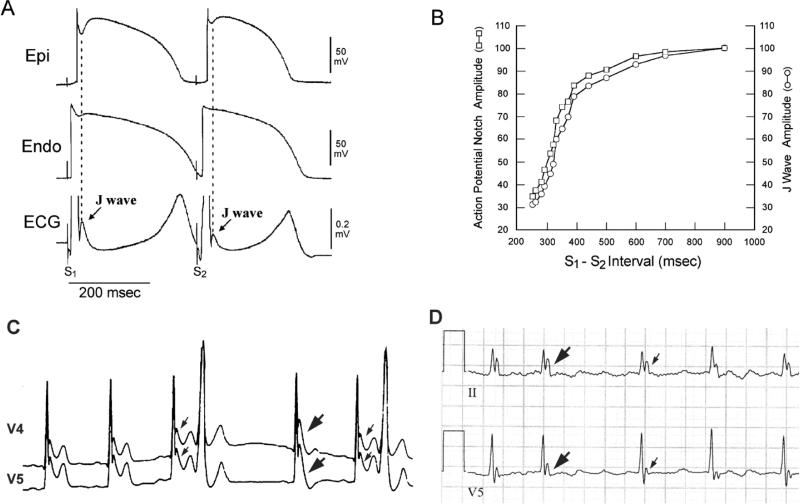
Rate and pause-dependence of the J wave in an experimental model and two clinical cases of BrS. A: Transmural ECG and transmembrane action potentials (APs) simultaneously recorded from a canine right ventricular wedge preparation: Prominent J waves and associated AP notches were observed during basic stimulation (S1-S1=4000ms). Premature stimulation (S1-S2=300ms) reduced the epicardial AP notch and J wave amplitude. B: Plot of epicardial AP notch (□) and J wave (○) amplitude over a range of S1-S2 intervals. Restitution of action potential notch amplitude parallels that of the J wave. Reproduced from with permission. C: ECG lead V4-V5 recorded from a 34 year-old Chinese man with idiopathic ventricular fibrillation, showing prominent J waves that are more accentuated after a pause (thick arrows) compared to those (thin arrows) recorded at shorter R-R intervals. Note that the amplified J wave after the pause was accompanied by T wave inversion (V5), an ECG marker associated with a high risk of ventricular fibrillation. D: A J-wave-like deflection at the terminal portion of the QRS in a patient with intra-ventricular conduction delay. In contrast to the J wave behavior observed in Figure 5C, the end of QRS notch observed in this case is tachycardia-dependent. The terminal deflection is attenuated at longer the R-R interval (thin arrows) and amplified at the shorter R-R interval (thick arrows). Reproduced from , with permission.

References

    1. Clements SD, Hurst JW. Diagnostic value of ECG abnormalities observed in subjects accidentally exposed to cold. AmJCardiol. 1972;29:729–734. - PubMed
    1. Thompson R, Rich J, Chmelik F, Nelson WL. Evolutionary changes in the electrocardiogram of severe progressive hypothermia. JElectrocardiol. 1977;10:67–70. - PubMed
    1. Eagle K. Images in clinical medicine. Osborn waves of hypothermia. NEnglJMed. 1994;10:680. - PubMed
    1. Kraus F. Ueber die wirkung des kalziums auf den kreislauf 1 ). DtschMedWochenschr. 1920;46:201–203.
    1. Sridharan MR, Horan LG. Electrocardiographic J wave of hypercalcemia. AmJCardiol. 1984;54:672–673. - PubMed

Publication types

MeSH terms