. 2016 Feb 1:69:261-9.
doi: 10.1016/j.compbiomed.2015.03.024. Epub 2015 Mar 28.

Development of a novel imaging informatics-based system with an intelligent workflow engine (IWEIS) to support imaging-based clinical trials

Affiliations

Development of a novel imaging informatics-based system with an intelligent workflow engine (IWEIS) to support imaging-based clinical trials

Ximing Wang et al. Comput Biol Med. .

Abstract

Imaging based clinical trials can benefit from a solution to efficiently collect, analyze, and distribute multimedia data at various stages within the workflow. Currently, the data management needs of these trials are typically addressed with custom-built systems. However, software development of the custom-built systems for versatile workflows can be resource-consuming. To address these challenges, we present a system with a workflow engine for imaging based clinical trials. The system enables a project coordinator to build a data collection and management system specifically related to study protocol workflow without programming. Web Access to DICOM Objects (WADO) module with novel features is integrated to further facilitate imaging related study. The system was initially evaluated by an imaging based rehabilitation clinical trial. The evaluation shows that the cost of the development of system can be much reduced compared to the custom-built system. By providing a solution to customize a system and automate the workflow, the system will save on development time and reduce errors especially for imaging clinical trials.

Keywords: Imaging informatics system; Imaging-based clinical trials; System framework; Workflow engine.


Conflict of interest statement

Conflict of Interest Statement

Ximing Wang

None Declared

Brent J Liu, PhD

None Declared

Clarisa Martinez, DPT

None Declared

Xuejun Zhang, PhD

None Declared

Carolee J Winstein, PhD

None Declared

Figures

Figure 1
Figure 1
Traditional scenario and IWEIS scenario in the development of clinical trial informatics system. Stages with negative impacts on the cost of system development are marked as red, and stages with positive impacts are marked as green. This figure shows where the challenges are in the traditional scenario and where the IWEIS scenario will improve the efficiency of the system development.
Figure 2
Figure 2
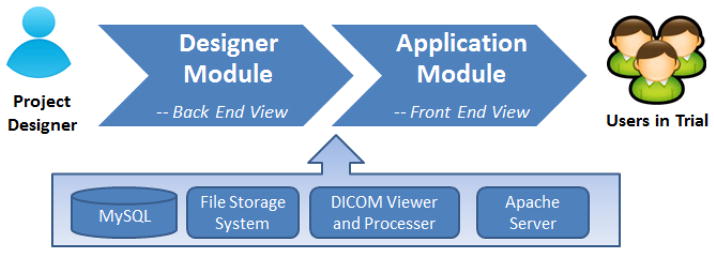
Schematic presentation of the IWEIS system architecture. The system architecture is a two-tier layer comprised of a base layer with four main components. In the second tier, the designer module is utilized for deployment and the application module is utilized as the imaging informatics based system for front end users in clinical trial applications.
Figure 3
Figure 3
Workflow Designer Module in the back end. The user is able to pick a shape in the left panel, drag and drop it into the canvas. The canvas illustrates a sample workflow design example of the DOSE rehabilitation clinical trial. Arrow A links to the engine rules page. Arrow B allows the user to edit contents in each stage of the workflow.
Figure 4
Figure 4
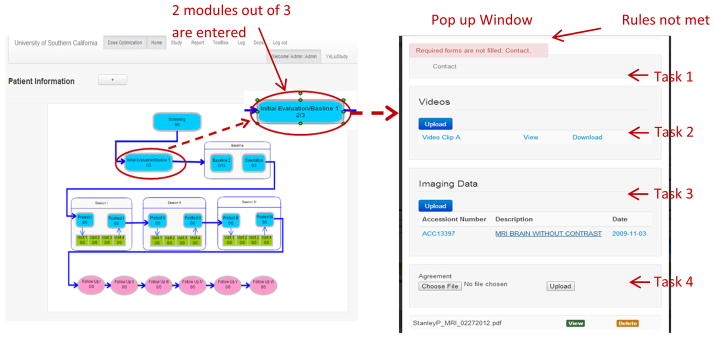
Screenshot of Patient profile page with integrated workflow in the front end. The left panel illustrates the patient’s page. In each stage of the workflow, the number shows the completion status of the modules. Clicking the stage leads to a popup window with all the modules in that stage (right panel). If the rules for a stage are not satisfied, the workflow stage will be inaccessible.
Figure 5
Figure 5
Web-based zero footprint DICOM WADO viewer. The user is able to combine a self-designed data collection form with the images. Therefore user is able to read the image, fill out the reading result with a customized form and send it to database. The viewer also provides annotation, measurement, and ROI marker tool to assist the identification of lesions or other pathologies related to the clinical trial.
Figure 6
Figure 6
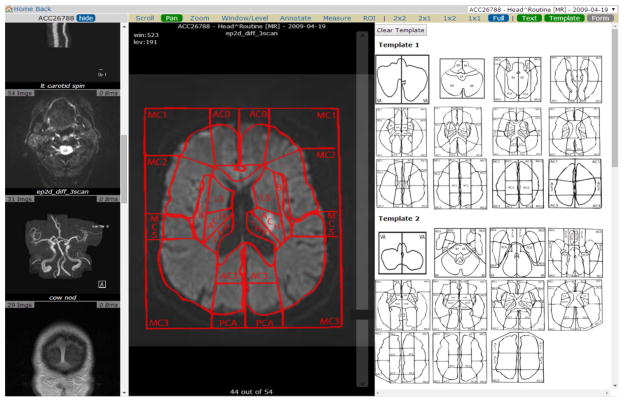
Template masking tool. On the right part of the window, a library of sample templates (Templates adapted from Damasio et al.[17], courtesy of Dr. Matthew Edwardson) uploaded by user can be chosen. The uploaded templates can be shown on top of the image and can be rotated, zoomed in and zoomed out. Overlaying the template on top of images facilitate the identification of lesion location.
Figure 7
Figure 7
Data collection review flowchart. For each data collection, the data entry person is required to review and approve the data to complete the data entry. Moreover, the study manager is also able to define if the data needs to be approved by other users, such as supervisors or a QA group to complete the data entry.

References

    1. ClinicalTrials.gov. http://clinicaltrials.gov/ct2/resources/trends.
    1. Erickson BJ, Buckner JC. Imaging in Clinical Trials. Cancer Informatics. 2007;4:13–18. - PMC - PubMed
    1. Parker J, Coiera E. Improving Clinical Communication: A View from Psychology. Journal of the American Medical Informatics Associationı: JAMIA. 2000;7(5):453–461. - PMC - PubMed
    1. Pavlović Ivan, Kern Tomaž, Miklavčič Damijan. Comparison of paper-based and electronic data collection process in clinical trials: Costs simulation study. Contemporary Clinical Trials. 2009 Jul;30(4):300–16. doi: 10.1016/j.cct.2009.03.008. - DOI - PubMed
    1. Huang HK. PACS and Imaging Informatics: Principles and Applications. John Wiley & Sons; Hoboken, New Jersey: 2010.

Publication types

LinkOut - more resources