. 2015 Apr 28;112(17):5455-60.
doi: 10.1073/pnas.1422576112. Epub 2015 Apr 13.

Inhibition of TLR2 signaling by small molecule inhibitors targeting a pocket within the TLR2 TIR domain

Affiliations

Inhibition of TLR2 signaling by small molecule inhibitors targeting a pocket within the TLR2 TIR domain

Pragnesh Mistry et al. Proc Natl Acad Sci U S A. .

Abstract

Toll-like receptor (TLR) signaling is initiated by dimerization of intracellular Toll/IL-1 receptor resistance (TIR) domains. For all TLRs except TLR3, recruitment of the adapter, myeloid differentiation primary response gene 88 (MyD88), to TLR TIR domains results in downstream signaling culminating in proinflammatory cytokine production. Therefore, blocking TLR TIR dimerization may ameliorate TLR2-mediated hyperinflammatory states. The BB loop within the TLR TIR domain is critical for mediating certain protein-protein interactions. Examination of the human TLR2 TIR domain crystal structure revealed a pocket adjacent to the highly conserved P681 and G682 BB loop residues. Using computer-aided drug design (CADD), we sought to identify a small molecule inhibitor(s) that would fit within this pocket and potentially disrupt TLR2 signaling. In silico screening identified 149 compounds and 20 US Food and Drug Administration-approved drugs based on their predicted ability to bind in the BB loop pocket. These compounds were screened in HEK293T-TLR2 transfectants for the ability to inhibit TLR2-mediated IL-8 mRNA. C16H15NO4 (C29) was identified as a potential TLR2 inhibitor. C29, and its derivative, ortho-vanillin (o-vanillin), inhibited TLR2/1 and TLR2/6 signaling induced by synthetic and bacterial TLR2 agonists in human HEK-TLR2 and THP-1 cells, but only TLR2/1 signaling in murine macrophages. C29 failed to inhibit signaling induced by other TLR agonists and TNF-α. Mutagenesis of BB loop pocket residues revealed an indispensable role for TLR2/1, but not TLR2/6, signaling, suggesting divergent roles. Mice treated with o-vanillin exhibited reduced TLR2-induced inflammation. Our data provide proof of principle that targeting the BB loop pocket is an effective approach for identification of TLR2 signaling inhibitors.

Keywords: BB loop; CADD; TLR2 pocket; small molecule inhibitor.


Conflict of interest statement

The authors declare no conflict of interest.

Figures

Fig. 1.
Fig. 1.
Differential effect of C29 on gene expression in human cell lines and murine peritoneal macrophages. (A) Structure of C29. (B) Total RNA was extracted from HEK-TLR2 cells pretreated for 1 h with media, vehicle (65 μM NaOH), or C29 (10 μM or 50 μM) and then stimulated with P3C (200 ng/mL), P2C (200 ng/mL), or human TNF-α (300 ng/mL) for 1 h in the presence of media, vehicle, or C29. IL-8 mRNA was measured by qRT-PCR and was normalized to the expression of the GAPDH housekeeping gene. (C) THP-1 human macrophage-like cell line was plated in the presence of phorbol 12-myristate 13-acetate (PMA; 20 ng/mL) for 24 h and washed twice in media. Total RNA was extracted from cell cultures pretreated for 1 h with media, vehicle (260 μM NaOH), or C29 (50 μM, 100 μM, or 200 μM) and then stimulated with P3C (50 ng/mL; Left) or P2C (50 ng/mL; Right) for 1 or 4 h in the presence of media, vehicle, or C29. IL-1β mRNA was measured as described in B. (D and E) Total RNA was extracted from murine peritoneal macrophages that had been pretreated for 1 h with media (white bars), vehicle (130 μM NaOH, black bars), or C29 (25 μM, dark gray bars; 50 μM, light gray bars) and then stimulated with P3C (50 ng/mL) or P2C (100 ng/mL) for 1 h in the presence of media, vehicle, or C29. TNF-α mRNA was measured by qRT-PCR and normalized to the expression of the hypoxanthine-guanine phosphoribosyltransferase (HPRT) housekeeping gene. (F) Murine macrophages derived from peritoneal exudate cells (PEC) were pretreated for 1 h with media, vehicle, or C29 (50 μM) and then stimulated with P3C (50 ng/mL) for 4 or 6 h in the presence of media, vehicle, or C29. Culture supernatants were analyzed by ELISA for IL-12 p40 protein. HEK-TLR2 stable transfectants (G and H) and murine macrophages derived from PEC (IL) are shown. Total RNA was extracted from cell cultures pretreated for 1 h with media, vehicle (65 μM NaOH), or C29 (50 μM) and then stimulated with heat-killed P. aeruginosa (HKPA) [multiplicity of infection (MOI) = 50], HKSA (MOI = 50), heat-killed S. pneumoniae (HKSP) (MOI = 50), P3C (50 ng/mL), heat-killed E. coli (HKEC) (MOI = 0.1), live F. tularensis live vaccine strain (LVS; MOI = 10) or live S. pneumoniae (MOI = 0.7) for 4 h in the presence of media, vehicle, or C29. RNA was analyzed by qRT-PCR for the expression of the indicated gene products. The qRT-PCR results shown in BE and GL are the mean ± SEM from two independent experiments, and the qRT-PCR result shown in F is the mean ± SEM from three independent experiments each carried out in duplicate (*P ≤ 0.05; **P ≤ 0.01; ***P ≤ 0.001).
Fig. 2.
Fig. 2.
C29 inhibits ligand-induced interaction of TLR2 with MyD88 and blocks MAPK and NF-κB activation. (A) THP-1 cells were cultured in the presence of PMA (20 ng/mL) for 24 h and washed twice in media. THP-1 human monocytes were pretreated with media, vehicle (195 μM NaOH), or C29 (150 μM) for 1 h and treated with P3C (50 ng/mL) in the presence of media, vehicle, or C29 for 15 or 30 min. Coimmunoprecipitation (IP) was carried out using anti-MyD88 Ab and Western blot analysis [immunoblotting (IB)] using whole-cell lysates. (B) Densitometry analysis (mean ± SEM) of three independent experiments as shown in A. Veh, vehicle. (C) Murine peritoneal macrophages were pretreated for 1 h with media, vehicle (65 μM NaOH), or C29 (50 μM) and treated with P3C (50 ng/mL) for 5–30 min in the presence of media, vehicle, or C29. IB was performed using whole-cell lysates and Abs directed against the signaling intermediates indicated. β-Actin was probed as a loading protein. A is representative of three independent experiments, and B is the mean ± SEM from three independent experiments (*P ≤ 0.05). C is representative of two independent experiments.
Fig. 3.
Fig. 3.
Pocket residues serve divergent roles in TLR2/1 and TLR2/6 responsiveness. (A and B) HEK293T cells were transiently transfected with reporter constructs for endothelial leukocyte adhesion molecule (ELAM)-luciferase; Renilla-luciferase; and pcDNA3.1, WT pcDNA3-YFP-hTLR2, or mutant TLR2 constructs in the same vector. Cells were pretreated for 1 h with media, vehicle (65 μM NaOH), or C29 (50 μM) and treated with P3C or P2C (50 ng/mL) for 5 h in the presence of media, vehicle, or C29. Lysates were prepared, and the dual-luciferase assay was performed. (C and D) HEK293T cells were transiently transfected with pcDNA3.1, WT pcDNA3-YFP-hTLR2, or mutant TLR2 constructs in the same vector. Western blot analysis was performed using whole-cell lysates (WCL) (C) or membrane extracts (D) to ensure comparable expression of each TLR2 mutant. Pan-Cadherin was probed as a loading protein for membrane extracts. A and B represent the mean ± SEM from two independent experiments, each carried out in duplicate, and C and D are representative of two independent experiments.
Fig. 4.
Fig. 4.
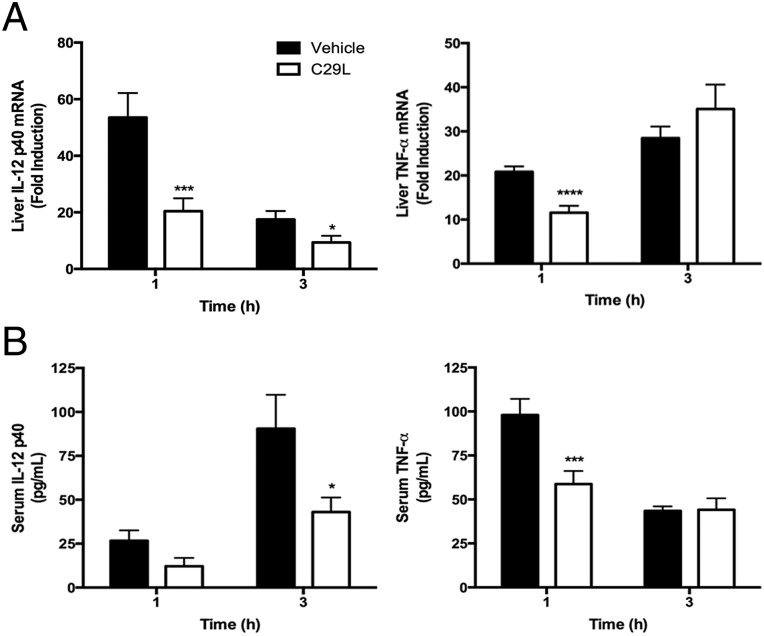
C29L inhibits TLR2/1-induced inflammation in vivo. C57BL/6J mice were pretreated i.p. with vehicle (water) or C29L (1.314 mM/g) for 1 h. Mice received a second pretreatment administered i.p. with vehicle (water) or C29L (1.314 mM/g), were challenged subsequently i.p. with PBS or P3C (100 μg), and were killed 1 h or 3 h later. Liver RNA was analyzed by qRT-PCR (A), and serum concentrations were analyzed using Multiplex beads (B) (*P ≤ 0.05; ***P ≤ 0.001; ****P ≤ 0.0001). In A and B, n = 6 (the combined data from two separate experiments) for each treatment group.

References

    1. Medzhitov R. Toll-like receptors and innate immunity. Nat Rev Immunol. 2001;1(2):135–145. - PubMed
    1. Takeuchi O, et al. Discrimination of bacterial lipoproteins by Toll-like receptor 6. Int Immunol. 2001;13(7):933–940. - PubMed
    1. Takeuchi O, et al. Cutting edge: Role of Toll-like receptor 1 in mediating immune response to microbial lipoproteins. J Immunol. 2002;169(1):10–14. - PubMed
    1. Cole LE, et al. Immunologic consequences of Francisella tularensis live vaccine strain infection: Role of the innate immune response in infection and immunity. J Immunol. 2006;176(11):6888–6899. - PubMed
    1. Cole LE, et al. Toll-like receptor 2-mediated signaling requirements for Francisella tularensis live vaccine strain infection of murine macrophages. Infect Immun. 2007;75(8):4127–4137. - PMC - PubMed

Publication types

MeSH terms