


Cluster analysis of midlife women's sleep-related symptoms: racial/ethnic differences
- PMID: 25871005
- PMCID: PMC4866935
- DOI: 10.1097/GME.0000000000000460
Cluster analysis of midlife women's sleep-related symptoms: racial/ethnic differences
Abstract
Objective: The purpose of this study was to identify clusters of midlife women by sleep-related symptoms in multiethnic groups and to examine racial/ethnic differences in the clusters.
Methods: This secondary analysis was conducted on data from 1,054 midlife women who participated in two cross-sectional descriptive national Internet surveys. The instruments included questions on background characteristics, health, and menopause status, and the Sleep Index for Midlife Women. The data were analyzed using hierarchical clustering methods, χ2 test, analysis of variance, and multinomial logistic regression analyses.
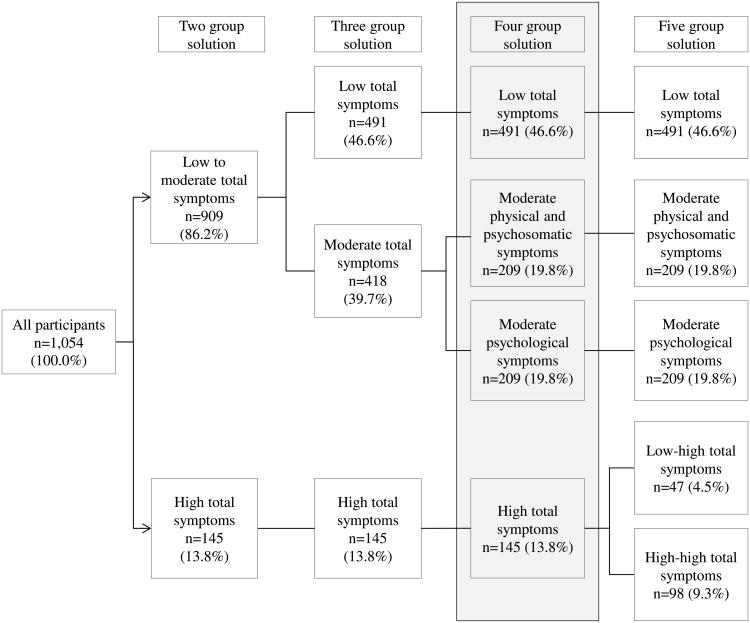
Results: A four-cluster solution was adopted: cluster 1 (low total symptoms group), cluster 2 (moderate physical and psychosomatic symptoms group), cluster 3 (moderate psychological symptoms group), and cluster 4 (high total symptoms group). There were significant differences in education, employment status, family income, social support, country of birth, race/ethnicity, body mass index, perceived general health, diagnosed disease, access to health care, and menopause status among clusters (P < 0.05). In cluster 1 only, there were significant racial/ethnic differences in the total number of total severity scores for physical symptoms (P < 0.01). When racial/ethnic differences in individual symptoms in each cluster were determined, there were no consistent racial/ethnic differences.
Conclusions: Researchers need to consider that racial/ethnic differences could be prominent in midlife women with low sleep-related symptoms.
Conflict of interest statement
The authors have no conflict of interest/financial disclosure.
Figures
Comment in
-
Menopause, symptom clusters, and the complexity of women's lives.Menopause. 2015 Nov;22(11):1153-4. doi: 10.1097/GME.0000000000000555. Menopause. 2015. PMID: 26506313 No abstract available.
References
-
- Avis NE, Stellato R, Crawford S, et al. Is there a menopausal syndrome? Menopausal status and symptoms across racial/ethnic groups. Soc Sci Med. 2001;52:345–356. - PubMed
-
- U. S. National Library of Medicine. Sleep disorders - overview. [Accessed Novemebr 22 2014]; http://www.ncbi.nlm.nih.gov/pubmedhealth/PMH0001803/. Updated January 22 2014.
-
- Massart DL, Kaufman L. The interpretation of analytical chemical data by the use of cluster analysis. New York, NY: John Wiley & Sons, Inc.; 1983.
Publication types
MeSH terms
Grants and funding
LinkOut - more resources
Full Text Sources
Medical
