


Supportive therapy for schizophrenia
- PMID: 25871462
- PMCID: PMC6486211
- DOI: 10.1002/14651858.CD004716.pub4
Supportive therapy for schizophrenia
Abstract
Background: Supportive therapy is often used in everyday clinical care and in evaluative studies of other treatments.
Objectives: To review the effects of supportive therapy compared with standard care, or other treatments in addition to standard care for people with schizophrenia.
Search methods: For this update, we searched the Cochrane Schizophrenia Group's register of trials (November 2012).
Selection criteria: All randomised trials involving people with schizophrenia and comparing supportive therapy with any other treatment or standard care.
Data collection and analysis: We reliably selected studies, quality rated these and extracted data. For dichotomous data, we estimated the risk ratio (RR) using a fixed-effect model with 95% confidence intervals (CIs). Where possible, we undertook intention-to-treat analyses. For continuous data, we estimated the mean difference (MD) fixed-effect with 95% CIs. We estimated heterogeneity (I(2) technique) and publication bias. We used GRADE to rate quality of evidence.
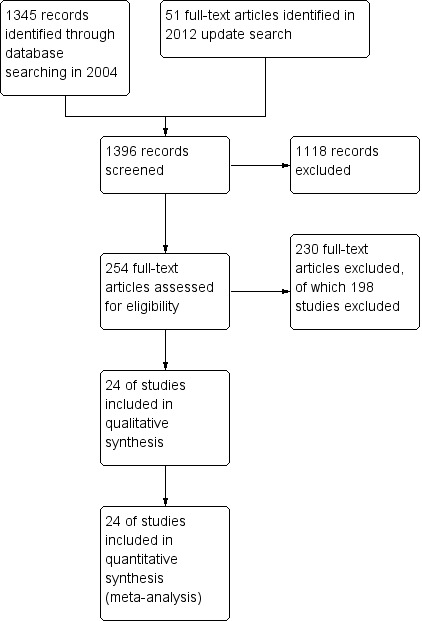
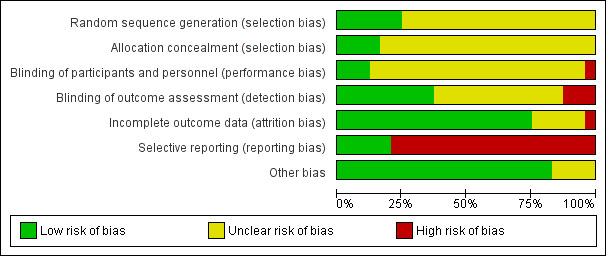
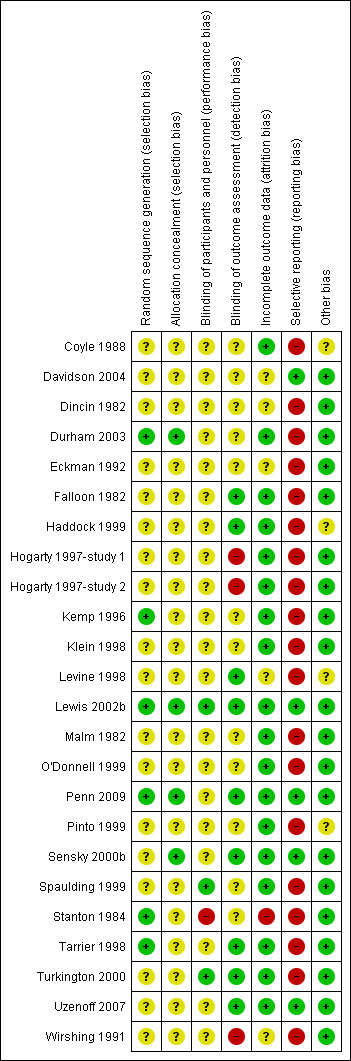
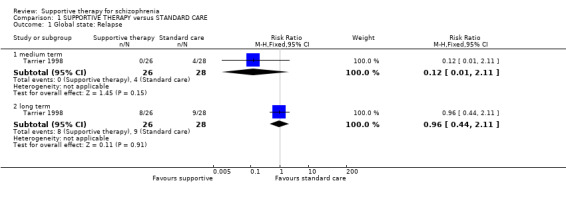
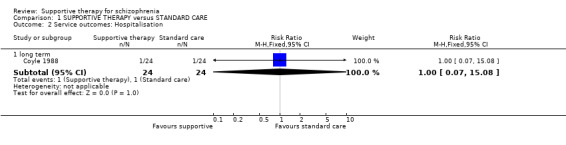
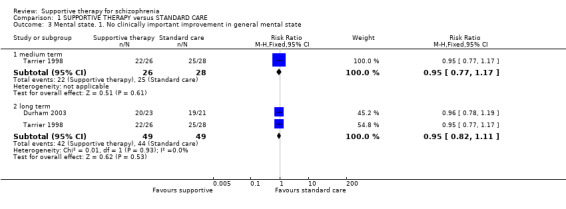
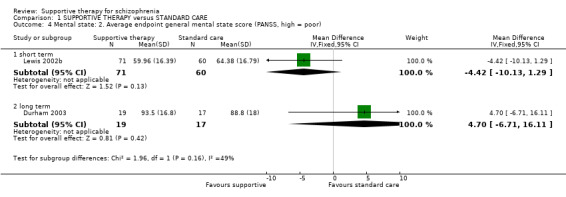
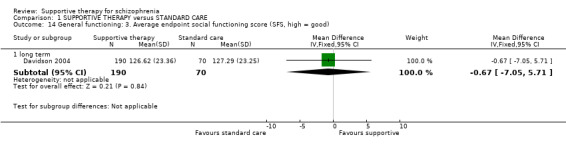
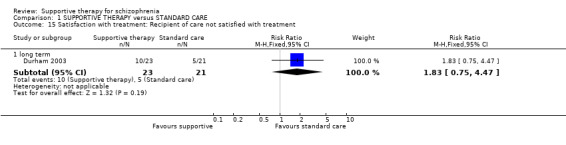
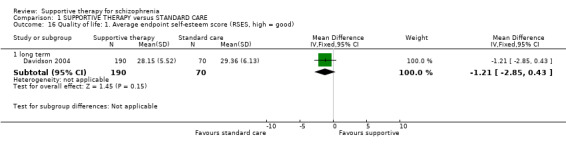
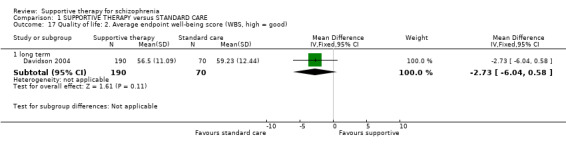
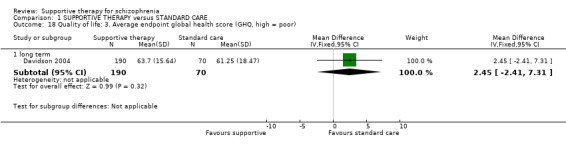
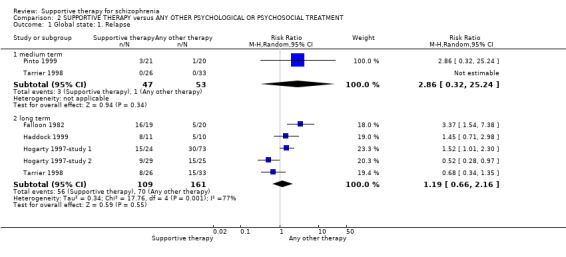
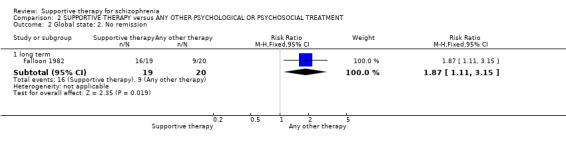
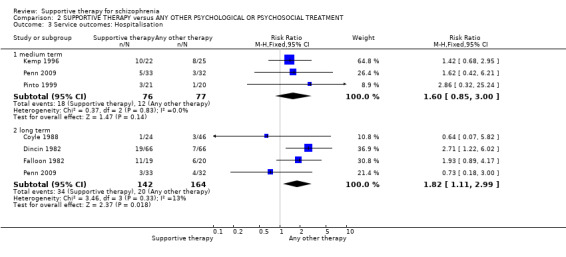
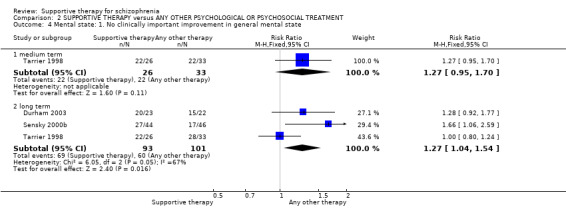
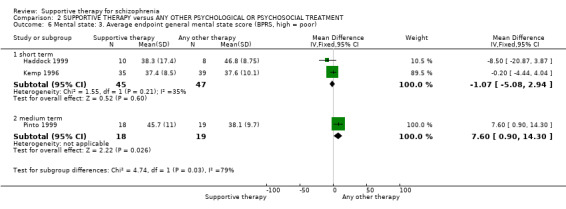
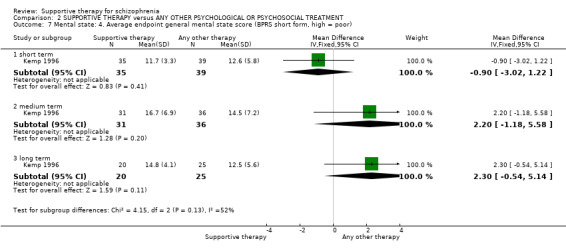
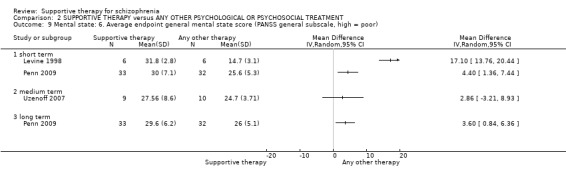
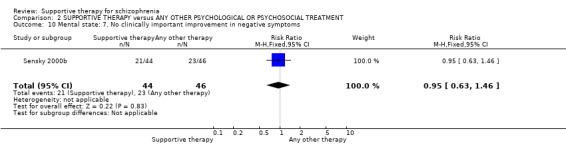
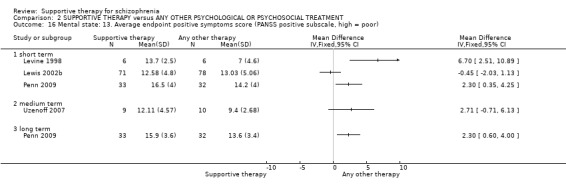
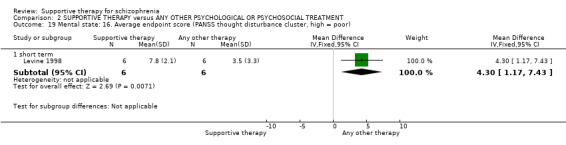
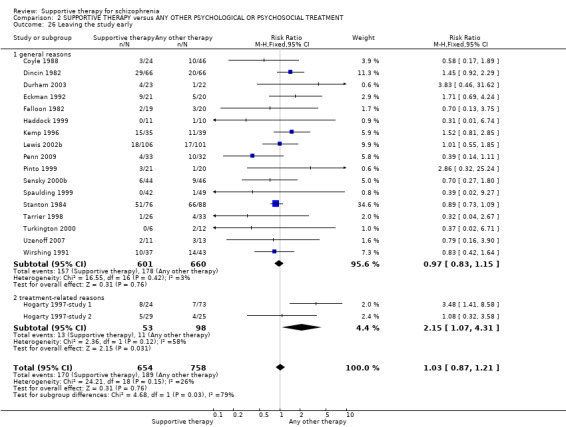
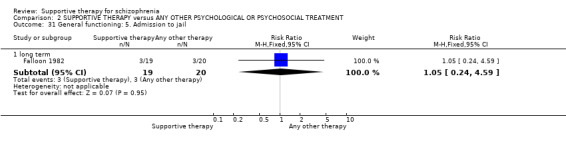
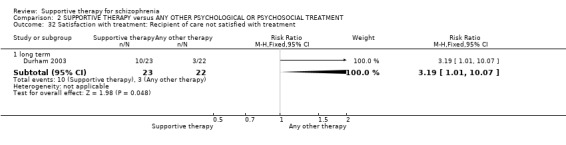
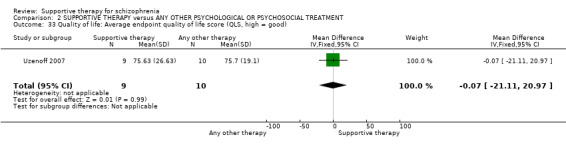
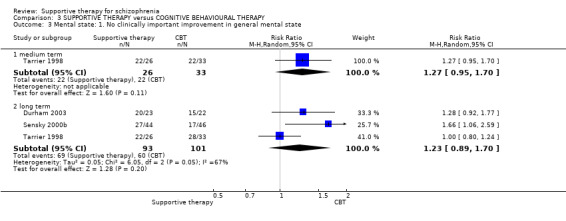
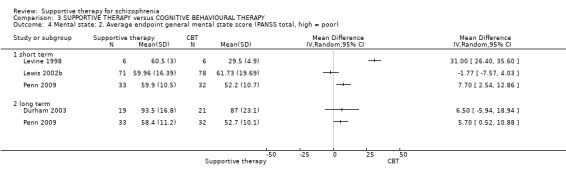
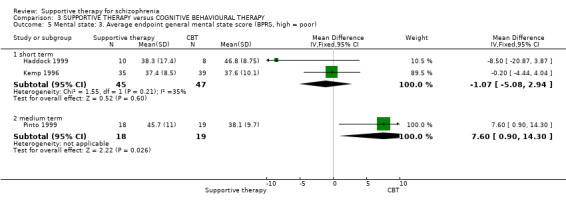
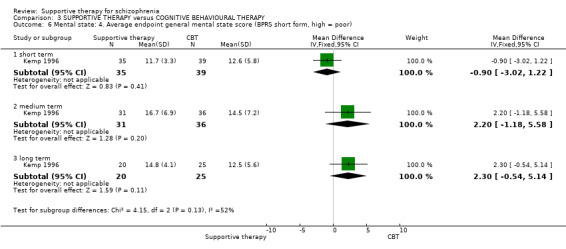
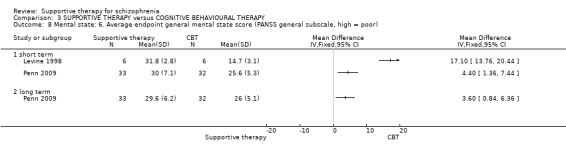
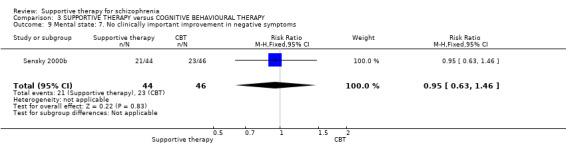
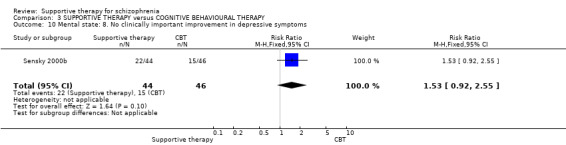
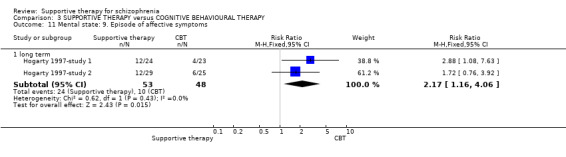
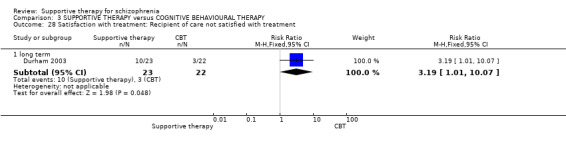
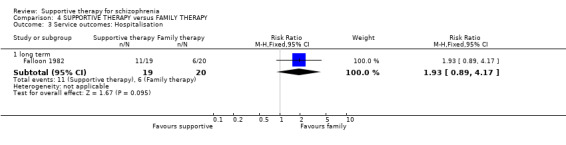
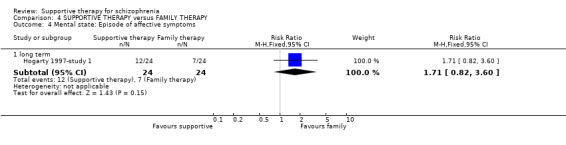
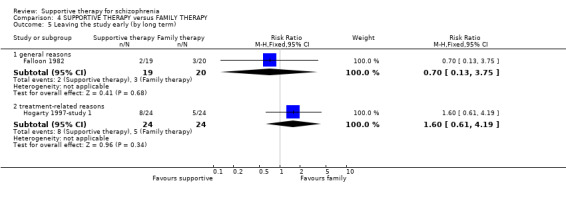
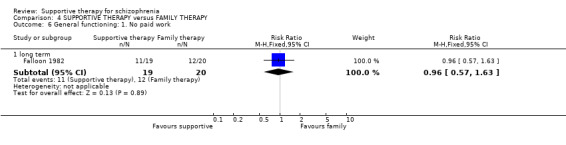
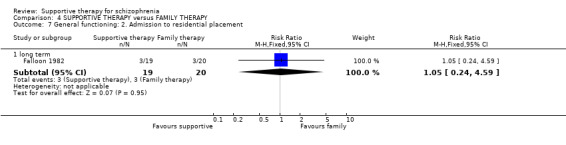
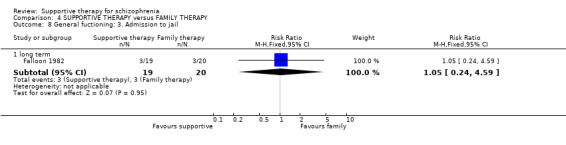
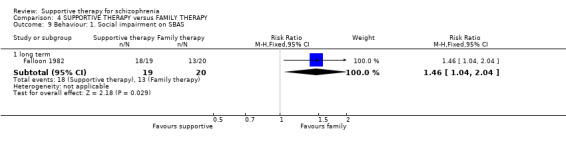
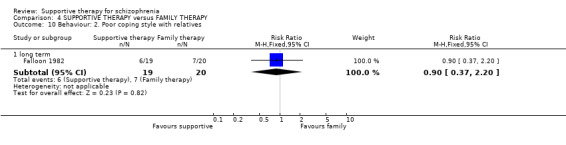
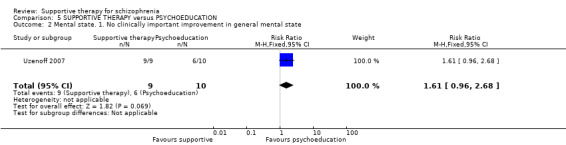
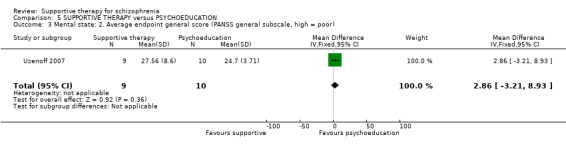
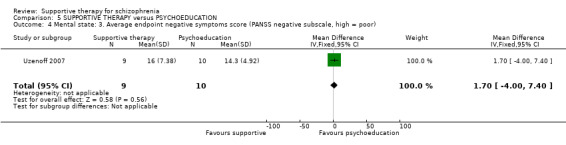
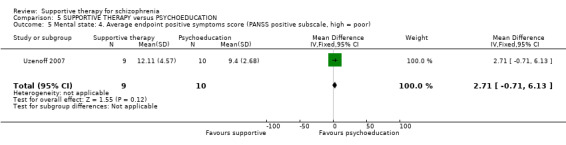
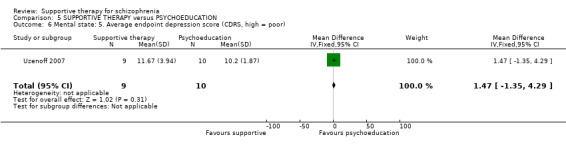
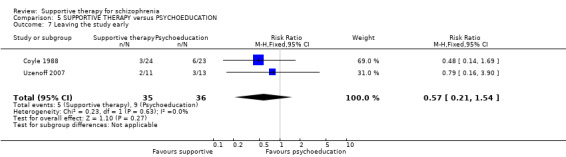
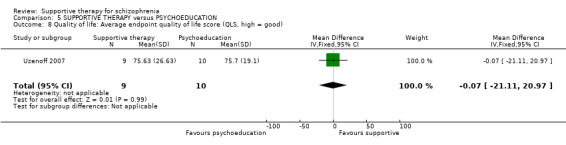
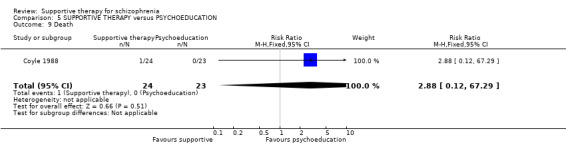
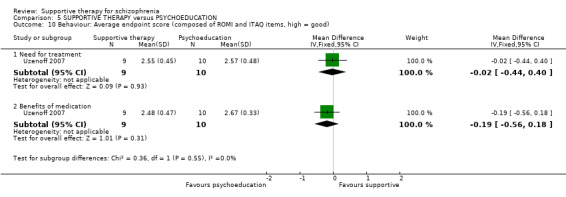
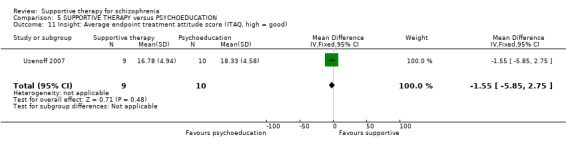
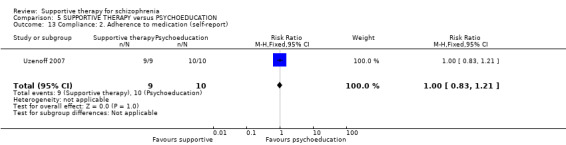
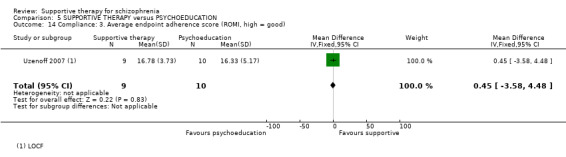
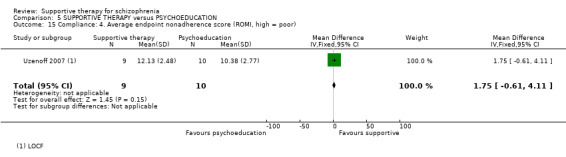
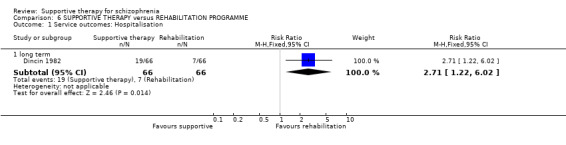
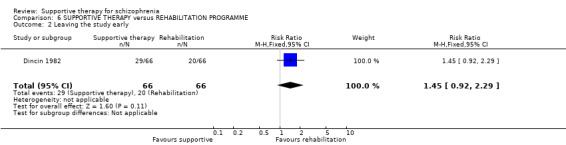
Main results: Four new trials were added after the 2012 search. The review now includes 24 relevant studies, with 2126 participants. Overall, the evidence was very low quality.We found no significant differences in the primary outcomes of relapse, hospitalisation and general functioning between supportive therapy and standard care.There were, however, significant differences favouring other psychological or psychosocial treatments over supportive therapy. These included hospitalisation rates (4 RCTs, n = 306, RR 1.82 CI 1.11 to 2.99, very low quality of evidence), clinical improvement in mental state (3 RCTs, n = 194, RR 1.27 CI 1.04 to 1.54, very low quality of evidence) and satisfaction of treatment for the recipient of care (1 RCT, n = 45, RR 3.19 CI 1.01 to 10.7, very low quality of evidence). For this comparison, we found no evidence of significant differences for rate of relapse, leaving the study early and quality of life.When we compared supportive therapy to cognitive behavioural therapy CBT), we again found no significant differences in primary outcomes. There were very limited data to compare supportive therapy with family therapy and psychoeducation, and no studies provided data regarding clinically important change in general functioning, one of our primary outcomes of interest.
Authors' conclusions: There are insufficient data to identify a difference in outcome between supportive therapy and standard care. There are several outcomes, including hospitalisation and general mental state, indicating advantages for other psychological therapies over supportive therapy but these findings are based on a few small studies where we graded the evidence as very low quality. Future research would benefit from larger trials that use supportive therapy as the main treatment arm rather than the comparator.
Conflict of interest statement
Lucy Buckley ‐ none known.
Karla Soares‐Weiser and Nicola Maayan ‐ work for Enhance Review Ltd, a company that carries out systematic reviews mostly for the public sector. We currently do not provide services for the pharmaceutical industry.
Clive Adams ‐ none known.
Figures
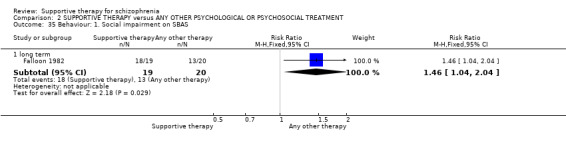
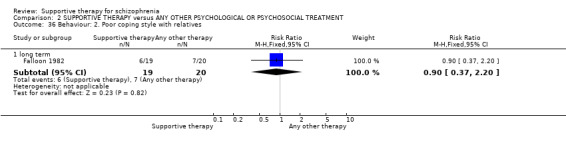
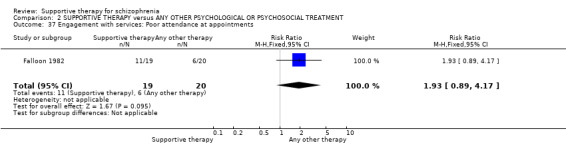
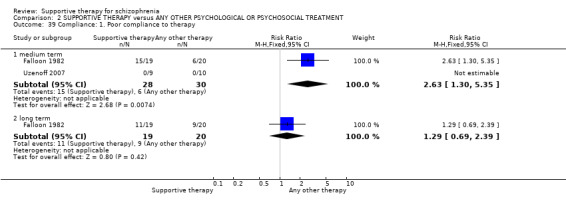
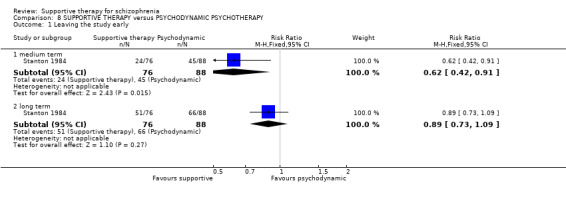
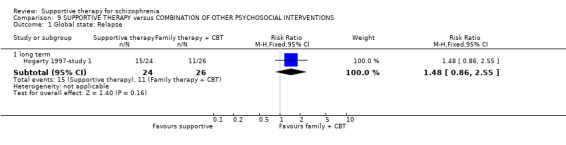
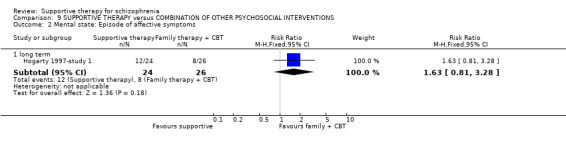
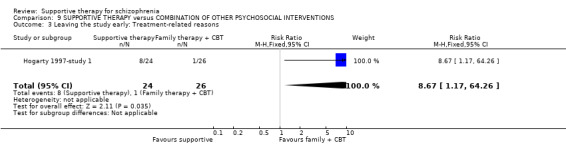
Update of
-
Supportive therapy for schizophrenia.Cochrane Database Syst Rev. 2007 Jul 18;(3):CD004716. doi: 10.1002/14651858.CD004716.pub3. Cochrane Database Syst Rev. 2007. Update in: Cochrane Database Syst Rev. 2015 Apr 14;(4):CD004716. doi: 10.1002/14651858.CD004716.pub4. PMID: 17636772 Updated.
References
References to studies included in this review
Coyle 1988 {published data only}
-
- Coyle P. A comparative analysis of varying treatment approaches on the level of community adjustment among schizophrenic outpatients. PhD dissertation:submitted to the Adelphi University, USA 1988.
Davidson 2004 {published data only}
-
- Davidson L, Shahar G, Stayner DA, Chinman MJ, Rakfeldt J, Tebes JK. Supported socialization for people with psychiatric disabilities: Lessons from a randomized controlled trial. Journal of Community Psychology 2004;32:453‐77.
-
- Shahar G, Kidd S, Styron TH, Davidson L. Consumer support and satisfaction with mental health services in severe mental illness: the moderating role of morale. Journal of Social and Clinical Psychology 2006;25:945‐62.
Dincin 1982 {published data only}
-
- Dincin J, Witheridge TF. Psychiatric rehabilitation as a deterrent to recidivism. Hospital and Community Psychiatry 1982;33(8):645‐50. - PubMed
Durham 2003 {published data only}
-
- Durham RC, Guthrie M, Morton RV, Reid DA, Treliving LR, Fowler DMR, et al. Tayside‐Fife clinical trial of cognitive‐behavioural therapy for medication‐resistant psychotic symptoms. Results to 3‐month follow‐up. British Journal of Psychiatry 2003;182:303‐11. - PubMed
Eckman 1992 {published data only}
-
- Eckman TA, Wirshing WC, Marder SR, Liberman RP, Johnston‐Cronk K, Zimmermann K, et al. Technique for training schizophrenic patients in illness self‐management: a controlled trial. American Journal of Psychiatry 1992;149(11):1549‐55. [MEDLINE: ; PMID 1384364] - PubMed
Falloon 1982 {published data only}
-
- Doane JA, Falloon IR, Goldstein MJ, Mintz J. Parental affective style and the treatment of schizophrenia. Predicting course of illness and social functioning. Archives of General Psychiatry 1985;42(1):34‐42. - PubMed
-
- Falloon IR, Boyd JL, McGill CW, Razani J, Moss HB, Gilderman AM. Family management in the prevention of exacerbations of schizophrenia: a controlled study. New England Journal of Medicine 1982;306(24):1437‐40. - PubMed
-
- Falloon IR, Boyd JL, McGill CW, Williamson M, Razani J, Moss HB, et al. Family management in the prevention of morbidity of schizophrenia. Clinical outcome of a two‐year longitudinal study. Archives of General Psychiatry 1985;42(9):887‐96. - PubMed
-
- Falloon IR, McGill CW, Boyd JL, Pederson J. Family management in the prevention of morbidity of schizophrenia: social outcome of a two‐year longitudinal study. Psychological Medicine 1987;17(1):59‐66. - PubMed
-
- Falloon IR, Pederson J. Family management in the prevention of morbidity of schizophrenia: the adjustment of the family unit. British Journal of Psychiatry 1985;147:156‐63. - PubMed
Haddock 1999 {published data only}
-
- Haddock G, Tarrier N, Morrison AP, Hopkins R, Drake R, Lewis S. A pilot study evaluating the effectiveness of individual inpatient cognitive‐behavioural therapy in early psychosis. Social Psychiatry and Psychiatric Epidemiology 1999;34:254‐8. - PubMed
Hogarty 1997‐study 1 {published data only}
-
- Hogarty GE, Greenwald D, Ulrich RF, Kornblith SJ, DiBarry AL, Cooley S, et al. Three‐year trials of personal therapy among schizophrenic patients living with or independent of family, II: Effects on adjustment of patients. American Journal of Psychiatry 1997;154(11):1514‐24. - PubMed
-
- Hogarty GE, Kornblith SJ, Greenwald D, DiBarry AL, Cooley S, Ulrich RF, et al. Three‐year trials of personal therapy among schizophrenic patients living with or independent of family, I: Description of study and effects on relapse rates. American Journal of Psychiatry 1997;154(11):1504‐13. - PubMed
Hogarty 1997‐study 2 {published data only}
-
- Hogarty GE, Greenwald D, Ulrich RF, Kornblith SJ, DiBarry AL, Cooley S, et al. Three‐year trials of personal therapy among schizophrenic patients living with or independent of family, II: Effects on adjustment of patients. American Journal of Psychiatry 1997;154(11):1514‐24. - PubMed
-
- Hogarty GE, Kornblith SJ, Greenwald D, DiBarry AL, Cooley S, Ulrich RF, et al. Three‐year trials of personal therapy among schizophrenic patients living with or independent of family, I: Description of study and effects on relapse rates. American Journal of Psychiatry 1997;154(11):1504‐13. - PubMed
Kemp 1996 {published data only}
-
- Healey A, Knapp M, Astin J, Beecham J, Kemp R, Kirov G, et al. Cost‐effectiveness evaluation of compliance therapy for people with psychosis.. British Journal of Psychiatry 1998;172(5):420‐4. - PubMed
-
- Kemp R, Kirov B, Hayward P, David A. Randonised controlled trial of compliance therapy. 18‐month follow‐up. British Journal of Psychiatry 1998;172:413‐9. - PubMed
Klein 1998 {published data only}
-
- Klein A R, Cnaan R A, Whitecraft J. Significance of peer social support with dually diagnosed clients: findings from a pilot study. Research on Social Work Practice 1998;8:529‐51.
Levine 1998 {published data only}
-
- Levine J, Barak Y, Granek I. Cognitive group therapy for paranoid schizophrenics: applying cognitive dissonance. Journal of Cognitive Psychotherapy 1998;12(1):3‐12.
Lewis 2002b {published data only}
-
- Kingdon D. SOCRATES ‐ a multicentre, randomized controlled trial of cognitive behavioural therapy in early schizophrenia. National Research Register 2000. [National Research Register N0172004444]
-
- Lewis S, Tarrier N, Haddock G, Bentall R, Kinderman P, Kingdon D, et al. Randomised controlled trial of cognitive‐behavioural therapy in early schizophrenia: acute‐phase outcomes. British Journal of Psychiatry ‐ Supplementum 2002;suppl. 43:S91‐7. [MEDLINE: ; PMID 12271807] - PubMed
-
- Lewis SW, Tarrier N, Haddock G, Bentall R, Kinderman P, Kingdon D. Cognitive therapy improves outcomes in first episode psychosis. XIIth World Congress of Psychiatry. Yokohama, Japan, 2002.
-
- Lewis SW, Tarrier N, Haddock G, Bentall R, Kinderman P, Kingdon D, et al. A randomised controlled trial of cognitive behaviour therapy in early schizophrenia. Schizophrenia Research 2001, issue 1,2:263‐4. [MEDLINE: ; PMID 11215542; PsycINFO 2001‐16630‐011]
-
- Lewis SW, Tarrier N, Haddock G, Bentall R, Kinderman P, Kingdon D, et al. Cognitive therapy improves 18‐month outcomes but not time to relapse in first episode schizophrenia. Schizophrenia Research 2002;53:14.
Malm 1982 {published data only}
-
- Malm U. The influence of group therapy on schizophrenia. Acta Psychiatrica Scandinavica Supplementum 1982;Suppl 297:1‐65. [MEDLINE: ; PMID 6126069] - PubMed
O'Donnell 1999 {published data only}
-
- O'Donnell M, Parker G, Proberts M, Matthews R, Fisher D, Johnson B, et al. A study of client focused case management and consumer advocacy: The community and consumer service project. Australian and New Zealand Journal of Psychiatry 1999;33(5):684‐93. [EMBASE 1999362945] - PubMed
Penn 2009 {published data only}
-
- Penn D L, Meyer PS, Evans E, Wirth RJ, Cai K, Burchinal M. A randomized controlled trial of group cognitive‐behavioral therapy vs. enhanced supportive therapy for auditory hallucinations. Schizophrenia Research 2009;109:52‐9. - PubMed
Pinto 1999 {published data only}
-
- Pinto A, La‐Pia S, Mennella R, Giorgio D, DeSimone L. Cognitive behavioral therapy and clozapine for clients with treatment refractory schizophrenia. Psychiatric Services 1999;50(7):901‐4. - PubMed
Sensky 2000b {published data only}
-
- Sensky T, Turkington D, Kingdon D, Scott JL, Scott J, Siddle R, et al. A randomized controlled trial of cognitive behavioral therapy for persistent symptoms in schizophrenia resistant to medication. Archives of General Psychiatry 2000;57(2):165‐72. - PubMed
Spaulding 1999 {published data only}
-
- Spaulding WD, Reed D, Sullivan M, Richardson C, Weiler M. Effects of cognitive treatment in psychiatric rehabilitation. Schizophrenia Bulletin 1999;25(4):657‐76. - PubMed
Stanton 1984 {published data only}
-
- Frank AF, Gunderson JG. The role of the therapeutic alliance in the treatment of schizophrenia. Relationship to course and outcome. Archives of General Psychiatry 1990;47(3):228‐36. - PubMed
-
- Gunderson JG, Frank AF, Katz HM, Vannicelli ML, Frosch JP, Knapp PH. Effects of psychotherapy in schizophrenia: II. Comparative outcome of two forms of treatment. Schizophrenia Bulletin 1984;10(4):564‐98. - PubMed
-
- Stanton AH, Gunderson JG, Knapp PH, Frank AF, Vannicelli ML, Schnitzer R, et al. Effects of psychotherapy in schizophrenia: I. Design and implementation of a controlled study. Schizophrenia Bulletin 1984;10(4):520‐63. - PubMed
Tarrier 1998 {published data only}
-
- Tarrier N. The use of cognitive behaviour therapy in the treatment of schizophrenia. 8th Congress of the Association of European Psychiatrists; 1996 Jul 7‐12; London, UK. 1996. [MEDLINE: ; PMID 7961550] - PubMed
-
- Tarrier N, Kinney C, McCarthy E, Humphreys L, Wittkowski A, Morris J. Two‐year follow‐up of cognitive‐behavioral therapy and supportive counseling in the treatment of persistent symptoms in chronic schizophrenia. Journal of Consulting and Clinical Psychology 2000;68(5):917‐22. [EMBASE 2000386575] - PubMed
-
- Tarrier N, Kinney C, McCarthy E, Wittkowski A, Yusupoff L, Gledhill A. Are some types of psychotic symptoms more responsive to cognitive‐behaviour therapy?. Behavioural and Cognitive Psychotherapy 2001;29:45‐55.
-
- Tarrier N, Wittkowski A, Kinney C, McCarthy E, Morris J, Humphreys L. Durability of the effects of cognitive‐behavioural therapy in the treatment of chronic schizophrenia: 12‐Month follow‐up. British Journal of Psychiatry 1999;174:500‐4. [EMBASE 1999210779] - PubMed
Turkington 2000 {published data only}
-
- Turkington D, Kingdon D. Cognitive‐behavioural techniques for general psychiatrists in the management of patients with psychoses. British Journal of Psychiatry 2000;177:101‐6. - PubMed
Uzenoff 2007 {published data only}
-
- Uzenoff SR. A Preliminary Trial of Adherence‐Coping‐Education (ACE) Therapy for First‐episode Schizophrenia. Chapel Hill: The University of North Carolina, 2007.
-
- Uzenoff SR, Perkins DO, Hamer RM, Wiesen CA, Penn DL. A preliminary trial of Adherence‐Coping‐Education (ACE) therapy for early psychosis. Journal of Nervous and Mental Disease 2008;196:572‐5. - PubMed
Wirshing 1991 {published data only}
-
- Marder SR, Wirshing DA, Wirshing WC. Psychosocial and pharmacological strategies for improving treatment adherence in schizophrenia. 155th Annual Meeting of the American Psychiatric Association; 2002 May 18‐23; Philadelphia, PA, USA. 2002. [No. 3B]
-
- Marder SR, Wirshing DA, Wirshing WC. Psychosocial and pharmacological strategies for improving treatment adherence in schizophrenia. Annual Meeting of the American Psychiatric Association; 2001 May 5‐10; LA, USA. Marathon Multimedia, 2001. [MEDLINE: ; PMID 11290639] - PubMed
-
- Marder SR, Wirshing WC, Mintz J, McKenzie J, Johnston K, Eckman TA, et al. Two‐year outcome of social skills training and group psychotherapy for outpatients with schizophrenia. American Journal of Psychiatry 1996;153(12):1585‐92. - PubMed
-
- Wirshing WC, Eckman T, Liberman RP, Marder SR. Management of risk of relapse through skills training of chronic schizophrenics. In: Tamminga Ca SSC editor(s). Schizophrenia Research: Advances in Neuropsychiatry and Psychopharmacology. Raven Press, 1991:255‐67.
-
- Wirshing WC, Marder SR, Eckman T, Liberman RP, Mintz J. Acquisition and retention of skills training methods in chronic schizophrenic outpatients. Psychopharmacology Bulletin 1992;28(3):241‐5. [MEDLINE: ; PMID 1480726] - PubMed
References to studies excluded from this review
Aberg‐Wistedt 1995 {published data only}
-
- Aberg‐Wistedt A, Cressell T, Lidberg Y, Liljenberg B, Osby U. Two‐year outcome of team‐based intensive case management for patients with schizophrenia. Psychiatric Services 1995;12:1263‐6. [MEDLINE: ; PMID 8590112] - PubMed
Abramowitz 1989 {published data only}
-
- Abramowitz IA, Coursey RD. Impact of an educational support group on family participants who take care of their schizophrenic relatives. Journal of Consulting and Clinical Psychology 1989;57:232‐6. - PubMed
Addington 2011 {published data only}
-
- Addington J, Epstein I, Liu L, French P, BoydellK M, Zipursky RB. A randomized controlled trial of cognitive behavioral therapy for individuals at clinical high risk of psychosis. Schizophrenia Research 2011;125:54‐61. - PubMed
Anderson 1982 {published data only}
-
- Anderson CM, Reiss Douglas J. Approaches to psychoeducational family therapy. International Journal of Family Psychiatry 1982;3(4):501‐17.
Andres 1998 {published data only}
-
- Andres K, Schindler F, Brenner HD, Garst F, Donzel G, Schaub A. Coping oriented group therapy for patients with schizophrenic or schizoaffective disorders. An exploratory study [Bewaltigungsorientierte Gruppentherapie fur Patienten mit schizophrenen oder schizoaffektiven Storungen. Eine explorative Studie]. Fortschritte der Neurologie‐Psychiatrie 1998;5:225‐32. [MEDLINE: ; PMID 9653638] - PubMed
Andres 2000 {published data only}
-
- Andres K, Pfammatter M, Garst F, Teschner C, Brenner HD. Effects of a coping orientated group therapy for schizophrenia and schizoaffective patients: a pilot study. Acta Psychiatrica Scandinavica 2000;101(4):318‐22. [MEDLINE: ; PMID 10782553] - PubMed
Armstrong 1991 {published data only}
-
- Armstrong HE, Cox GB, Short BA, Allmon DJ. A comparative evaluation of two day treatment programs. Psychosocial Rehabilitation Journal 1991;14(4):53‐67.
Baker 1994 {published data only}
-
- Baker L. Training mentally ill offenders in problem‐solving. PhD dissertation submitted to the University of Pennsylvania 1994.
Beal 1977 {published data only}
-
- Beal D, Duckro P, Elias J, Hecht E. Graded group procedures for long term regressed schizophrenics. Journal of Nervous and Mental Disease 1977;164(2):102‐6. [MEDLINE: ; PMID 836481] - PubMed
Beard 1975 {published data only}
-
- Beard MT, Scott PY. The efficacy of group therapy by nurses for hospitalized patients. Nursing Research 1975;24(2):120‐4. [MEDLINE: ; PMID 1090905] - PubMed
Beard 1978 {published data only}
-
- Beard JH, Malamud TJ, Rossman E. Psychiatric rehabilitation and long‐term rehospitalisation rates: the findings of two research studies. Schizophrenia Bulletin 1978;4:622‐35. - PubMed
Becker 1998 {published data only}
-
- Becker DR, Drake RE, Bond GR, Xie H, Dain BJ, Harrison K. Job terminations among persons with severe mental illness participating in supported employment. Community Mental Health Journal 1998;34(1):71‐82. - PubMed
Beebe 2001 {published data only}
-
- Beebe LH. Community nursing support for clients with schizophrenia. Archives of Psychiatric Nursing 2001;XV(5):214‐22. [MEDLINE: ; CINAHL 2002036665; PMID 21467734] - PubMed
Bell 1993a {published data only}
-
- Bell MD, Milstein RM, Lysaker PH. Pay and participation in work activity: clinical benefits for clients with schizophrenia. Psychosocial Rehabilitation Journal 1993;17(2):173‐7.
Bell 1993b {published data only}
-
- Bell MD, Milstein RM, Lysaker PH. Pay as an incentive in work participation by patients with severe mental illness. Hospital and Community Psychiatry 1993;44(7):684‐6. - PubMed
Bell 1998 {published data only}
-
- Bell M, Bryson G. Psychological and psychosocial disorders. Rehabilitation effects of pay, activity, and support intensity on schizophrenia. Rehabilitation R&D Progress Reports 1998;35:228‐9.
Bell 2001 {published data only}
-
- Bell MD, Bryson G. Work rehabilitation in schizophrenia: does cognitive impairment limit improvement?. Schizophrenia Bulletin 2001;27:269‐79. - PubMed
Bell 2003 {published data only}
-
- Bell M, Lysaker P, Bryson G. A behavioral intervention to improve work performance in schizophrenia: Work behavior inventory feedback. Journal of Vocational Rehabilitation 2003;1:43‐50. [MEDLINE: ]
Bellack 1986 {published data only}
-
- Bellack AS. Social skills training in the treatment of chronic schizophrenics [Das Training sozialer Fertigkeiten zur Behandlung chronisch Schizophrener]. In: Boeker W BHD editor(s). Bewaltigung der Schizophrenie. Verlag Hans Huber, 1986:121‐128. [PSYNDEX 0020596]
Bond 1995 {published data only}
-
- Bond GR, Dietzen LL, McGrew JH, Miller LD. Accelerating entry into supported employment for persons with severe psychiatric disabilities. Rehabilitation Psychology 1995;40(2):75‐94.
Brown 1983 {published data only}
-
- Brown MA, Munford AM. Life skills training for chronic schizophrenics. Journal of Nervous and Mental Disease 1983;171(8):466‐70. [MEDLINE: ; PMID 6875530] - PubMed
Buchkremer 1997 {published data only}
-
- Buchkremer G, Klingberg S, Holle R, Monking HS, Hornung WP. Psychoeducational psychotherapy for schizophrenic patients and their key relatives or care‐givers: results of a 2‐year follow‐up. Acta Psychiatrica Scandinavica 1997;96(6):483‐91. [MEDLINE: ; PMID 9421346] - PubMed
Bush 1990 {published data only}
-
- Bush CT, Langford MW, Rosen P, Gott W. Operation outreach: intensive case management for severely psychiatrically disabled adults. Hospital and Community Psychiatry 1990;41(6):647‐9. [MEDLINE: ; PMID 2361668] - PubMed
Canning 1997 {published data only}
-
- Canning. The effect of family support on the working alliance in psychotherapy with psychiatrically disturbed parents. PhD dissertation submitted to Yale University, USA 1997:106. [Dissertation Abstracts (order number) AAC 9805882]
Carra 2010 {published data only}
-
- Carra G. Multiple group family treatment for schizophrenia in Italy. Schizophrenia Research 2010;117:121.
Castelein 2008 {published data only}
-
- Castelein S, Bruggeman R, Busschbach JT, Gaag M, Stant AD, Knegtering H, et al. The effectiveness of minimally guided peer support groups for people suffering from psychosis: a randomized controlled trial. Schizophrenia Research 2008;98:52‐3.
Castelein 2008a {published data only}
-
- Castelein S, Bruggeman R, Busschbach J T, Gaag M, Stant A D, Knegtering H, et al. The effectiveness of peer support groups in psychosis: a randomized controlled trial. Acta Psychiatrica Scandinavica 2008;118:64‐72. - PubMed
Castilla‐Puentes 2002 {published data only}
-
- Castilla‐Puentes RC, Valero J, Vargas J, Gongora O, Pava C, Perel J. Music therapy and medication compliance in psychotic patients. 155th Annual Meeting of the American Psychiatric Association. Philadelphia, PA, USA, 2002.
Chien 2008 {published data only}
-
- Chien WT, Thompson DR, Norman I. Evaluation of a peer‐led mutual support group for Chinese families of people with schizophrenia. American Journal of Community Psychology 2008;42:122‐34. - PubMed
Chinman 2010 {published data only}
Clark 1998 {published data only}
-
- Clark RE, Xie H, Becker DR, Drake RE. Benefits and costs of supported employment from three perspectives. Journal of Behavioral Health Services and Research 1998;25(1):22‐34. - PubMed
Cook 2011 {published data only}
-
- Cook JA, Steigman P, Pickett S, Diehl S, Fox A, Shipley P, et al. Randomized controlled trial of peer‐led recovery education using building recovery of individual dreams and goals through education and support (bridges). Schizophrenia Research 2012;136(1‐3):36‐42. - PubMed
Cook 2012 {published data only}
-
- Cook J A, Steigman P, Pickett S, Diehl S, Fox A, Shipley P, et al. Randomized controlled trial of peer‐led recovery education using building recovery of individual dreams and goals through education and support (bridges). Schizophrenia Research 2012;136:36‐42. - PubMed
Curtis 1992 {published data only}
-
- Curtis JL, Millman EJ, Struening E, D'Ercole A. Effect of case management on rehospitalization and utilization of ambulatory care services. Hospital and Community Psychiatry 1992;43(9):895‐9. [MEDLINE: ; PMID 3289523] - PubMed
Curtis 1996 {published data only}
-
- Curtis JL, Millman EJ, Struening E, D'Ercole A. Deaths among former psychiatric inpatients in an outreach case management program. Psychiatric Services 1996;47(4):398‐402. [MEDLINE: ; PMID 8689371] - PubMed
Czobor 1995 {published data only}
-
- Czobor P, Volavka J, Meibach RC. Effect of risperidone on hostility in schizophrenia. Journal of Clinical Psychopharmacology 1995;15(4):243‐9. - PubMed
D'Ercole 1997 {published data only}
-
- D'Ercole A, Struening E, Curtis JL, Millman EJ, Morris A. Effects of diagnosis, demographic characteristics, and case management on rehospitalization. Psychiatric Services 1997;45(5):682‐8. [MEDLINE: ; PMID 9144824] - PubMed
Daumit 2010 {published data only}
-
- Daumit G, Appel L, Leatherman E, Latkin C, Dalcin A, Goggins B, et al. Randomized trial of peer‐supported physical activity for persons with severe mental illness in community psychiatry. Journal of General Internal Medicine 2010;25(3 (Suppl.)):378‐9.
Dixon 2002 {published data only}
-
- Dixon L, Hoch JS, Clark R, Bebout R, Drake R, McHugo G, et al. Cost‐effectiveness of two vocational rehabilitation programs for persons with severe mental illness. Psychiatric Services 2002;53(9):1118‐24. - PubMed
Donlon 1973 {published data only}
-
- Donlon PT, Rada RT, Knight SW. A therapeutic aftercare setting for "refractory" chronic schizophrenic patients. American Journal of Psychiatry 1973;130(6):682‐4. [PsycINFO 51‐07592] - PubMed
Drake 1993 {published data only}
-
- Drake RE, Bebout RR, Roach JP. A research evaluation of social network case management for homeless persons with dual disorders. In: Harris H, Bergman HC editor(s). Case Management for Mentally Ill Patients: Theory and Practice. Chronic mental illness. Pennsylvania: Harwood Academic Publishers, 1993:83‐98. [PSYCINFO 1993‐98432‐005]
Drake 1996 {published data only}
-
- Drake RE, McHugo GJ, Becker DR, Anthony WA, Clark RE. The New Hampshire study of supported employment for people with severe mental illness. Journal of Consulting and Clinical Psychology 1996;64(2):391‐9. - PubMed
Drake 1999 {published data only}
-
- Drake RE, McHugo GJ, Bebout RR, Becker DR, Harris M, Bond GR, et al. A randomized clinical trial of supported employment for inner city patients with severe mental disorders. Archives of General Psychiatry 1999;56(7):627‐33. - PubMed
Drury 1996a {published data only}
-
- Drury V, Birchwood M, Cochrane R, MacMillan F. Cognitive therapy and recovery from acute psychosis ‐ A controlled trial. I. Impact on psychotic symptoms. British Journal of Psychiatry 1996;169:593‐601. - PubMed
Drury 1996b {published data only}
-
- Drury V, Birchwood M, Cochrane R, MacMillan F. Cognitive therapy and recovery from acute psychosis ‐ A controlled trial. II. Impact on recovery time. British Journal of Psychiatry 1996;169:602‐7. - PubMed
Drury 2000 {published data only}
-
- Drury V, Birchwood M, Cochrane R. Cognitive therapy and recovery from acute psychosis: a controlled trial. 3. Five‐year follow‐up. British Journal of Psychiatry 2000;177:8‐14. [MEDLINE: ; PMID 10945081] - PubMed
Eack 2007 {published data only}
Eack 2010 {published data only}
Eack 2011 {published data only}
Eack 2012 {published data only}
Essock 1995 {published data only}
-
- Essock SM, Kontos N. Implementing assertive community treatment teams. Psychiatric Services 1995;46(7):679‐83. [MEDLINE: ; PMID 7552558] - PubMed
Field 1997 {published data only}
-
- Field CD, Galletly C, Anderson D, Walker P. Computer aided cognitive rehabilitation: possible application to the attentional deficit of schizophrenia, a report of negative results. Perceptual and Motor Skills 1997;85:995‐1002. - PubMed
Ford 1995 {published data only}
-
- Ford R, Beadsmoore A, Ryan P, Repper J, Craig T, Muijen M. Providing the safety net: case management for people with a serious mental illness. Journal of Mental Health 1995;1:91‐7. [CINAHL 1996004717]
Forsyth 1961 {published data only}
-
- Forsyth RP. MMPI and demographic correlates of post‐hospital adjustment in neuropsychiatric patients. Dissertation Abstracts 1961;21:2783‐4. - PubMed
Franklin 1987 {published data only}
Freeman 1998 {published data only}
-
- Freeman D, Garety P, Fowler D, Kuipers E, Dunn G, Bebbington P, et al. The London East Anglia randomized controlled trial of cognitive behaviour therapy for psychosis. IV: Self esteem and persecutory delusions. British Journal of Clinical Psychology 1998;37(4):415‐30. [MEDLINE: ; PMID 9856295] - PubMed
Gaither 2003 {published data only}
-
- Gaither ML, Nazzaro D, Barnett B, Huegel SG, Haas GL. A randomized clinical trial of a brief cognitive‐behavioral treatment for the chronic phase of schizophrenia. Schizophrenia Research 2003:322‐3. [EMBASE 2003252036]
Garety 1994 {published data only}
-
- Garety PA, Kuipers L, Fowler D, Chamberlain F, Dunn G. Cognitive behavioural therapy for drug‐resistant psychosis. British Journal of Medical Psychology 1994;67(Pt 3):259‐71. [MEDLINE: ; PMID 7803318] - PubMed
Glick 1974 {published data only}
-
- Glick ID, Hargreaves WA, Goldfield MD. Short vs long hospitalization: a prospective controlled study: I. The preliminary results of a one‐year follow‐up of schizophrenics. Archives of General Psychiatry 1974;30(3):363‐9. - PubMed
Glick 1975 {published data only}
-
- Glick ID, Hargreaves WA, Raskin M, Kutner SJ. Short versus long hospitalization: a prospective controlled study. II. Results for schizophrenic inpatients. American Journal of Psychiatry 1975;132(4):385‐90. - PubMed
Glick 1976a {published data only}
-
- Glick ID, Hargreaves WA, Drues J, Showstack JA. Short versus long hospitalization: a prospective controlled study. IV. One‐year follow‐up results for schizophrenia patients. American Journal of Psychiatry 1976;133(5):509‐14. - PubMed
Glick 1976b {published data only}
-
- Glick ID, Hargreaves WA, Drues JMA, Showstack JA. Short versus long hospitalization: a controlled study. III. Inpatient results for non‐schizophrenics. Archives of General Psychiatry 1976;33:78‐83. - PubMed
Glick 1976c {published data only}
-
- Glick ID, Hargreaves WA, Drues JMA, Showstack JA. Short versus long hospitalization: a prospective controlled study. V. One‐year follow up for non‐schizophrenics. American Journal of Psychiatry 1976;133:515‐7. - PubMed
Glick 1977 {published data only}
-
- Glick ID, Hargreaves WA, Drues JA, Showstack JA, Katzow JJ. Short versus long hospitalization: a prospective controlled study. VII. Two‐year follow‐up results for non‐schizophrenics. Archives of General Psychiatry 1977;34:314‐7. - PubMed
Glick 1979 {published data only}
-
- Glick I, Hargreaves W, Drues J, Showstack J. Psychiatric hospital treatment for the 1980's: a controlled study of short versus long hospitalization. Heath and Company. Lexington Books D.C, 1979.
Glynn 2001 {published data only}
-
- Glynn SM, Marder SR, Liberman RP, Blair K, Wirshing WC, Wirshing DA, et al. Supplementing clinic based skills training for schizophrenia with manualized community support: nine month follow‐up effects on social adjustment. Schizophrenia Research 2001;49(12):261. - PubMed
Grassi 2001 {published data only}
-
- Grassi A, Bruni R, Pileggi F, Chiappelli M, Boldrini M, Franceschi E, et al. Analysis and comparative evaluations of the costs of supports and treatments of schizophrenia, affective psychosis, paranoia and neurosis. Epidemiologia e Psichiatria Sociale 2001;10(2):115‐24. - PubMed
Grawe 1998 {published data only}
-
- Grawe RW, Widen JH. Result of two years optimal out‐patient treatment of first episode schizophrenia: a controlled study. 25th Nordic Psychiatric Congress. Nord J Psychiatry. 1998; Vol. Suppl 41.
Haddock 2000a {published data only}
-
- Haddock G. Dual diagnosis project evaluation of family support cognitive behaviour therapy for recent onset schizophrenia sufferers with substance misuse, problems. National Research Register 2000.
Haddock 2000b {published data only}
-
- Haddock G. Evaluation of a family support and cognitive‐behavioural treatment service for recent onset schizophrenia sufferers with substance misuse problems. National Research Register 2000.
Hafner 1983 {published data only}
-
- Hafner RJ, Badenoch A, Fisher J, Swift H. Spouse aided versus individual therapy in persisting psychiatric disorders: a systematic comparison. Family Process 1983;22(3):385‐99. - PubMed
Haldun 2002 {published data only}
-
- Haldun S, Mehmet S, Perihan G, Ilkten C, Besti U. Optimal treatment of schizophrenia. XIIth World Congress of Psychiatry; 2002 Aug 24‐29; Yokohama, Japan. 2002. [MEDLINE: ; 1773245]
Hannes 1974 {published data only}
-
- Hannes M, Siegel HD. The short term effect of socializing on performance of schizophrenics in recreational therapy. Journal of Community Psychology 1974;1:51‐3. [PsycINFO 56‐08317]
Hargreaves 1977 {published data only}
-
- Hargreaves WA, Glick ID, Drues J, Showstack JA, Feigenbaum E. Short versus long hospitalization: a prospective controlled study. VI. Two‐year follow‐up results for schizophrenics. Archives of General Psychiatry 1977;34:305‐11. - PubMed
Harrison‐Read 2002 {published data only}
-
- Harrison‐Read P, Lucas B, Tyrer P, Ray J, Shipley K, Simmonds S, et al. Heavy users of acute psychiatric beds: randomized controlled trial of enhanced community management in an outer London borough. Psychological Medicine 2002;32(3):403‐16. [MEDLINE: ; 11989986] - PubMed
Harvey 2002 {published data only}
-
- Harvey K, Burns T, Fiander M, Huxley P, Manley C, Fahy T. The effect of intensive case management on the relatives of patients with severe mental illness. Psychiatric Services 2002;53(12):1580‐5. [MEDLINE: ; PMID 12461219] - PubMed
Herz 1974 {published data only}
-
- Herz MI, Spitzer RL, Gibbon M, Greenspan K, Reibel S. Individual versus group aftercare treatment. American Journal of Psychiatry 1974;131:808‐12. - PubMed
Herz 2000 {published data only}
-
- Herz MI, Lamberti JS, Mintz J, Scott R, O'Dell SP, McCartan L, et al. A program for relapse prevention in schizophrenia: a controlled study. Archives of General Psychiatry 2000;57(3):277‐83. [MEDLINE: ; PMID 10711914] - PubMed
Hogarty 1973 {published data only}
-
- Goldberg SC, Schooler NR, Hogarty GE, Roper M. Prediction of relapse in schizophrenic outpatients treated by drug and sociotherapy. Archives of General Psychiatry 1977;34(2):171‐84. - PubMed
-
- Hogarty G, Goldberg SC. Drug and social therapy in schizophrenic outpatients. Unknown.
-
- Hogarty GE, Goldberg SC. Drug and sociotherapy in the aftercare of schizophrenic patients. One‐year relapse rates. Archives of General Psychiatry 1973;28:54‐64. - PubMed
-
- Hogarty GE, Goldberg SC, Schooler NR. Drug and sociotherapy in the aftercare of schizophrenic patients. III. Adjustment of non relapsed patients. Archives of General Psychiatry 1974;31(5):609‐18. - PubMed
-
- Hogarty GE, Goldberg SC, Schooler NR, Ulrich RF. Drug and sociotherapy in the aftercare of schizophrenic patients. II. Two‐year relapse rates. Archives of General Psychiatry 1974;31(5):603‐8. - PubMed
Hogarty 1977 {published data only}
-
- Hogarty GE, Ulrich RF. Temporal effects of drug and placebo in delaying relapse in schizophrenic outpatients. Archives of General Psychiatry 1977;34(3):297‐301. - PubMed
Hogarty 1984 {published data only}
-
- Hogarty GE, Munetz MR. Pharmacogenic depression among outpatient schizophrenic patients: a failure to substantiate. Journal of Clinical Psychopharmacology 1984;4(1):17‐24. - PubMed
Hogarty 1986a {published data only}
-
- Hogarty GE, Anderson C. A controlled trial of family therapy, social skills training and drug therapy in the aftercare of schizophrenics. Effects on relapse and expressed emotion. In: Boeker W BHD editor(s). Bewaeltigung der Schizophrenie. Bern, Switzerland: Verlag Hans Huber, 1986:72‐86.
Hogarty 1986b {published data only}
-
- Hogarty GE, Anderson CM. Medication, family psychoeducation, and social skills training: first year relapse results of a controlled study. Psychopharmacology Bulletin 1986;22(3):860‐2. - PubMed
-
- Hogarty GE, Anderson CM, Reiss DJ, Kornblith SJ, Greenwald DP, Javna CD, et al. Environmental/Personal Indicators in the Course of Schizophrenia Research Group. Family psychoeducation, social skills training and maintenance chemotherapy in the aftercare of schizophrenia. I. One‐year effects of a controlled study on relapse and expressed emotion.. Archives of General Psychiatry 1986;43:633‐42. - PubMed
Hogarty 1986c {published data only}
-
- Hogarty GE, Anderson CM, Reiss DJ, Kornblith SJ, Greenwald DP, Javna CD, et al. Environmental‐personal Indicators in the Course of Schizophrenia Research Group. Family psychoeducation, social skills training, and maintenance chemotherapy in the aftercare treatment of schizophrenia. I. One‐year effects of a controlled study on relapse and expressed emotion.. Archives of General Psychiatry 1986;43(7):633‐42. - PubMed
-
- Hogarty GE, Anderson CM, Reiss DJ, Kornblith SJ, Greenwald DP, Ulrich RF, et al. Environmental‐Personal Indicators in the Course of Schizophrenia (EPICS) Research Group. Family psychoeducation, social skills training, and maintenance chemotherapy in the aftercare treatment of schizophrenia. II. Two‐year effects of a controlled study on relapse and adjustment. Archives of General Psychiatry 1991;48(4):340‐7. - PubMed
Hogarty 1988 {published data only}
-
- Hogarty GE, McEvoy JP, Munetz M, DiBarry AL, Bartone P, Cather R, et al. Dose of fluphenazine, familial expressed emotion, and outcome in schizophrenia. Results of a two‐year controlled study. Archives of General Psychiatry 1988;45(9):797‐805. - PubMed
Hornung 1998 {published data only}
-
- Hornung WP, Klingberg S, Feldmann R, Schonauer K, Schulze Monking H. Collaboration with drug treatment by schizophrenic patients with and without psychoeducational training: Results of a 1‐year follow‐up. Acta Psychiatrica Scandinavica 1998;97(3):213‐9. [MEDLINE: ; EMBASE 1998058470; PMID 9543310] - PubMed
Hornung 1999 {published data only}
-
- Hornung WP, Feldmann R, Klingberg S, Buchkremer G, Reker T. Long term effects of a psychoeducational psychotherapeutic intervention for schizophrenic outpatients and their key persons: results of a five year follow‐up [Langzeitwirkungen einer psychoedukativen‐psychotherapeutischen intervention bei schizophrenen ambulanten patienten und ihren bezugspersonen ‐ ergebnisse einer fuenf‐jahres‐katamnese]. European Archives of Psychiatry and Clinical Neuroscience 1999;249(3):162‐7. [MEDLINE: ; PMID 10433131] - PubMed
Hurlburt 1996 {published data only}
-
- Hurlburt MS, Hough RL, Wood PA. Effects of substance abuse on housing stability of homeless mentally ill persons in supported housing. Psychiatric Services 1996;47(7):731‐6. [EMBASE 1996220189] - PubMed
Huxley 2001 {published data only}
-
- Huxley P, Evans S, Burns T, Fahy T, Green J. Quality of life outcome in a randomized controlled trial of case management. Social Psychiatry and Psychiatric Epidemiology 2001;36(5):249‐55. [MEDLINE: ; PMID 11515703] - PubMed
Isrctn50487713 2010 {published data only}
-
- ISRCTN50487713. Self help therapy and recovery‐trial: Evaluation of a recovery guide for psychosis. http://www.controlled‐trials.com/ISRCTN50487713 (accessed 20 February 2014).
Isrctn69299093 2011 {published data only}
-
- ISRCTN69299093. An evaluation of the feasibility and effectiveness of a supported self management package for relatives of people with recent onset psychosis: Relatives education and coping toolkit (react). http://www.controlled‐trials.com/ISRCTN69299093 (accessed 20 February 2014). - PMC - PubMed
Isrctn96754763 2011 {published data only}
-
- ISRCTN96754763. Sos inpatients: A pilot study of enhanced support, openness and supervision for staff working on adult mental health wards. http://www.controlled‐trials.com/ISRCTN96754763 (accessed 20 February 2014).
Issakidis 1999 {published data only}
-
- Issakidis C, Sanderson K, Teesson M, Johnston S, Buhrich N. Intensive case management in Australia: a randomized controlled trial. Acta Psychiatrica Scandinavica 1999;99(5):360‐7. [MEDLINE: ; PMID 10353452] - PubMed
Jones 1994 {published data only}
-
- Jones K, Colson P, Valencia E, Susser E. A preliminary cost effectiveness analysis of an intervention to reduce homelessness among the mentally ill. Psychiatric Quarterly 1994;65(4):243‐56. [MEDLINE: ; PMID 7831412] - PubMed
Kaplan 2011 {published data only}
-
- Kaplan K, Salzer M S, Solomon P, Brusilovskiy E, Cousounis P. Internet peer support for individuals with psychiatric disabilities: A randomized controlled trial. Social Science and Medicine 2011;72:54‐62. - PubMed
Karon 1969 {published data only}
-
- Karon BP, O'Grady P. Intellectual test changes in schizophrenic patients in the first six months of treatment. Psychotherapy Theory Research and Practice 1969;6(2):88‐96.
-
- Karon BP, Vandenbos GR. Experience, medication, and the effectiveness of psychotherapy with schizophrenics. British Journal of Psychiatry 1970;116(533):427‐8. - PubMed
-
- Karon BP, Vandenbos GR. The consequences of psychotherapy for schizophrenic patients. Psychotherapy Theory Research and Practice 1972;9(2):111‐9.
Kaufmann 1995 {published data only}
-
- Kaufmann CL. The self help employment center: some outcomes from the first year. Psychosocial Rehabilitation Journal 1995;18(4):145‐62. [CINAHL 1995039486]
Keith 1977 {published data only}
-
- Keith RD, Engelkes JR, Winborn BB. Employment‐seeking preparation and activity: an experimental job‐placement training model for rehabilitation clients. Rehabilitation Counseling Bulletin. 1977;21:159‐65.
Kern 2002 {published data only}
-
- Kern RS, Liberman RP, Kopelowicz A, Mintz J, Green MF. Applications of errorless learning for improving work performance in persons with schizophrenia. American Journal of Psychiatry 2002;159(11):1921‐6. - PubMed
Keshavan 2011 {published data only}
-
- Keshavan M, Eack SM. Brain structure and cognition in schizophrenia and the effects of treatment. Schizophrenia Bulletin 2011;37(Suppl. 1):310.
Kim 1997 {published data only}
-
- Kim C, Kang DH, Jang JH, Cho JS, Youn S, Shim KS. Two‐year effects of psychosocial treatment on relapse of chronic schizophrenia. 150th Annual Meeting of the American Psychiatric Association; 1997 May 17‐22; San Diego, USA. 1997. [MEDLINE: ; PMID 8611831] - PubMed
Klingberg 1999 {published data only}
-
- Klingberg S, Buchkremer G, Holle R, Schulze‐Monking H, Hornung WP. Differential therapy effects of psychoeducational psychotherapy for schizophrenic patients: results of a 2 year follow up. European Archives of Psychiatry and Clinical Neuroscience 1999;249(2):66‐72. [MEDLINE: ; PMID 10369152] - PubMed
Klingberg 2010 {published data only}
-
- Klingberg S, Wittorf A, Meisner C, Wolwer W, Wiedemann G, Herrlich J, et al. Cognitive behavioural therapy versus supportive therapy for persistent positive symptoms in psychotic disorders: The positive study, a multicenter, prospective, single‐blind, randomised controlled clinical trial. Trials 2010;11:123. - PMC - PubMed
-
- Wagner M. Cognitive biases and cognitive deficits in patients with positive symptoms: Relationship with symptoms and with symptom change during psychotherapy. European Archives of Psychiatry and Clinical Neuroscience 2011;261:S14.
-
- Wittorf A, Klingberg S. The therapeutic alliance in cbt for pychoses: Course and predictive value for outcome. European Archives of Psychiatry and Clinical Neuroscience 2011;261:S13‐S4.
Koivunen 2010 {published data only}
-
- Koivunen M, Valimaki M, Patel A, Knapp M, Hatonen H, Kuosmanen L, et al. Effects of the implementation of the web‐based patient support system on staff's attitudes towards computers and it use: A RANDOMised controlled trial. Scandinavian Journal of Caring Sciences 2010;24:592‐9. - PubMed
Kris 1965 {published data only}
-
- Kris EB. Day hospitals. Current Therapeutic Research 1965;7(5):320‐3. - PubMed
Kuipers 1998 {published data only}
-
- Kuipers E, Fowler D, Garety P, Chisholm D, Freeman D, Dunn G, et al. London East Anglia randomised controlled trial of cognitive behavioural therapy for psychosis. III: Follow up and economic evaluation at 18 months. British Journal of Psychiatry 1998;173:61‐8. [MEDLINE: ; PMID 9850205] - PubMed
Lecomte 1999 {published data only}
-
- Lecomte T, Cyr M, Lesage AD, Wilde J, Leclerc C, Ricard N. Efficacy of a self‐esteem module in the empowerment of individuals with schizophrenia. Journal of Nervous and Mental Disease 1999;187(7):406‐13. [MEDLINE: ; PMID 10426460] - PubMed
Lehman 1993 {published data only}
-
- Lehman AF, Herron JD, Schwartz RP, Myers CP. Rehabilitation for adults with severe mental illness and substance use disorders. A clinical trial. Journal of Nervous and Mental Disease 1993;181(9):588‐9. [MEDLINE: ; PMID 8426176] - PubMed
Lehman 2001 {published data only}
-
- Lehman AF, Goldberg R, McNary S, Dixon L, Postrado L, Osher F. Improving employment outcomes for persons with schizophrenia and other severe and persistent mental illnesses. Schizophrenia Research 2001;49(12):273‐4.
Lehman 2002a {published data only}
-
- Lehman AF. Improving employment outcomes for persons with severe mental illness. 155th Annual Meeting of the American Psychiatric Association; 2002 May 18‐23; Philadelphia, PA, USA. 2002. [No. 91D]
Lehman 2002b {published data only}
-
- Lehman AF, Goldberg R, Dixon LB, McNary S, Postrado L, Hackman A, et al. Improving employment outcomes for persons with severe mental illnesses. Archives of General Psychiatry 2002;59:165‐72. - PubMed
Levene 1989 {published data only}
-
- Levene JE, Newman F, Jefferies JJ. Focal family therapy outcome study. I: patient and family functioning. Canadian Journal of Psychiatry (Revue Canadienne de Psychiatrie) 1989;34(7):641‐7. [MEDLINE: ; PMID 2804876] - PubMed
Lewis 2000 {published data only}
-
- Lewis S. Evaluation of family support and cognitive behavioural treatment service for recent onset schizophrenia sufferers with substance misuse problems. National Research Register 2000.
Lewis 2001a {published data only}
-
- Lewis SW. SOCRATES: study of cognitive realignment therapy in early schizophrenia. Current Controlled Trials (http://www.controlled‐trials.com/accessed February 2001) 2001.
Lindenmayer 1995 {published data only}
-
- Lindenmayer J, Grochowski S, Hyman RB. Five factor model of schizophrenia ‐ replication across samples. Schizophrenia Research 1995;14(3):229‐34. - PubMed
Linszen 1994 {published data only}
-
- Linszen DH, Dingemans PM, Lenior ME, Nugter MA, Scholte WF, Does AJ. Relapse criteria in schizophrenic disorders: different perspectives. Psychiatry Research 1994;54(3):273‐81. - PubMed
Linszen 1996 {published data only}
-
- Linszen D, Dingemans P, Does JW, Nugter A, Scholte P, Lenior R, et al. Treatment, expressed emotion and relapse in recent onset schizophrenic disorders. Psychological Medicine 1996;26(2):333‐42. - PubMed
Linszen 1997 {published data only}
-
- Linszen DH, Dingemans PM, Nugter MA, Does AJ, Scholte WF, Lenior MA. Patient attributes and expressed emotion as risk factors for psychotic relapse. Schizophrenia Bulletin 1997;23:119‐30. - PubMed
Linszen 1998 {published data only}
-
- Linszen D, Dingemans P, Scholte W, Lenior M, Goldstein M. Early recognition, intensive intervention and other protective and risk factors for psychotic relapse in patients with first psychotic episodes in schizophrenia. International Clinical Psychopharmacology 1998;13:S7‐S12. - PubMed
Linszen 2009 {published data only}
-
- Linszen D, Wouters L, Krikke M, Nieman D, Amelsvoort TV, Lenior M, et al. Continuity of treatment and supporting parent groups in early phase schizophrenia: a 5 year randomised trial. Proceedings of the 12th International Congress on Schizophrenia Research; 2009 Mar 28‐Apr 1; San Diego, CA. 2009:346.
Macias 1994 {published data only}
-
- Macias C, Kinney R, Farley OW, Jackson R, Vos B. The role of case management within a community support system: partnership with psychosocial rehabilitation. Community Mental Health Journal 1994;30(4):323‐39. [MEDLINE: ; EMBASE 1994198866; PMID 7956109] - PubMed
Marder 1994a {published data only}
-
- Marder SR, Wirshing WC, Putten T, Mintz J, McKenzie J, Johnston Cronk K, et al. Fluphenazine vs placebo supplementation for prodromal signs of relapse in schizophrenia. Archives of General Psychiatry 1994;51(4):280‐7. - PubMed
Marder 1994b {published data only}
-
- Marder SR, Meibach RC. Risperidone in the treatment of schizophrenia. American Journal of Psychiatry 1994;151(6):825‐35. - PubMed
Marder 2001b {published data only}
-
- Marder SR. Management for risk of relapse in schizophrenia. CRISP database (https:, www‐commons.cit.nih.gov/crisp/index.html accessed 19th February 2001) 2001. [CRISP Grant Number ‐ 2R01MH41573‐11A1]
Marshall 1985 {published data only}
-
- Marshall C. Stress reduction through skills training in families of the severely psychiatrically disabled a rehabilitation psychology approach (chronically mentally ill). PhD dissertation submitted to the University of Arizona, USA 1985.
May 1976a {published data only}
-
- May PR, Tuma AH, Dixon WJ. Schizophrenia ‐ a follow‐up study of results of treatment. I. Design and other problems. Archives of General Psychiatry 1976;33(4):474‐8. [MEDLINE: ; PMID 938184] - PubMed
-
- May PR, Tuma AH, Dixon WJ, Yale C, Thiele DA, Kraude WH. Schizophrenia. A follow‐up study of the results of five forms of treatment. Archives of General Psychiatry 1981;38(7):776‐84. [MEDLINE: ; PMID 6113821] - PubMed
-
- May PR, Tuma AH, Yale C, Potepan P, Dixon WJ. Schizophrenia ‐ a follow‐up study of results of treatment. II. Hospital stay over two to five years. Archives of General Psychiatry 1976;33(4):481‐6. [MEDLINE: ; PMID 938185] - PubMed
-
- Tuma AH, May PR, Yale C, Forsythe AB. Therapist characteristics and the outcome of treatment in schizophrenia. Archives of General Psychiatry 1978;35(1):81‐5. [MEDLINE: ; PMID 619842] - PubMed
McEvoy 1994 {published data only}
-
- McEvoy JP. Efficacy of risperidone on positive features of schizophrenia. Journal of Clinical Psychiatry 1994;55(5SUPPL):18‐21. - PubMed
McFarlane 1992 {published data only}
-
- McFarlane WR, Stastny P, Deakins S. Family‐aided assertive community treatment: a comprehensive rehabilitation and intensive case management approach for persons with schizophrenic disorders. New Directions for Mental Health Services 1992;53:43‐54. [MEDLINE: ; PMID 1579118] - PubMed
McFarlane 2002 {published data only}
-
- McFarlane WR, Cook W, Balser R, Boyak C, Leavitt R. Effects of fact and an employers consortium on employment in severe mental illness. 155th Annual Meeting of the American Psychiatric Association. Philadelphia, PA, 2002.
McGorry 1999 {published data only}
-
- McGorry P, Adlard S, Yung A, McDonald A, Phillips L, Hearn N. Detection and intervention in pre‐psychotic schizophrenia. Current Opinion in Psychiatry 1999;12(Suppl 1):S62. [11th World Congress of Psychiatry [CD‐ROM] Conifer, Excerpta Medica Medical Communications BV, 1999 S‐17‐2]
McGorry 2000 {published data only}
-
- McGorry PD, Phillips LJ, Yung AR, Francey S, Germano D, Bravin J, et al. A randomised controlled trial of interventions in the pre psychotic phase of psychotic disorders. Schizophrenia Research 2000; Vol. Number 1 ‐ Special Issue.
McInnis 1967 {published data only}
-
- McInnis TL, Ullmann LP. Positive and negative reinforcement with short and long term hospitalized schizophrenics in a probability learning situation. Journal of Abnormal Psychology 1967;72(2):157‐62. [MEDLINE: ; PMID 5623443; PsycINFO 1999‐13800‐005] - PubMed
Meisler 2002 {published data only}
-
- Meisler N. Rural‐based supported employment approaches: results from the South Carolina site of the employment intervention demonstration project. 155th Annual Meeting of the American Psychiatric Association. Philadelphia, PA, USA, 2002.
Meister 2010 {published data only}
-
- Meister K, Rietschel L, Burlon M, Jannsen H, Bock T, Wegscheider K, et al. A cluster‐randomized, parallel group, observer blind trial of a group based motivational‐behavioural therapy for young people with psychosis and substance use disorder. Early Intervention in Psychiatry 2010;4:163.
Miknyak 2001 {published data only}
-
- Miknyak SI, Vlokh IY. To the question of the maintenance therapy of chronic schizophrenia. Schizophrenia Research 2001, issue 1,2:239. [MEDLINE: ; PMID 11215542; PsycINFO 2001‐16630‐011]
Morse 1997 {published data only}
-
- Morse GA, Calsyn RJ, Klinkenber W, Dean, Trusty ML, Gerber F, et al. An experimental comparison of three types of case management for homeless mentally ill persons. Psychiatric Services 1997;48(4):497‐503. [PsycINFO 1997‐03557‐006] - PubMed
Mosher 1975 {published data only}
-
- Mosher LR, Menn A, Matthew SM. Soteria: evaluation of a home‐based treatment for schizophrenia. American Journal of Orthopsychiatry 1975;45(3):455‐67. [MEDLINE: ; PMID 238399] - PubMed
Mueser 2001a {published data only}
-
- Mueser KT, Becker DR, Wolfe R. Supported employment, job preferences, job tenure and satisfaction. Journal of Mental Health 2001;10(4):411‐7.
Mueser 2001b {published data only}
-
- Mueser KT, Salyers MP, Mueser PR. A prospective analysis of work in schizophrenia. Schizophrenia Bulletin 2001;27(2):281‐96. - PubMed
NCT 2005 {published data only}
-
- NCT00169052. Rehabilitation and health care for elderly with SMI. http://clinicaltrials.gov/show/NCT00169052 (accessed 20 February 2014).
NCT 2005a {published data only}
-
- NCT00177983. Support to patients and families. http://www.clinicaltrials.gov/show/NCT00177983 (accessed 20 February 2014).
NCT 2009 {published data only}
-
- NCT00936351. Mindfulness meditation as a rehabilitation strategy for persons with schizophrenia. http://www.clinicaltrials.gov/show/ NCT00936351 (accessed 20 February 2014).
NCT 2009a {published data only}
-
- NCT00940394. Effectiveness of family group interventions for people with schizophrenia. http://www.clinicaltrials.gov/show/ NCT00940394 (accessed 20 February 2014).
NCT 2012a {published data only}
-
- NCT01561859. Brain imaging, cognitive enhancement and early schizophrenia. http://ClinicalTrials.gov/show/NCT01561859 (accessed 20 february 2014).
Nelson 2007 {published data only}
-
- Nelson B, Phillips LJ, Yung AR, Francey SM, Leicester S, Baker K, et al. A double blind, placebo‐controlled randomized trial of low‐dose risperidone, intensive psychological treatment and supportive therapy in young people with subthreshold symptoms at incipient risk of psychotic disorder: baseline characteristics of the sample. Schizophrenia Bulletin 2007;33:450.
Nugter 1997a {published data only}
-
- Nugter MA, Dingemans PMAJ, Linszen DH, Does AJW, Gersons BPR. Parental communication deviance: its stability and the effect of family treatment in recent‐onset Schizophrenia. Acta Psychiatrica Scandinavica 1997;95(3):199‐204. [MEDLINE: ; PMID 9111852] - PubMed
Nugter 1997b {published data only}
-
- Nugter A, Dingemans P, Does JW, Linszen D, Gersons B. Family treatment, expressed emotion and relapse in recent onset schizophrenia. Psychiatry Research 1997;72(1):23‐31. - PubMed
O'Donnell 2002 {published data only}
-
- O'Donnell C, Sharkey L, O'Donohue G, Owens N, Migone M, Harris R, et al. Influence of compliance therapy and carer education on the outcome of schizophrenia. Schizophrenia Research 2002;3 Suppl.1:253. [MEDLINE: ; PMID 11479066] - PubMed
Ogrodniczuk 2000 {published data only}
-
- Ogrodniczuk JS, Piper WE, Joyce AS, McCallum M. Different perspectives of the therapeutic alliance and therapist technique in 2 forms of dynamically oriented psychotherapy. Canadian Journal of Psychiatry 2000;45(Revue Canadienne de Psychiatrie):452‐8. - PubMed
Ohlenschlaeger 2002 {published data only}
-
- Ohlenschlaeger J, Nordentoft M, Køster A, Poulsen HD, Bredkjær S. Effect of person continuity on the use of coercion: the Danish opus‐project. Schizophrenia Research 2002;53(3SUPPL1):52.
Philipps 2001 {published data only}
-
- Philipps LJ, McGorry P, Yung A, Francey D, Germano F, Bravin J, et al. The development of preventive interventions for early psychosis: early findings and directions for the future. 7th World Congress of Biological Psychiatry; 2001 Jul 1‐6; Berlin, Germany. 2001, issue Suppl. 1. [7th World Congress of Biological Psychiatry [CD‐ROM] Conifer, Excerpta Medica Medical Communications BV, 2001 S066‐02]
Phillips 1999 {published data only}
-
- Phillips LJ, McGorry PD, Yung AR, Francey S, Cosgrave L, Germano D, et al. The development of preventive interventions for early psychosis: early findings and directions for the future conference abstract. Schizophrenia Research. 1999; Vol. 12&3:331‐2.
Pickett 1997 {published data only}
-
- Pickett SA, Heller T, Cook JA. Professional versus family‐led support groups: exploring the differences. 150th Annual Meeting of the American Psychiatric Association. San Diego, USA, 1997.
Pushkaryova 1999 {published data only}
-
- Pushkaryova T. Rehabilitation of the psychotic patients with use of modern methods of efferent therapy and psychotherapy. 11th World Congress of Psychiatry. Hamburg, Germany, 1999.
Razali 1995 {published data only}
-
- Razali MS, Yahya H. Compliance with treatment in schizophrenia ‐ a drug intervention program in a developing country. Acta Psychiatrica Scandinavica 1995;91(5):331‐5. [MEDLINE: ; PMID 7639089] - PubMed
Rector 2002 {published data only}
-
- Rector NA, Seeman MV, Segal ZV. Cognitive therapy of schizophrenia: Toronto trial. 155th Annual Meeting of the American Psychiatric Association; 2002 May 18‐23; Philadelphia, PA, USA. 2002. [NR219 Tuesday, May 16, 9 00 a.m.‐10 30 a.m]
Reynolds 2002 {published data only}
-
- Reynolds W. The Effects of a Transitional Discharge Model for Psychiatric Clients: A pilot study. Unpublished Report. 2002.
Ritch 2001 {published data only}
-
- Ritch JL, Velligan DI, Prihoda TJ, Sui DW, Maples NJ, Miller AL, et al. Effectiveness of compensatory strategies in both recently discharged and stable outpatients with schizophrenia. Schizophrenia Research. 2001, issue 1,2:266. [MEDLINE: ; PMID 11215542; PsycINFO 2001‐16630‐011]
Ritch 2002 {published data only}
-
- Ritch JL, Velligan DI, Dicocco M, Prihoda TJ, Mann TA, Miller AL. The efficacy of cognitive adaptation training versus assertive community treatment for improving functional outcomes. Schizophrenia Research 2002;3 Suppl.1:210. [MEDLINE: ; PMID 11479066] - PubMed
Rosenheck 2003 {published data only}
-
- Rosenheck R, Kasprow W, Frisman L, Liu‐Mare W. Cost‐effectiveness of supported housing for homeless persons with mental illness. Archives of General Psychiatry 2003;60(9):940‐51. [CINAHL 2003153019] - PubMed
Rosenthal 2000 {published data only}
-
- Rosenthal RN, Miner CR, Philomena S, Hellerstein DJ, Muran JC. Alliance and engagement in substance‐abusing schizophrenia patients. 153rd Annual Meeting of the American Psychiatric Association; 2000 May 13‐18; Chicago, USA. 2000. [153rd Annual Meeting of the American Psychiatric Association [CD‐ROM] MARATHON Multimedia, 2000 No 30D]
Ro‐Trock 1977 {published data only}
-
- Ro‐Trock GK, Wellisch DK, Schoolar JC. A family therapy outcome study in an inpatient setting. American Journal of Orthopsychiatry 1977;47(3):514‐22. - PubMed
-
- Wellisch DK, Ro‐Trock GK. A three year follow of family therapy. International Journal of Family Therapy 1980;2(3):169‐75.
Ruan 2008 {published data only}
-
- Ruan S, Zheng WDu L. A control study of clozapine plus fluoxetine in schizophrenia with depressive symptoms. Journal of Clinical Psychosomatic Diseases [临床心身疾病杂志] 2008;14:211‐3.
Serok 1984 {published data only}
-
- Serok S, Rabin C, Spitz Y. Intensive Gestalt group therapy with schizophrenics. International Journal of Group Psychotherapy 1984;43(3):431‐50. [MEDLINE: ; EMBASE 1984242594; PMID 6490255] - PubMed
Shi 2000 {published data only}
-
- Shi Y, Zhao B, Xu D, Sen J. A comparative study of life quality in schizophrenic patients after family intervention. Chinese Mental Health Journal 2000;14(2):135‐7.
Shin 2002 {published data only}
-
- Shin SK, Lukens EP. Effects of psychoeducation for Korean Americans with chronic mental illness. Psychiatric Services 2002;53(9):1125‐31. - PubMed
Slavinsky 1982 {published data only}
-
- Slavinsky AT, Krauss JB. Two approaches to the management of long‐term psychiatric outpatients in the community. Nursing Research 1982;31:284‐9. - PubMed
Smith 1999 {published data only}
-
- Smith TE, Hull JW, Romanelli S, Fertuck E, Weiss KA. Symptoms and neurocognition as rate limiters in skills training for psychotic patients. American Journal of Psychiatry 1999;156(11):1817‐8. - PubMed
Solomon 1994a {published data only}
-
- Solomon P, Draine J. Family perceptions of consumers as case managers. Community Mental Health Journal 1994;45(2):165‐76. [MEDLINE: ; PMID 8013213] - PubMed
Solomon 1994b {published data only}
-
- Solomon P, Draine J, Meyerson A. Jail recidivism and receipt of community mental health services. Hospital and Community Psychiatry 1994;45(8):793‐7. [MEDLINE: ; PMID 7982695] - PubMed
Solomon 1995a {published data only}
-
- Solomon P, Draine J. The efficacy of a consumer case management team: 2‐year outcomes of a randomized trial. Journal of Mental Health Administration 1995;22(2):135‐46. [MEDLINE: ; SOCIOFILE 95W22429; PMID 10142127] - PubMed
Solomon 1995b {published data only}
-
- Solomon P, Draine J. Consumer case management and attitudes concerning family relations among persons with mental illness. Psychiatric Quarterly 1995;66(3):249‐61. [MEDLINE: ; PMID 7568532] - PubMed
Solomon 1996 {published data only}
-
- Solomon P, Draine J. Perspectives concerning consumers as case managers. Community Mental Health Journal 1996;32(1):41‐6. [MEDLINE: ; EMBASE 1996042453; PMID 8635316] - PubMed
Stant 2011 {published data only}
-
- Stant A, Castelein S, Bruggeman R, Busschbach J, Gaag M, Knegtering H, et al. Economic aspects of peer support groups for psychosis. Community Mental Health Journal 2011;47:99‐105. - PubMed
Stroup 2003 {published data only}
-
- Stroup S, Appelbaum P. The subject advocate: protecting the interests of participants with fluctuating decision making capacity. IRB: a Review of Human Subjects Research 2003;32(3):9‐11. [MEDLINE: ; PUBMED 14569988] - PubMed
Sun ShuMin 2007 {published data only}
-
- 孙淑敏, 张月卿, 张伟青. Social support schizophrenic patients. Medical Journal of Chinese People's Health [中国民康医学] 2007;19:1053‐4.
Tarrier 2000a {published data only}
-
- Tarrier N. Evaluation of the family support and cognitive service for recent onset schizophrenia sufferers with substance misuse. National Research Register 2000.
Tarrier 2000d {published data only}
-
- Tarrier N. Training family support workers to relieve carer burden. National Research Register 2000.
Telles 1995 {published data only}
-
- Telles C, Karno M, Mintz J, Paz G, Arias M, Tucker D, et al. Immigrant families coping with schizophrenia. Behavioral family intervention v. case management with a low‐income Spanish‐speaking population. British Journal of Psychiatry 1995;167(4):473‐9. [MEDLINE: ; PMID 8829715] - PubMed
Test 1991 {published data only}
-
- Test MA, Knoedler WH, Allness DJ, Burke SS, Brown RL, Wallisch LS. Long‐term community care through an assertive continuous treatment team. In: Tamminga Ca SSC editor(s). Advances in Neuropsychiatry and Psychopharmacology: Schizophrenia Research. Vol. 1, Raven Press, 1991:239‐46. [PsycINFO 91‐032024‐023]
Theilemann 1993 {published data only}
-
- Theilemann S. Comparing cognitive therapy with sociotherapy in reducing cognitive disturbances of schizoaffective disorders. Nervenarzt 1993;64(9):587‐93. - PubMed
Tong Shouming 2010 {published data only}
-
- 童寿明, 张毓茂, 郭玉花, 陈凯, 刘有平, 陈晓燕, et al. social support for the first time the drug compliance of schizophrenia Google Translate. Medical Journal of Chinese People's Health [中国民康医学] 2010;22(5):530‐1, 533.
Toprac 2002 {published data only}
-
- Toprac M, Hoppe SK, Daggett P, Wambach K, Onken S, Burek S, et al. The Texas earns supported employment demonstration project. 155th Annual Meeting of the American Psychiatric Association. Philadelphia, PA, USA, 2002.
Torrey 2000 {published data only}
-
- Torrey WC, Mueser KT, McHugo GH, Drake RE. Self esteem as an outcome measure in studies of vocational rehabilitation for adults with severe mental illness. Psychiatric Services 2000;51(2):229‐33. - PubMed
Tsang 2001 {published data only}
-
- Tsang HW. Rehab rounds: Social skills training to help mentally ill persons find and keep a job. Psychiatric Services 2001;52(7):891‐4. - PubMed
Tyrer 1995 {published data only}
-
- Tyrer P, Morgan J, Horn E, Jayakody M, Evans K, Brummell R, et al. A randomised controlled study of close monitoring of vulnerable psychiatric patients. Lancet 1995;345(8952):756‐9. [MEDLINE: ; PMID 7891486] - PubMed
Vaughan 1992 {published data only}
-
- Vaughan K, Doyle M, McConaghy N, Blaszczynski A, Fox A, Tarrier N. The Sydney intervention trial: a controlled trial of relatives' counselling to reduce schizophrenic relapse. Social Psychiatry and Psychiatric Epidemiology 1992;27(1):16‐21. [MEDLINE: ; PMID 1557677] - PubMed
Velligan 1999 {published data only}
-
- Velligan DI, Bow‐Thomas CC, Eckert SL, Halgunselth LC, Huntzinger CD, Miller AL. Randomized controlled trial of the use of compensatory strategies in schizophrenic outpatients: cognitive adaptation training. Schizophrenia Research. 1999:333.
Walker 1969 {published data only}
-
- Walker R, Winick W, Frost ES, Lieberman JM. Social restoration of hospitalised psychiatric patients through a program of special employment in industry. Rehabilitation Literature 1969;30:297‐303. - PubMed
Wallace 1985 {published data only}
-
- Wallace CJ, Liberman RP. Social skills training for patients with schizophrenia: a controlled clinical trial. Psychiatry Research 1985;15(3):239‐47. [MEDLINE: ; PsycINFO 73‐20548; PMID 3862158] - PubMed
Wallace 2001 {published data only}
-
- Wallace CJ. Clinical trial of the workplace fundamentals module. CRISP database (https://www‐commons.cit.nih.gov/crisp/index.html accessed 19th February 2001) 2001.
Weinman 1974 {published data only}
-
- Weinman B, Kleiner R, Yu JH, Tillson VA. Social treatment of the chronic psychotic patient in the community. Journal of Community Psychology 1974;2(4):358‐65.
Wojciechowska 2001 {published data only}
-
- Wojciechowska A, Walczewski K, Cechnicki A. Correlations between some features of social networks and treatment outcome in patients with schizophrenia three years after initial hospitalization. Psychiatria Polska 2001;35(1):21‐32. - PubMed
Wolkon 1971 {published data only}
-
- Wolkon GH, Karmen M, Tanaka HT. Evaluation of a social rehabilitation program for recently released psychiatric patients. Community Mental Health Journal 1971;7(4):312‐22. - PubMed
Wuerker 2002 {published data only}
-
- Wuerker AK, Long JD, Haas GL, Bellack AS. Interpersonal control, expressed emotion, and change in symptoms in families of persons with schizophrenia. Schizophrenia Research 2002;58:281‐92. - PubMed
Yung 2008 {published data only}
-
- Yung A, Nelson B, Phillips L, Francey S, Leicester S, Yuen H, et al. A double blind, placebo‐controlled randomized trial of low‐dose risperidone, cognitive‐behaviour therapy, and supportive therapy in young people at ultra high risk of psychotic disorder: 12 month outcome data. Early Intervention in Psychiatry 2008;2:A12.
Yung 2011 {published data only}
-
- Yung AR, Phillips LJ, Nelson B, Francey SM, PanYuen H, Simmons MB, et al. Randomized controlled trial of interventions for young people at ultra high risk for psychosis: 6‐month analysis. Journal of Clinical Psychiatry 2011;72:430‐40. - PubMed
Ziedonis 1997 {published data only}
-
- Ziedonis DM, Harris SA, Wyatt P, Trudeau TP, George K, Johnson D. Motivational enhancement therapy and nicotine replacement improve smoking cessation outcomes. 150th Annual Meeting of the American Psychiatric Association. San Diego, USA, 1997.
References to studies awaiting assessment
Bechdolf 2012 {published data only}
-
- Bechdolf A, Pohlmann B, Guettgemanns J, Geyer C, Lindner K, Ferber C, et al. State‐dependent motivational interviewing for people with schizophrenia and substance use. Results of a randomised controlled trial. Nervenarzt 2012;83:888‐96. - PubMed
Blankertz 1997 {published data only}
-
- Blankertz LE, Keller C. The provision of long‐term vocational supports for individuals with severe mental illness. American Sociological Association 1997.
Falloon 1983 {published data only}
-
- Falloon IRH, Razani J, Moss HB, Boyd JL, McGill CW, Pederson J. Community management of schizophrenia. Partnerberatung 1983;20(2/3):73‐9.
References to ongoing studies
ACTRN12610000241033 2010 {published data only}
-
- ACTRN12610000241033. A pilot project investigating the feasibility and effects of a 6 month peer support program commencing 3 months prior to discharge from a specialist first‐episode psychosis treatment center. https://www.anzctr.org.au/Trial/Registration/TrialReview.aspx?ACTRN=1261... (accessed 20 February 2014).
ACTRN12612000974808 2012 {published data only}
-
- ACTRN12612000974808. Peer delivered support intervention for people who hear voices: Pilot randomised controlled trial. http://www.anzctr.org.au/ACTRN12612000974808.aspx (accessed 20 February 2014).
Bennett 2003 {published data only}
-
- Bennett ME, Bellack S, Gearon JS. Treating substance abuse in schizophrenia: Preliminary analysis of data from a randomized treatment trial. Schizophrenia Research 2003;60(1 Suppl 1):319. [EMBASE 2003252036]
Durham 2000a {published data only}
-
- Durham R. Cognitive‐behavioural therapy with medication‐resistant psychotic symptoms: a clinical trial with psychiatric nurses as therapists. National Research Register 2000. [National Research Register N0470079877]
Hogarty 2001 {published data only}
-
- Hogarty GE. Environmental‐personal treatment of schizophrenia. CRISP database (http://www‐commons.cit.nih.gov/crisp/index.html accessed 19th February 2001) 2001.
ISRCTN02457313 2006 {published data only}
-
- ISRCTN02457313. The effectiveness of support groups for people suffering from psychosis: A randomized controlled trial. http://www.controlled‐trials.com/ISRCTN02457313 (accessed 20 February 2014).
ISRCTN50487713 2011 {published data only}
-
- ISRCTN50487713. An evaluation of different levels of support in using a recovery guide for people with psychosis and the impact of choice on outcomes. http://www.controlled‐trials.com/ISRCTN50487713 (accessed 20 February 2014).
NCT 2007 {published data only}
-
- NCT00495911. A randomized controlled trial of individual therapy for first episode psychosis. http://www.clinicaltrials.gov/show/NCT00495911 (accessed 20 February 2014).
NCT 2007a {published data only}
-
- NCT00458094. Peer support for increasing physical activity in people with serious mental illnesses. http://www.clinicaltrials.gov/show/ NCT00458094 (accessed 20 February 2014).
NCT 2007b {published data only}
-
- NCT00522613. Recovery group pilot. http://www.clinicaltrials.gov/show/ NCT00522613 (accessed 20 February 2014).
NCT 2008 {published data only}
-
- NCT00495911. A randomized controlled trial of individual therapy for first episode psychosis. http://www.clinicaltrials.gov/show/ NCT00495911 (accessed 20 February 2014).
NCT 2012 {published data only}
-
- NCT01566513. Effectiveness and cost effectiveness of peer mentors in reducing hospital use. http://ClinicalTrials.gov/show/NCT01566513 (accessed 20 February 2014).
Robinson 2010 {published data only}
-
- Robinson J, Bruxner A, Harrigan S, Bendall S, Killackey E, Tonin V, et al. The development, design, and testing of a peer support intervention in youth being discharged from a first episode psychosis clinic. Australian and New Zealand Journal of Psychiatry 2010;4(1 (Suppl.)):43.
Rohricht 2000 {published data only}
-
- Rohricht F. Randomised controlled exploratory trial in the effectiveness of body oriented psychotherapy on anergia/negative symptoms in patients with chronic schizophrenia. Unpublished Report.
-
- Rohriht F. RCT in effectiveness of body oriented psychotherapy on anergia in patients with chronic schizophrenia. National Research Register 2000.
Sensky 2000a {published data only}
-
- Sensky T. A five year follow‐up of patients with schizophrenia with drug‐resistant symptoms treated with cognitive behaviour therapy or a befriending intervention. National Research Register 2000.
Tarrier 2000c {published data only}
-
- Tarrier N. A psychological intervention programme to reduce positive symptoms and prevent relapse in psychotic patients. National Research Register 2000.
Additional references
Addington 1993
-
- Addington D, Addington J, Maticka‐Tyndale E. Assessing depression in schizophrenia: the Calgary Depression Scale. British Journal of Psychiatry 1993;163(Suppl 22):39‐44. - PubMed
Altman 1996
Andreasen 1983
-
- Andreasen NC. The Scale for the Assessment of Negative Symptoms (SANS). Iowa City: University of Iowa, 1983.
Andreasen 1984
-
- Andreasen NC. The Scale for the Assessment of Positive Symptoms (SAPS). Iowa City: University of Iowa, 1984.
APA 1987
-
- American Psychiatric Association. Diagnostic and Statistical Manual of Mental Disorders. 3rd Edition. Washington, DC: APA, 1987.
Barber 2001
Beck 1996
-
- Beck AT, Steer RA, Ball R, Ranieri W. Comparison of Beck Depression Inventories ‐IA and ‐II in psychiatric outpatients. Journal of Personality Assessment 1996;67(3):588‐97. - PubMed
Beck 2004
-
- Beck AT, Baruch E, Balter JM, Steer RA, Warman DM. A new instrument for measuring insight: the Beck Cognitive Insight Scale. Schizophrenia research 2004;68:319‐30. - PubMed
Birchwood 1990
-
- Birchwood M, Smith J, Cochrane R, Wetton S, Copestake S. The Social Functioning Scale. The development and validation of a new scale of social adjustment for use in family intervention programmes with schizophrenic patients. British Journal of Psychiatry 1990;157:853‐9. - PubMed
Bland 1997
Bloch 1996
-
- Bloch S. Introduction to the Psychotherapies. 3rd Edition. Oxford University Press, 1996.
Boissel 1999
-
- Boissel JP, Cucherat M, Li W, Chatellier G, Gueyffier F, Buyse M, et al. The problem of therapeutic efficacy indices. 3. Comparison of the indices and their use [Apercu sur la problematique des indices d'efficacite therapeutique, 3: comparaison des indices et utilisation. Groupe d'Etude des Indices D'efficacite]. Therapie 1999;54(4):405‐11. [PUBMED: 10667106] - PubMed
Chadwick 2000
-
- Chadwick P, Lee S, Birchwood M. The revised Beliefs About Voices Questionnaire (BAVQ‐R). British Journal of Psychiatry 2000;177:229‐32. - PubMed
Chilvers 2006
Cormac 2004
Davey 1997
-
- Davey Smith G, Egger M. Meta‐analyses of randomised controlled trials. Lancet 1997;350(9085):1182. - PubMed
David 1990
-
- David AS. Insight and psychosis. British Journal of Psychiatry 1990;156:798‐808. - PubMed
Deeks 2000
-
- Deeks J. Issues in the selection for meta‐analyses of binary data. Proceedings of the 8th International Cochrane Colloquium; 2000 Oct 25‐28; Cape Town. Cape Town: The Cochrane Collaboration, 2000.
Divine 1992
-
- Divine GW, Brown JT, Frazier LM. The unit of analysis error in studies about physicians' patient care behaviour. Journal of General Internal Medicine 1992;7(6):623‐9. - PubMed
DoH 2001
-
- Department of Health. Treatment Choice in Psychological Therapies and Counselling Evidence Based Clinical Practice Guideline. London: Department of Health, 2001.
Donner 2002
-
- Donner A, Klar N. Issues in the meta‐analysis of cluster randomized trials. Statistics in Medicine 2002;21:2971‐80. - PubMed
Egger 1997
Elbourne 2002
-
- Elbourne D, Altman DG, Higgins JPT, Curtina F, Worthingtond HV, Vaile A. Meta‐analyses involving cross‐over trials: methodological issues. International Journal of Epidemiology 2002;31(1):140‐9. - PubMed
Endicott 1976
-
- Endicott J, Spitzer RL, Fleiss JL, Cohen J. Global Assessment Scale: a procedure for measuring overall severity of psychiatric disturbance. Archives of General Psychiatry 1976;33(6):766‐71. - PubMed
Furukawa 2006
-
- Furukawa TA, Barbui C, Cipriani A, Brambilla P, Watanabe N. Imputing missing standard deviations in meta‐analyses can provide accurate results. Journal of Clinical Epidemiology 2006;59(7):7‐10. - PubMed
Goldberg 1972
-
- Goldberg D, McDowell I, Newell C. General Health Questionnaire (GHQ), 12 item version, 20 item version, 30 item version, 60 item version [GHQ12, GHQ20, GHQ30, GHQ60]. Measuring health: A guide to rating scales and questionnaire 1972:225‐36.
Gulliford 1999
-
- Gulliford MC, Ukoumunne OC, Chinn S. Components of variance and intraclass correlations for the design of community‐based surveys and intervention studies: data from the Health Survey for England 1994. American Journal of Epidemiology 1999;149:876‐83. - PubMed
Haddock 1999b
-
- Haddock G, McCarron J, Tarrier N, Faragher EB. Scales to measure dimensions of hallucinations and delusions: the psychotic symptom rating scales (PSYRATS). Psychological Medicine 1999;29(4):879‐89. - PubMed
Hayward 1995
-
- Hayward P. Medication self‐management: A preliminary report on an intervention to improve medication compliance. Journal of Mental Health 1995;4:511‐8.
Heinrichs 1984
-
- Heinrichs DW, Hanlon TE, Carpenter WT Jr. The quality of life scale. Schizophrenia Bulletin 1984;10:388‐98. - PubMed
Hellerstein 1994
Higgins 2003
Higgins 2005
-
- Higgins JPT, Green S. Cochrane Handbook for Systematic Reviews ofInterventions. Chichester UK: John Wiley and Sons , Ltd., 2005.
Higgins 2011
-
- Higgins JPT, Green S (editors). Cochrane Handbook for Systematic Reviews of Interventions Version 5.0.2 [updated September 2011]. The Cochrane Collaboration, 2011. Available from www.cochrane‐handbook.org..
Hogan 1983
-
- Hogan TP, Awad AG, Eastwood R. A self report scale predictive of drug compliance in schizophrenics: reliability and discriminative validity. Psychological Medicine 1983;13:177‐83. - PubMed
Holmes 1995
-
- Holmes J. Supportive psychotherapy. The search for positive meanings. British Journal of Psychiatry 1995;167(4):439‐45; 446‐7. [MEDLINE: ] - PubMed
Holmes 2000
-
- Holmes J. Fitting the biopsychosocial jigsaw together. British Journal of Psychiatry 2000;177:93‐4. - PubMed
Hutton 2009
-
- Hutton JL. Number needed to treat and number needed to harm are not the best way to report and assess the results of randomised clinical trials. British Journal of Haematology 2009;146(1):27‐30. - PubMed
Katz 1963
-
- Katz MM, Lyerly SB. Methods for measuring adjustment and social behaviour in the community: I. Rationale, description, discriminative validity and scale development. nt. Psychological Repo 1963;13:503‐35.
Kay 1986
-
- Kay SR, Opler LA, Fiszbein A. Positive and Negative Syndrome Scale (PANSS) Manual. North Tonawanda, NY: Multi‐Health Systems, 1986.
Kay 1987
-
- Kay S, Fitzbein A, Opler L. The Positive and Negative Syndrome Scale (PANSS). Schizophrenia Bulletin 1987;13:261‐73. - PubMed
Lehman 1988
-
- Lehman AF. A quality of life interview for the chronically mentally ill. Evaluation and Program Planning 1988;11:51‐62.
Leucht 2005
-
- Leucht S, Kane JM, Kissling W, Hamann J, Etschel E, Engel RR. What does the PANSS mean?. Schizophrenia Research 2005;79(2‐3):231‐8. [PUBMED: 15982856] - PubMed
Leucht 2005a
-
- Leucht S, Kane JM, Kissling W, Hamann J, Etschel E, Engel R. Clinical implications of brief psychiatric rating scale scores. British Journal of Psychiatry 2005;187:366‐71. [PUBMED: 16199797] - PubMed
Leucht 2007
Lukoff 1996
-
- Lukoff D, Nuechterlein KH, Ventura J. Manual for the expanded BPRS. Schizophrenia Bulletin 1996;12:594‐602.
Margison 2000
-
- Margison F, Barkham M, Evans C, McGrath G, Mellor CJ, Audin K, et al. Measurement and Psychotherapy. Evidence‐based practice and practice‐based evidence. British Journal of Psychiatry 2000;177:123‐30. - PubMed
Marshall 2000
-
- Marshall M, Lockwood A, Bradley C, Adams C, Joy C, Fenton M. Unpublished rating scales: a major source of bias in randomised controlled trials of treatments for schizophrenia. British Journal of Psychiatry 2000;176:249‐52. - PubMed
McEvoy 1989
-
- McEvoy JP, Apperson LJ, Appelbaum PS, Ortlip P, Brecosky J, Hammill K, et al. Insight in schizophrenia. Its relationship to acute psychopathology. Journal of Nervous and Mental Disease 1989;177(1):43‐7. - PubMed
McIntosh 2006
Misch 2000
Moher 2001
-
- Moher D, Schulz KF, Altman D. The CONSORT statement: revised recommendations for improving the quality of reports of parallel‐group randomized trials. JAMA 2001;285:1987‐91. - PubMed
Montgomery 1978
-
- Montgomery SA, Taylor P, Montgomery D. Development of a schizophrenia scale sensitive to change. Neuropharmacology 1978;17:1053‐71. - PubMed
Montgomery 1979
-
- Montgomery SA, Asberg M. A new depression scale designed to be sensitive to change. British Journal of Psychiatry 1979;134:382‐9. - PubMed
NICE 2003
-
- The National Collaborating Centre for Mental Health. Schizophrenia. Full national clinical guideline on core interventions in primary and secondary care. London: Gaskell, The Royal College of Psychiatrists, 2003.
Overall 1962
-
- Overall JE, Gorham DR. The brief psychiatric rating scale. Psychological Reports 1962;10:799‐812.
Pekkala2002
Pharoah 2006
Pinsker 1991
-
- Pinsker H, Rosenthal R, McCullough L. Dynamic supportive therapy. Handbook of Short‐term Dynamic Psychotherapy. New York: BasicBooks, 1991:220‐47.
Platt 1980
-
- Platt S, Weyman A, Hirsch S, Hewett S. The social behaviour assessment schedule (SBAS): rationale, contents, scoring and reliability of a new intervention schedule. Social Psychiatry 1980;15:43‐55.
Radloff 1977
-
- Radloff LS. The CES‐D Scale: a self‐report depression scale for research in the general population. Applied Psychological Measurement 1977;1(3):385‐401.
Rosenberg 1965
-
- Rosenberg M. Rosenberg self‐esteem scale (RSE). Acceptance and Commitment Therapy. Measures Package 1965:61.
Roth 1996
-
- Roth A, Fonagy P, Parry G, Target M, et al. What Works for Whom? A Critical Review of Psychotherapy 0Research. New York: Guilford Press, 1996.
Ryff 1989
-
- Ryff Carol D. Happiness is everything, or is it? Explorations on the meaning of psychological well‐being. Journal of Personality and Social Psychology 1989;57:1069‐81.
Schulz 1995
-
- Schulz KF, Chalmers I, Hayes RJ, Altman DG. Empirical evidence of bias: dimensions of methodological quality associated with estimates of treatment effects in controlled trials. JAMA 1995;273:408‐12. - PubMed
Schünemann 2008
-
- Schünemann HJ, Oxman AD, Vist GE, Higgins JPT, Deeks JJ, Glasziou P, et al. Chapter 12: Interpreting results and drawing conclusions. In: Higgins JPT, Green S editor(s). Cochrane Handbook for Systematic Reviews of Interventions. The Cochrane Collaboration, 2008:359‐83.
Ukoumunne 1999
-
- Ukoumunne OC, Gulliford MC, Chinn S, Sterne JAC, Burney PGJ. Methods for evaluating area‐wide and organisation‐based intervention in health and health care: a systematic review. Health Technology Assessment 1999;3(5):1‐75. - PubMed
Weiden 1994
-
- Weiden P, Rapkin B, Mott T, Zygmunt A, Goldman D, Horvitz‐Lennon M, et al. Rating of medication influences (ROMI) scale in schizophrenia. Schizophrenia Bulletin 1994;20:297‐310. - PubMed
Werman 1994
-
- Werman D. The Practice of Supportive Therapy. New York: Brunner, 1994.
Xia 2009
-
- Xia J, Adams CE, Bhagat N, Bhagat V, Bhoopathi P, El‐Sayeh H, et al. Loss to outcomes stakeholder survey: the LOSS study. Psychiatric Bulletin 2009;33(7):254‐7.
References to other published versions of this review
Buckley 2007a
Publication types
MeSH terms
Substances
Grants and funding
LinkOut - more resources
Full Text Sources
Medical
