


Comment
doi: 10.7554/eLife.07527.
A cross-kingdom history
Affiliations
- PMID: 25872909
- PMCID: PMC4396505
- DOI: 10.7554/eLife.07527
Item in Clipboard
Comment
A cross-kingdom history
Elife.
.
Abstract
The enzyme that catalyses the last step in the synthesis of ascorbate has been repeatedly lost and replaced during the evolution of the different kingdoms of eukaryotes.
Keywords: Galdieria; L-gulonolactone oxidase; Porphyra; ascorbate; evolutionary biology; genomics; plant biology; vitamin C.
Conflict of interest statement
Figures
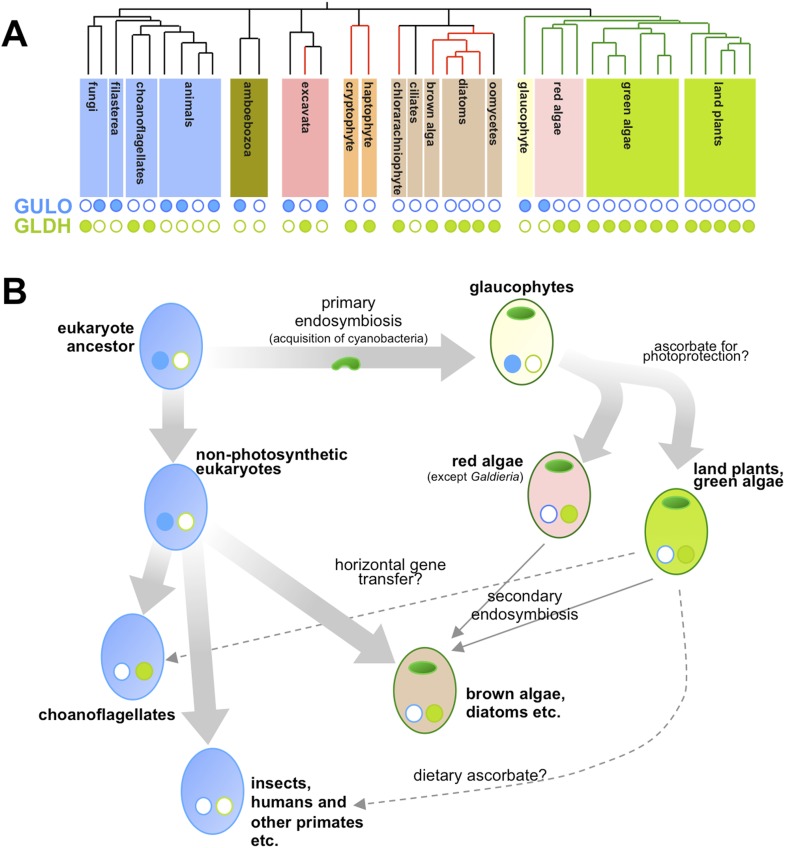
(A) The phylogenetic tree depicts the currently accepted evolutionary relationships between the major lineages of eukaryotes. Black vertical lines indicate non-photosynthetic groups, whilst green lines indicate organisms that became photosynthetic after acquiring an ancestral cyanobacterium (via a so-called ‘primary endosymbiosis event’). Red lines indicate organisms that became photosynthetic after acquiring a red alga or green alga (via so-called ‘secondary endosymbiosis events’). Groups with a copy of the gene for an enzyme called GULO in their genome are marked with a closed blue circle, whilst those with a copy of the gene for an enzyme called GLDH are marked with a closed green circle. Empty circles indicate that the gene is absent from the genome. (B) The schematic model suggests how the primary routes of ascorbate biosynthesis arose in the various eukaryotic lineages and offers potential explanations based on Wheeler et al.'s findings. The presence and absence of GULO and GLDH are indicated as above, and chloroplasts (which are originally derived from the cyanobacterial ancestor) are indicated via green ovals. The wide arrows indicate the evolutionary relationships between groups. The thin arrows indicate the acquisition of a red or green alga by a non-photosynthetic eukaryote and dashed arrows represent events that may explain the gain or loss of genes involved in ascorbate biosynthesis.
Comment on
-
Evolution of alternative biosynthetic pathways for vitamin C following plastid acquisition in photosynthetic eukaryotes.Elife. 2015 Mar 13;4:e06369. doi: 10.7554/eLife.06369. Elife. 2015. PMID: 25768426 Free PMC article.
References
-
- Nishikimi M, Kawai T, Yagi K. Guinea pigs possess a highly mutated gene for L-gulono-gamma-lactone oxidase, the key enzyme for L-ascorbic acid biosynthesis missing in this species. Journal of Biological Chemistry. 1992;267:21967–21972. - PubMed
Publication types
MeSH terms
Substances
LinkOut - more resources
Full Text Sources
Medical
