Randomized, Placebo-Controlled Trial of Green Tea Catechins for Prostate Cancer Prevention
- PMID: 25873370
- PMCID: PMC4596745
- DOI: 10.1158/1940-6207.CAPR-14-0324
Randomized, Placebo-Controlled Trial of Green Tea Catechins for Prostate Cancer Prevention
Abstract
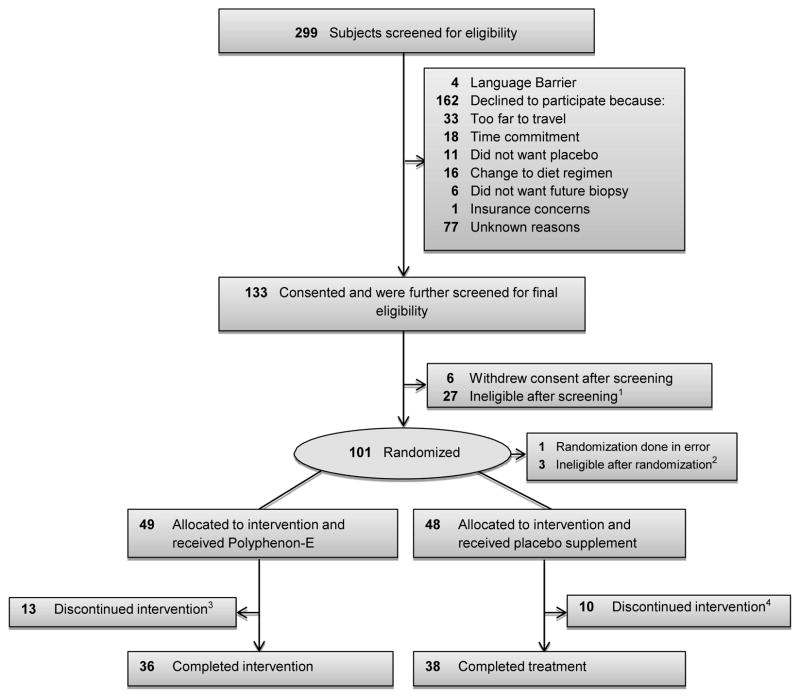
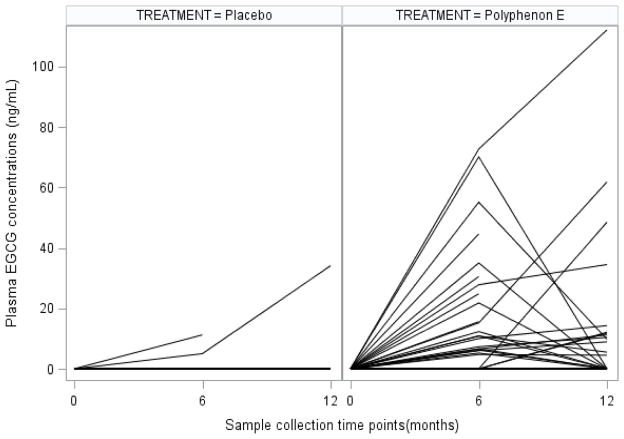
Preclinical, epidemiologic, and prior clinical trial data suggest that green tea catechins (GTC) may reduce prostate cancer risk. We conducted a placebo-controlled, randomized clinical trial of Polyphenon E (PolyE), a proprietary mixture of GTCs, containing 400 mg (-)-epigallocatechin-3-gallate (EGCG) per day, in 97 men with high-grade prostatic intraepithelial neoplasia (HGPIN) and/or atypical small acinar proliferation (ASAP). The primary study endpoint was a comparison of the cumulative one-year prostate cancer rates on the two study arms. No differences in the number of prostate cancer cases were observed: 5 of 49 (PolyE) versus 9 of 48 (placebo), P = 0.25. A secondary endpoint comparing the cumulative rate of prostate cancer plus ASAP among men with HGPIN without ASAP at baseline, revealed a decrease in this composite endpoint: 3 of 26 (PolyE) versus 10 of 25 (placebo), P < 0.024. This finding was driven by a decrease in ASAP diagnoses on the Poly E (0/26) compared with the placebo arm (5/25). A decrease in serum prostate-specific antigen (PSA) was observed on the PolyE arm [-0.87 ng/mL; 95% confidence intervals (CI), -1.66 to -0.09]. Adverse events related to the study agent did not significantly differ between the two study groups. Daily intake of a standardized, decaffeinated catechin mixture containing 400 mg EGCG per day for 1 year accumulated in plasma and was well tolerated but did not reduce the likelihood of prostate cancer in men with baseline HGPIN or ASAP.
Trial registration: ClinicalTrials.gov NCT00596011.
©2015 American Association for Cancer Research.
Figures
References
-
- American Cancer Society. http://www.cancer.org/Cancer/ProstateCancer/DetailedGuide/prostate-cance....
-
- Lippman SM, Hong WK. Cancer prevention science and practice. Cancer research. 2002;62:5119–25. - PubMed
-
- Sporn MB, Suh N. Chemoprevention of cancer. Carcinogenesis. 2000;21:525–30. - PubMed
-
- Montironi R, Mazzucchelli R, Lopez-Beltran A, Cheng L, Scarpelli M. Mechanisms of disease: high-grade prostatic intraepithelial neoplasia and other proposed preneoplastic lesions in the prostate. Nature clinical practice. Urology. 2007;4:321–32. - PubMed
-
- Han KS, Jeong IG, Joung JY, Yang SO, Chung J, Seo HK, et al. Prevalence of high-grade prostatic intraepithelial neoplasia in prostate gland of Korean men: comparisons between radical prostatectomy and cystoprostatectomy. Urology. 2007;70:1100–3. - PubMed
Publication types
MeSH terms
Substances
Associated data
Grants and funding
LinkOut - more resources
Full Text Sources
Medical
Research Materials
Miscellaneous