Review
. 2015 Mar 31:6:66.
doi: 10.3389/fphar.2015.00066. eCollection 2015.

Large-scale production and protein engineering of G protein-coupled receptors for structural studies

Affiliations
Review

Large-scale production and protein engineering of G protein-coupled receptors for structural studies

Dalibor Milić et al. Front Pharmacol. .

Abstract

Structural studies of G protein-coupled receptors (GPCRs) gave insights into molecular mechanisms of their action and contributed significantly to molecular pharmacology. This is primarily due to technical advances in protein engineering, production and crystallization of these important receptor targets. On the other hand, NMR spectroscopy of GPCRs, which can provide information about their dynamics, still remains challenging due to difficulties in preparation of isotopically labeled receptors and their low long-term stabilities. In this review, we discuss methods used for expression and purification of GPCRs for crystallographic and NMR studies. We also summarize protein engineering methods that played a crucial role in obtaining GPCR crystal structures.

Keywords: G protein-coupled receptor (GPCR); expression; isotope labeling; protein engineering; purification.


Figures

FIGURE 1
FIGURE 1
Crystal structure of the β2-adrenoceptor–Gs protein complex (PDB ID: 3SN6) illustrates some of the protein engineering strategies available for structural studies of GPCRs. The receptor (gray) was N-terminally fused with T4L (blue) and complexed with an agonist (orange spheres). The complex with Gs protein (α-subunit shown in cyan, β-subunit in green and γ-subunit in orange) is additionally stabilized by nanobody (magenta). Three point mutations (residues shown as red spheres) had to be introduced in order to delete a glycosylation site (mutation N187E) and to increase expression level of the T4L–β2-adrenoceptor chimera (mutations M96T, M98T). Finally, the receptor molecule was truncated to remove a flexible C-terminal tail interfering with crystallization.
FIGURE 2
FIGURE 2
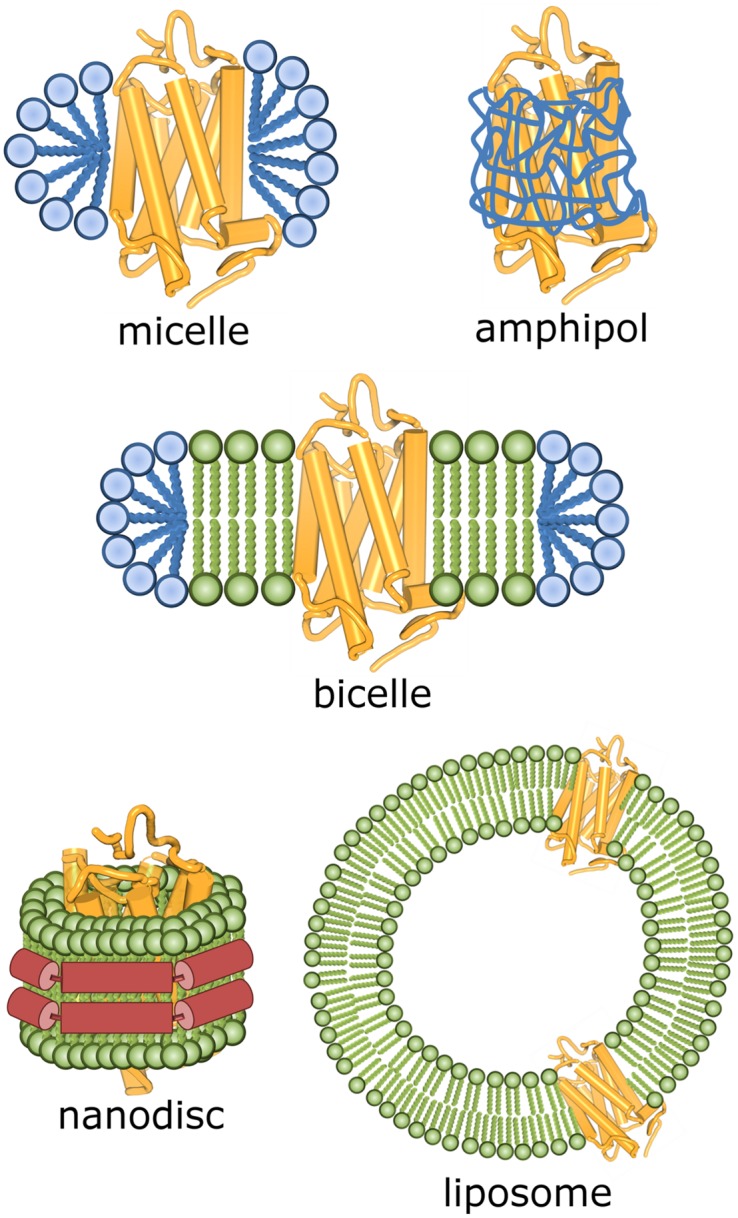
Schematic representation of some possible environments for GPCR molecules after their extraction from biological membranes.
FIGURE 3
FIGURE 3
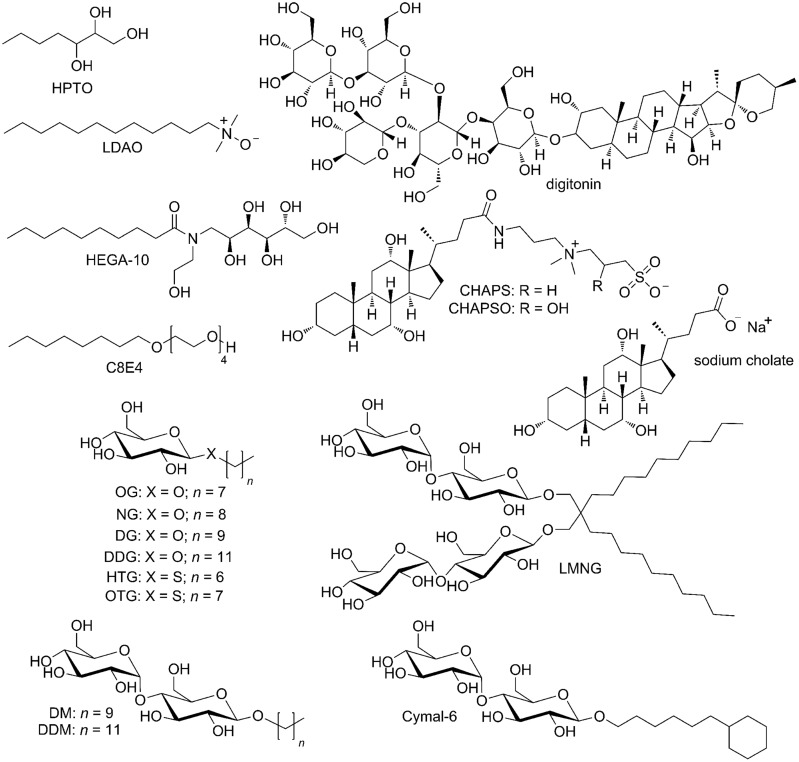
Detergents used in solubilization and purification of rhodopsin and other GPCRs for crystallographic studies.
FIGURE 4
FIGURE 4
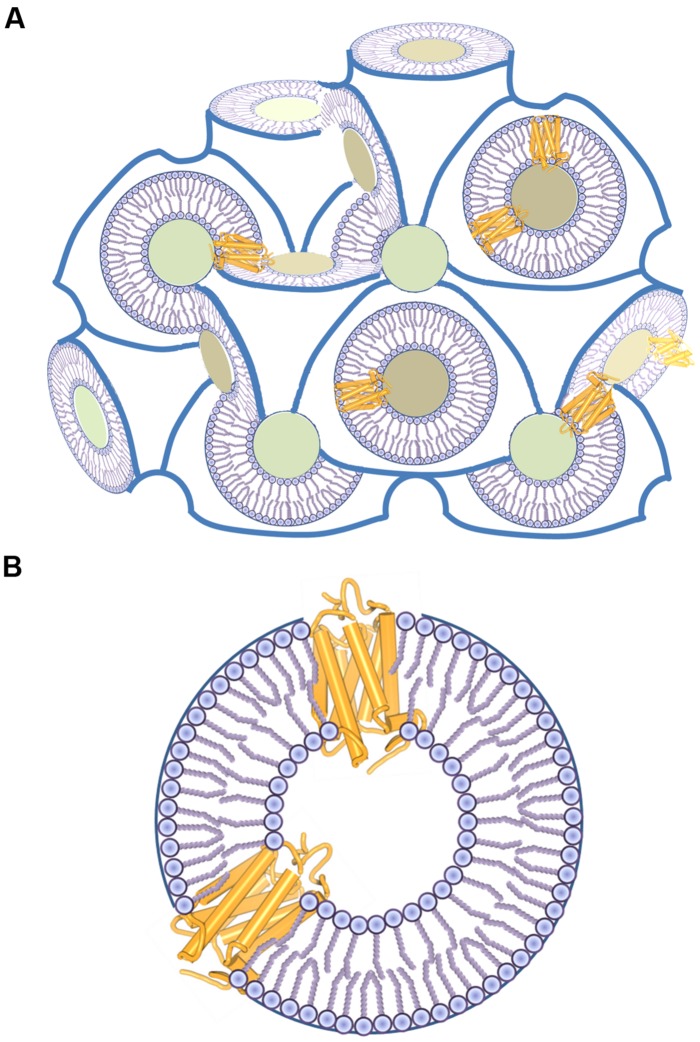
Structure of a LCP. (A) LCP consists of water channels (shown as colored cross-sections) and a continuous 3D lipid bilayer that allows free diffusion of the reconstituted membrane protein molecules. (B) A detailed view of GPCR molecules in a LCP bilayer.
FIGURE 5
FIGURE 5
Variety of fusion partners used for crystallization of GPCRs. A flexible T4L molecule consists of an N-terminal (cyan) and a C-terminal lobe (blue) connected via a helix C (pink); helix A (green) precedes the N-terminal lobe (A–D). Disulfide bonds (yellow spheres) decrease molecular flexibility in dsT4L (C). On the other hand, molecular size of T4L was reduced by deleting the N-terminal lobe in mT4L (D). The insertion sites of the fusion partners into ICL 3 are exactly the same for all three M3 receptor constructs (B–D). Both T4L and BRIL (red) were used as N-terminal fusion partners (A,E). Structures of the BRIL chimeras show clearly the sodium-ion allosteric site (E,F). In the Rd (orange) chimera, a Zn2+ ion substitutes the naturally occurring Fe2+/3+ (G). PGS (green) was identified as a fusion partner most recently (H). For all structures, C atoms of the orthosteric ligands are represented as orange spheres. PDB IDs: 4GBR (A), 4DAJ (B), 4U14 (C), 4U15 (D), 4N6H (E), 4EIY (F), 4MBS (G) and 4RNB (H).

References

    1. Ai X., Caffrey M. (2000). Membrane protein crystallization in lipidic mesophases: detergent effects. Biophys. J. 79 394–405 10.1016/S0006-3495(00)76301-6 - DOI - PMC - PubMed
    1. Alexander S. P. H., Benson H. E., Faccenda E., Pawson A. J., Sharman J. L., Spedding M., et al. (2013). The concise guide to PHARMACOLOGY 2013/14: G protein-coupled receptors. Br. J. Pharmacol. 170 1459–1581 10.1111/bph.12445 - DOI - PMC - PubMed
    1. Alexandrov A. I., Mileni M., Chien E. Y. T., Hanson M. A., Stevens R. C. (2008). Microscale fluorescent thermal stability assay for membrane proteins. Structure 16 351–359 10.1016/j.str.2008.02.004 - DOI - PubMed
    1. André N., Cherouati N., Prual C., Steffan T., Zeder-Lutz G., Magnin T., et al. (2006). Enhancing functional production of G protein-coupled receptors in Pichia pastoris to levels required for structural studies via a single expression screen. Protein Sci. 15 1115–1126 10.1110/ps.062098206 - DOI - PMC - PubMed
    1. Andréll J., Tate C. G. (2013). Overexpression of membrane proteins in mammalian cells for structural studies. Mol. Membr. Biol. 30 52–63 10.3109/09687688.2012.703703 - DOI - PMC - PubMed

LinkOut - more resources