Review
. 2015 Mar 31:6:242.
doi: 10.3389/fmicb.2015.00242. eCollection 2015.

Genomics of microbial plasmids: classification and identification based on replication and transfer systems and host taxonomy

Affiliations
Review

Genomics of microbial plasmids: classification and identification based on replication and transfer systems and host taxonomy

Masaki Shintani et al. Front Microbiol. .

Abstract

Plasmids are important "vehicles" for the communication of genetic information between bacteria. The exchange of plasmids transmits pathogenically and environmentally relevant traits to the host bacteria, promoting their rapid evolution and adaptation to various environments. Over the past six decades, a large number of plasmids have been identified and isolated from different microbes. With the revolution of sequencing technology, more than 4600 complete sequences of plasmids found in bacteria, archaea, and eukaryotes have been determined. The classification of a wide variety of plasmids is not only important to understand their features, host ranges, and microbial evolution but is also necessary to effectively use them as genetic tools for microbial engineering. This review summarizes the current situation of the classification of fully sequenced plasmids based on their host taxonomy and their features of replication and conjugative transfer. The majority of the fully sequenced plasmids are found in bacteria in the Proteobacteria, Firmicutes, Spirochaetes, Actinobacteria, Cyanobacteria and Euryarcheota phyla, and key features of each phylum are included. Recent advances in the identification of novel types of plasmids and plasmid transfer by culture-independent methods using samples from natural environments are also discussed.

Keywords: Inc group; conjugative transfer; host; plasmid; replication.


Figures
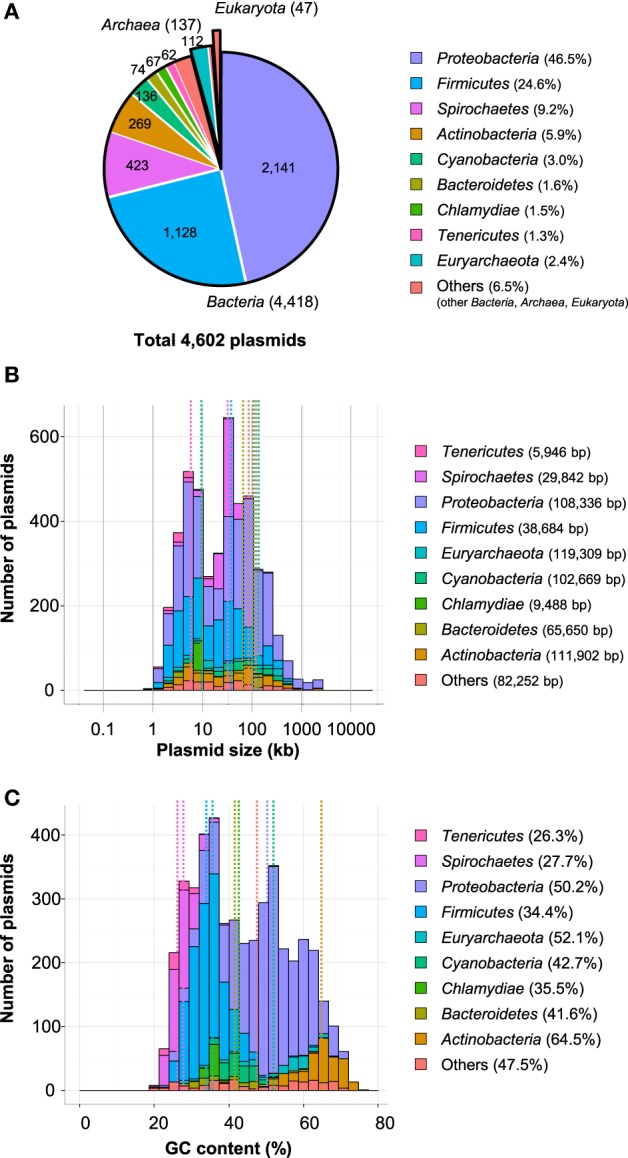
Figure 1
Figure 1
The phylogenetic distribution of fully sequenced plasmids (A), histograms of plasmid size (B), and GC content (%) (C). The ratios of each phylum (A), the average size of plasmids (B), and the average GC contents (C) are shown in parentheses and as dotted lines.
Figure 2
Figure 2
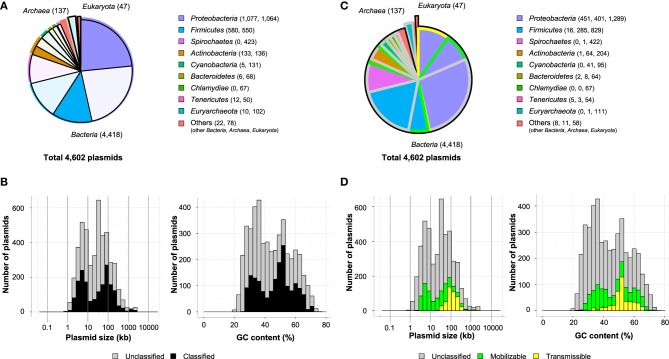
Ratios of classified plasmids in each phylum (A) and histograms of their size (B, left) and GC content (B, right) are shown. The unclassified plasmids are shown as shaded, and the numbers of classified plasmids and unclassified plasmids are shown in parentheses (A). Ratios of putative transmissible plasmids (yellow), putative mobilizable plasmids (green), and others (gray) in each phylum (C) are shown. Histograms of their size (D, left) and GC content (D, right) are shown.
Figure 3
Figure 3
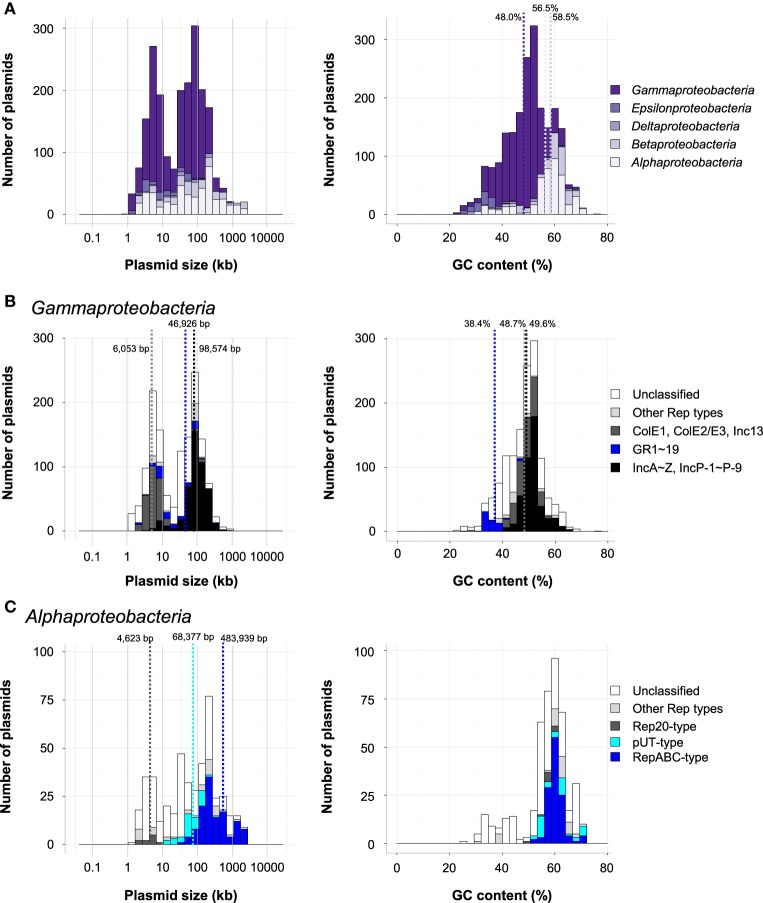
(A) Histograms of plasmid size (left) and GC content (right) of Proteobacteria in each class. (B) Histograms of plasmid size (left) and GC content (right) in Gammaproteobacteria. The distribution of classified plasmids are shown in black (IncA-Z and IncP-1 to IncP-9), blue (GR1 to GR19), dark gray (ColE1, ColE2/E3, and Inc13), light gray (other Rep types), and white (unclassified). (C) Histograms of plasmid size (left) and GC content (right) in Alphaproteobacteria. The distribution of classified plasmids are shown in blue (RepABC-type), light blue (pUT-type), dark gray (Rep20-type), light gray (other Rep types), and white (unclassified). The average sizes of Rep20-type, pUT-type, and RepABC-type plasmids are represented by dotted lines.
Figure 4
Figure 4
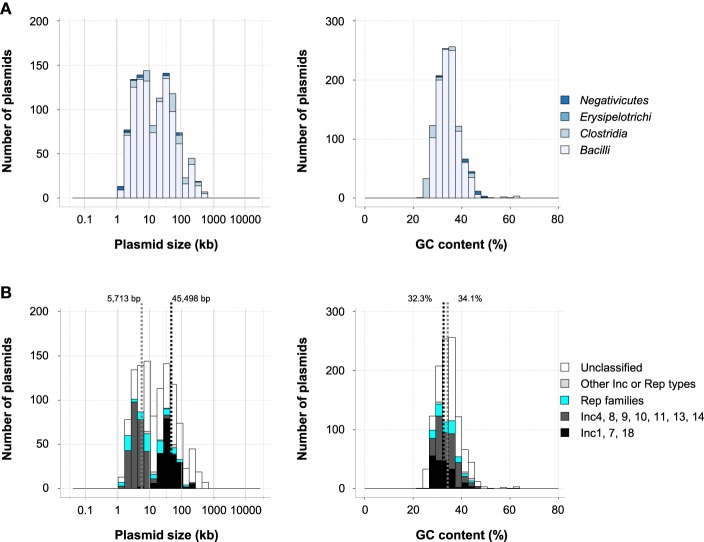
(A) Histograms of plasmid size (left) and GC content (right) of Firmicutes in each class. (B) Histograms of plasmid size (left) and GC content (right) in Bacilli. The distribution of classified plasmids is shown in black (Inc1, Inc7, and Inc18), dark gray (Inc4, Inc8, Inc9, Inc10, Inc11, Inc13, and Inc14), light blue (Rep families number 1–24 containing 7b, 10b), light gray (other Inc or Rep types) and white (unclassified). The average sizes and GC contents of groups Inc4, 8, 9, 10, 11, 13, 14 and those of Inc1, 7, 18 are represented by dotted lines.
Figure 5
Figure 5
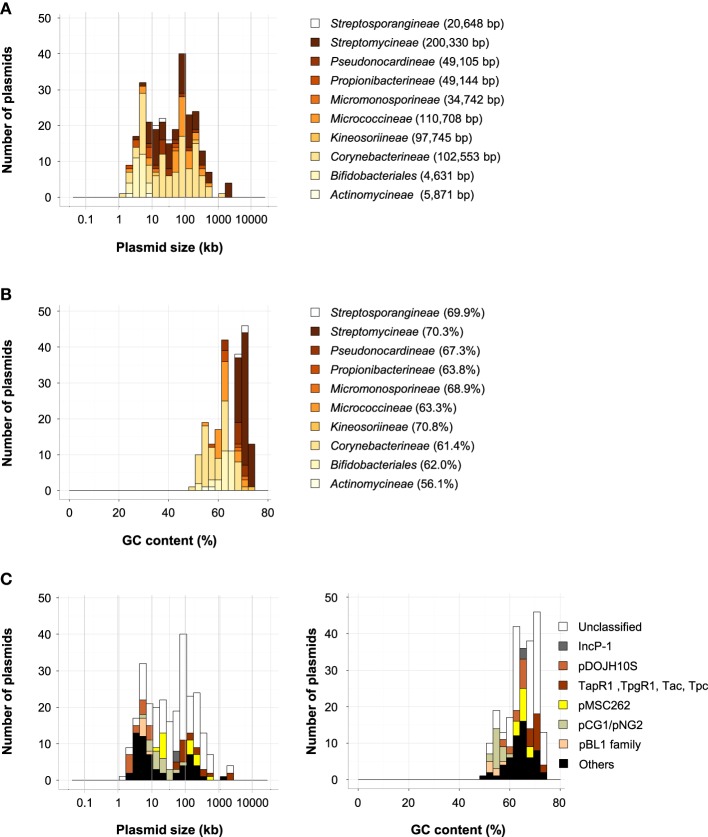
Histograms of plasmid size (A) and GC content (B) of Actinobacteria in each suborder and order (Bifidobacteriales). The average size of plasmids (A) and the average GC content (B) are shown in parentheses. (C) Histograms of plasmid size (left) and GC content (right) in phylum Actinobacteria. The distribution of classified plasmids is shown in beige (pBL1 family), spring green (pCG1/pNG2 family), yellow (pMSC262 family), brown (plasmids with TapR1, TpgR1 Tac, and/or Tpc), light brown (pDOJH10S-type), and gray (IncP-1 plasmids), black (other Rep types), and white (unclassified plasmids).

References

    1. Adamczyk M., Jagura-Burdzy G. (2003). Spread and survival of promiscuous IncP-1 plasmids. Acta Biochim. Pol. 50, 425–453. - PubMed
    1. Ainsworth S., Stockdale S., Bottacini F., Mahony J., van Sinderen D. (2014). The Lactococcus lactis plasmidome: much learnt, yet still lots to discover. FEMS Microbiol. Rev. 38, 1066–1088. 10.1111/1574-6976.12074 - DOI - PubMed
    1. Alvarado A., Garcillan-Barcia M. P., de la Cruz F. (2012). A degenerate primer MOB typing (DPMT) method to classify gamma-proteobacterial plasmids in clinical and environmental settings. PLoS ONE 7:e40438. 10.1371/journal.pone.0040438 - DOI - PMC - PubMed
    1. Amann R., Fuchs B. M. (2008). Single-cell identification in microbial communities by improved fluorescence in situ hybridization techniques. Nat. Rev. Microbiol. 6, 339–348. 10.1038/nrmicro1888 - DOI - PubMed
    1. Aminov R. I. (2011). Horizontal gene exchange in environmental microbiota. Front. Microbiol. 2:158. 10.3389/fmicb.2011.00158 - DOI - PMC - PubMed

LinkOut - more resources