. 2015:2015:916240.
doi: 10.1155/2015/916240. Epub 2015 Mar 22.

Clustering molecular dynamics trajectories for optimizing docking experiments

Affiliations

Clustering molecular dynamics trajectories for optimizing docking experiments

Renata De Paris et al. Comput Intell Neurosci. 2015.

Abstract

Molecular dynamics simulations of protein receptors have become an attractive tool for rational drug discovery. However, the high computational cost of employing molecular dynamics trajectories in virtual screening of large repositories threats the feasibility of this task. Computational intelligence techniques have been applied in this context, with the ultimate goal of reducing the overall computational cost so the task can become feasible. Particularly, clustering algorithms have been widely used as a means to reduce the dimensionality of molecular dynamics trajectories. In this paper, we develop a novel methodology for clustering entire trajectories using structural features from the substrate-binding cavity of the receptor in order to optimize docking experiments on a cloud-based environment. The resulting partition was selected based on three clustering validity criteria, and it was further validated by analyzing the interactions between 20 ligands and a fully flexible receptor (FFR) model containing a 20 ns molecular dynamics simulation trajectory. Our proposed methodology shows that taking into account features of the substrate-binding cavity as input for the k-means algorithm is a promising technique for accurately selecting ensembles of representative structures tailored to a specific ligand.


Figures
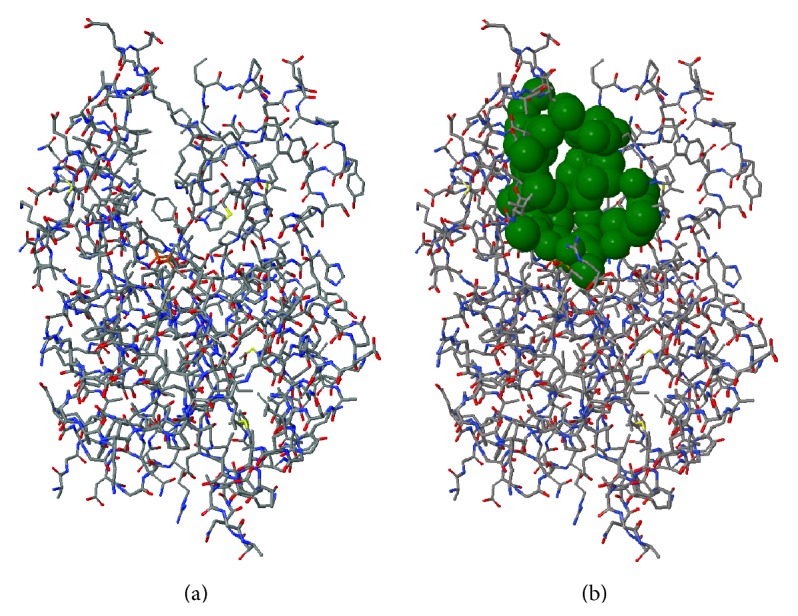
Figure 1
Figure 1
Substrate-binding cavity of the InhA enzyme from Mycobacterium tuberculosis (PDB ID: 1BVR) identified by the CASTp software. The stick representation is colored by atom type (carbon and hydrogen: light grey; nitrogen: blue; oxygen: red; sulphur: yellow). (a) Chain A of the 1BVR crystal structure submitted to CASTp. (b) In green the substrate-binding cavity of the 1BVR enzyme represented by van der Waals spheres.
Figure 2
Figure 2
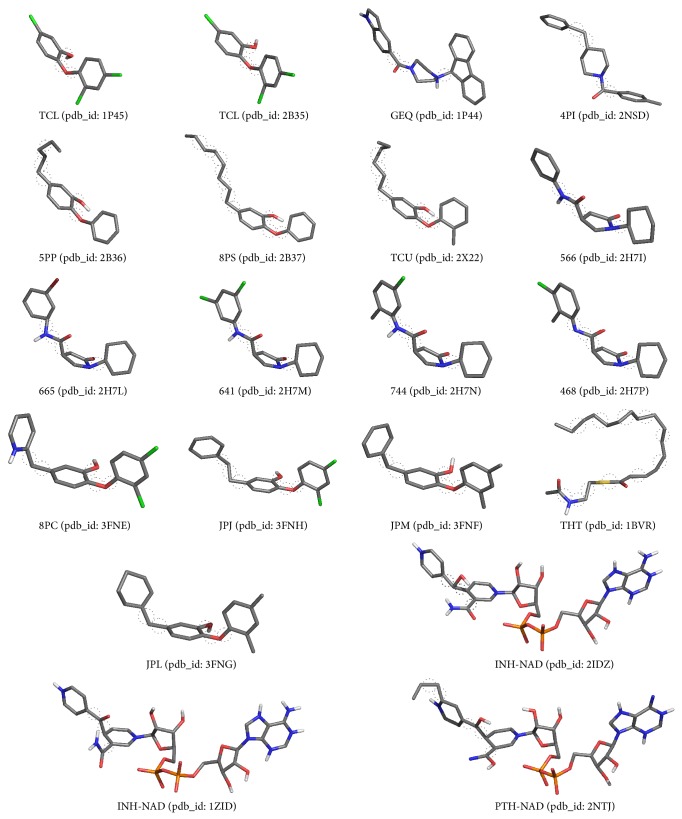
Stick representation of the 3D structures of the 20 ligands used in docking experiments. Each ligand, with its structures colored by atom type, is identified by their name and their corresponding PDB identification (PDB ID). The dashed circle represents the rotatable bonds selected by AutoDockTools 1.5.6.
Figure 3
Figure 3
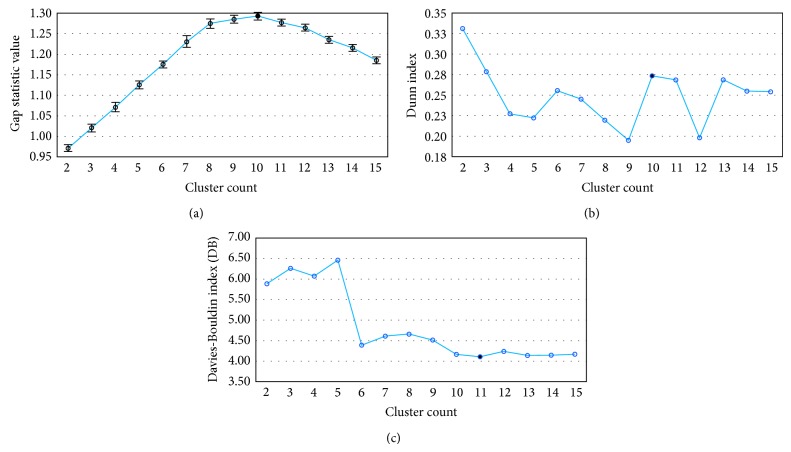
Clustering validity criteria for the MD trajectory of the InhA enzyme as a function of the number of clusters. (a) Gap statistic. (b) Dunn's index. (c) DB index. Black circles identify the best number of clusters for each criterion. The best gap result was used as the decisive criterion for selecting between k = 10 and k = 11, as suggested by Dunn's index and DB, respectively.
Figure 4
Figure 4
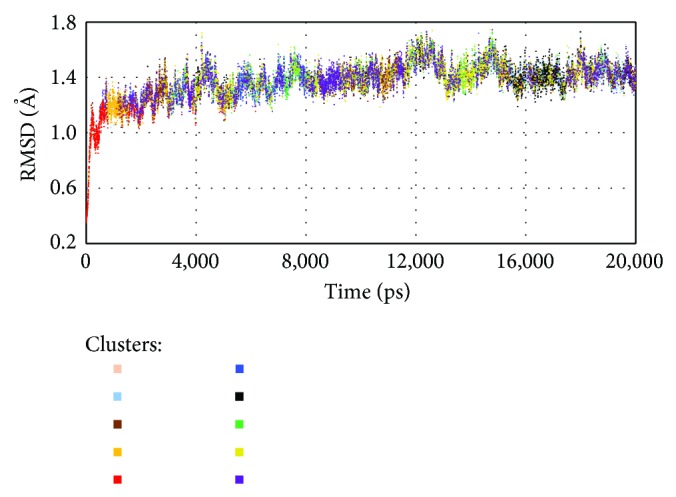
Cluster distribution along the InhA enzyme MD trajectory from the optimal k-means partition. Each object represents different backbone (N, Cα, C, and O) RMSD values as a function of time over the trajectory which are colored based on their cluster memberships.
Figure 5
Figure 5
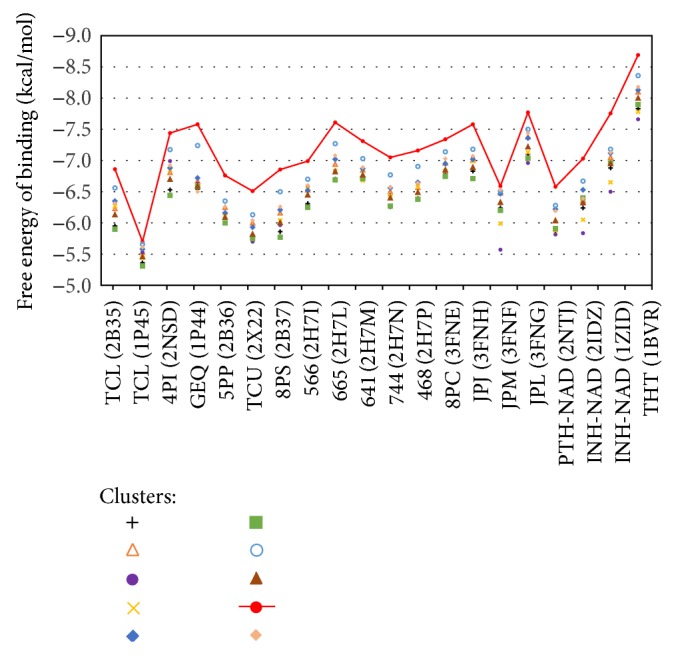
Evaluation of median FEB values of clusters as a function of compounds. The red circle represents the cluster with best median FEB values for each experiment. The red line highlights the clusters with the best median FEB values at the top.

References

    1. Cozzini P., Kellogg G. E., Spyrakis F., et al. Target flexibility: an emerging consideration in drug discovery and design. Journal of Medicinal Chemistry. 2008;51(20):6237–6255. doi: 10.1021/jm800562d. - DOI - PMC - PubMed
    1. Totrov M., Abagyan R. Flexible ligand docking to multiple receptor conformations: a practical alternative. Current Opinion in Structural Biology. 2008;18(2):178–184. doi: 10.1016/j.sbi.2008.01.004. - DOI - PMC - PubMed
    1. Alonso H., Bliznyuk A. A., Gready J. E. Combining docking and molecular dynamic simulations in drug design. Medicinal Research Reviews. 2006;26(5):531–568. doi: 10.1002/med.20067. - DOI - PubMed
    1. Nichols S. E., Swift R. V., Amaro R. E. Rational prediction with molecular dynamics for hit identification. Current Topics in Medicinal Chemistry. 2012;12(18):2002–2012. doi: 10.2174/156802612804910313. - DOI - PMC - PubMed
    1. Machado K. S., Winck A. T., Ruiz D. D., de Souza O. N. Mining flexible-receptor molecular docking data. Wiley Interdisciplinary Reviews: Data Mining and Knowledge Discovery. 2011;1(6):532–541. doi: 10.1002/widm.46. - DOI

Publication types

LinkOut - more resources