. 2015:2015:319240.
doi: 10.1155/2015/319240. Epub 2015 Mar 22.

Antifungal and antibacterial metabolites from a French poplar type propolis

Affiliations

Antifungal and antibacterial metabolites from a French poplar type propolis

Séverine Boisard et al. Evid Based Complement Alternat Med. 2015.

Abstract

During this study, the in vitro antifungal and antibacterial activities of different extracts (aqueous and organic) obtained from a French propolis batch were evaluated. Antifungal activity was evaluated by broth microdilution on three pathogenic strains: Candida albicans, C. glabrata, and Aspergillus fumigatus. Antibacterial activity was assayed using agar dilution method on 36 Gram-negative and Gram-positive strains including Staphylococcus aureus. Organic extracts showed a significant antifungal activity against C. albicans and C. glabrata (MIC80 between 16 and 31 µg/mL) but only a weak activity towards A. fumigatus (MIC80 = 250 µg/mL). DCM based extracts exhibited a selective Gram-positive antibacterial activity, especially against S. aureus (SA) and several of its methicillin-resistant (MRSA) and methicillin-susceptible (MSSA) strains (MIC100 30-97 µg/mL). A new and active derivative of catechin was also identified whereas a synergistic antimicrobial effect was noticed during this study.


Figures

Figure 1
Figure 1
HPLC chromatograms of E5: 1 3,4-dihydroxybenzaldehyde, 2 4-hydroxybenzoic acid, 3 caffeic acid, 4 vanillin, 5 4-hydroxyacetophenone, 6 p-coumaric acid, 7 ferulic acid, 8 isoferulic acid, 9 benzoic acid, 10 3,4-dimethoxycinnamic acid, 11 3-phenylpropanoic acid, 12 pinobanksin-5-methyl ether, 13 cinnamic acid, 14 4-methoxycinnamic acid, 15 pinobanksin, 16 naringenin, 17 quercetin, 18 quercetin-3-methyl ether, 19 pinocembrin-5-methyl ether, 20 1,3-di-p-coumaroylglycerol, 21 1-p-coumaroyl-3-feruloylglycerol, 22 kaempferol, 23 apigenin, 24 cinnamylidene acetic acid, 25 pinocembrin, 26 benzyl caffeate, 27 isopent-3-enyl caffeate, 28 pinobanksin-3-acetate, 29 prenyl caffeate, 30 2-acetyl-1,3-dicoumaroylglycerol, 31 phenylethyl caffeate (CAPE), 32 chrysin, 33 benzyl p-coumarate, 34 galangin, 35 benzyl ferulate, 36 prenyl ferulate, 37 kaempferide, 38 rhamnocitrin, 39 cinnamyl caffeate, 40 8-[(E)-phenylprop-2-en-1-one]-5-methoxy-(±)-catechin (new), 41 cinnamyl isoferulate, 42 cinnamyl p-coumarate, 43 pinostrobin, 44 alpinone-3-acetate, 45 tectochrysin, 46 benzyl cinnamate, 47 cinnamyl benzoate, 48 cinnamyl cinnamate, and 49 cinnamyl cinnamylidene acetate.
Figure 2
Figure 2
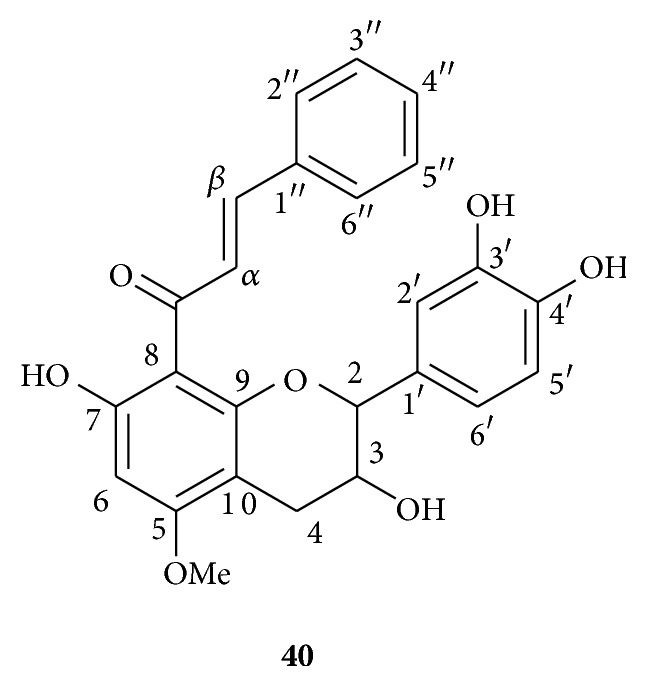
Chemical structure of the new compound 40.
Figure 3
Figure 3
2D NMR studies of compound 40: COSY (bold lines), selected HMBC (solid arrows: 1H → 13C), and NOESY (dashed arrows) correlations.
Figure 4
Figure 4
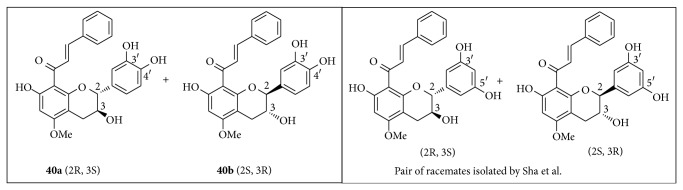
Structures of 8-[(E)-phenylprop-2-en-1-one]-(2R,3S)-5-methoxycatechin (40a) and 8-[(E)-phenylprop-2-en-1-one]-(2S,3R)-5-methoxycatechin (40b) and a similar pair of racemates isolated by Sha et al. 2009 [26].

References

    1. Cottica S. M., Sawaya A. C. H. F., Eberlin M. N., Franco S. L., Zeoula L. M., Visentainer J. V. Antioxidant activity and composition of propolis obtained by different methods of extraction. Journal of the Brazilian Chemical Society. 2011;22(5):929–935. doi: 10.1590/S0103-50532011000500016. - DOI
    1. Miguel M. G., Nunes S., Dandlen S. A., Cavaco A. M., Antunes M. D. Phenols and antioxidant activity of hydro-alcoholic extracts of propolis from Algarve, South of Portugal. Food and Chemical Toxicology. 2010;48(12):3418–3423. doi: 10.1016/j.fct.2010.09.014. - DOI - PubMed
    1. Gülçin I., Bursal E., Şehitoĝlu M. H., Bilsel M., Gören A. C. Polyphenol contents and antioxidant activity of lyophilized aqueous extract of propolis from Erzurum, Turkey. Food and Chemical Toxicology. 2010;48(8-9):2227–2238. doi: 10.1016/j.fct.2010.05.053. - DOI - PubMed
    1. Ota C., Unterkircher C., Fantinato V., Shimizu M. T. Antifungal activity of propolis on different species of Candida . Mycoses. 2001;44(9-10):375–378. doi: 10.1046/j.1439-0507.2001.00671.x. - DOI - PubMed
    1. Sawaya A. C. H. F., Palma A. M., Caetano F. M., et al. Comparative study of in vitro methods used to analyse the activity of propolis extracts with different compositions against species of Candida. Letters in Applied Microbiology. 2002;35(3):203–207. doi: 10.1046/j.1472-765X.2002.01169.x. - DOI - PubMed

LinkOut - more resources