


Elevated troponin T after acute ischemic stroke: Association with severity and location of infarction
- PMID: 25874055
- PMCID: PMC4395805
Elevated troponin T after acute ischemic stroke: Association with severity and location of infarction
Abstract
Background: Serum troponin elevation, characteristic of ischemic myocardial injury, has been observed in some acute ischemic stroke (AIS) patients. Its cause and significance are still controversial. The purpose of this study is to find determinants of troponin elevation and its relationship with stroke severity and location.
Methods: Between January 2013 and August 2013, 114 consecutive AIS patients confirmed by diffusion-weighted magnetic resonance imaging were recruited in this study. Serum troponin T level was measured as part of routine laboratory testing on admission. Ten lead standard electrocardiogram (ECG) was performed and stoke severity was assessed based on National Institutes of Health Stroke Scale (NIHSS).
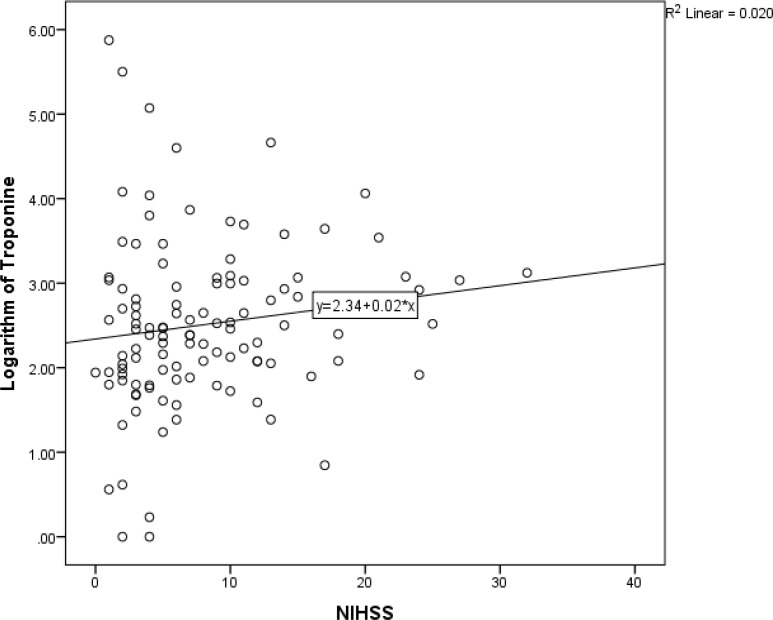
Results: Troponin T was elevated in 20 (17.6%) of 114 patients. Patients with elevated troponin were more likely to have higher age, higher serum creatinine and ischemic ECG changes. Troponin levels were higher in patients with more severe stroke measured by NIHSS [7.96 (6.49-9.78) vs. 13.59 (10.28-18.00)]. There was no association between troponin and locations of stroke and atrial fibrillation. There were 6 (5%) patients with elevated troponin in the presence of normal creatinine and ECG.
Conclusion: Stroke severity, not its location, was associated with higher troponin levels. Abnormal troponin levels are more likely, but not exclusively, to be due to cardiac and renal causes than cerebral ones.
Keywords: Creatinine; Electrocardiography; Location; National Institutes of Health Stroke Scale; Stroke; Troponin.
Figures
References
-
- Reichlin T, Hochholzer W, Bassetti S, Steuer S, Stelzig C, Hartwiger S, et al. Early diagnosis of myocardial infarction with sensitive cardiac troponin assays. N Engl J Med. 2009;361(9):858–67. - PubMed
-
- Jeremias A, Gibson CM. Narrative review: alternative causes for elevated cardiac troponin levels when acute coronary syndromes are excluded. Ann Intern Med. 2005;142(9):786–91. - PubMed
-
- Kelley WE, Januzzi JL, Christenson RH. Increases of cardiac troponin in conditions other than acute coronary syndrome and heart failure. Clin Chem. 2009;55(12):2098–112. - PubMed
-
- Jensen JK, Kristensen SR, Bak S, Atar D, Hoilund-Carlsen PF, Mickley H. Frequency and significance of troponin T elevation in acute ischemic stroke. Am J Cardiol. 2007;99(1):108–12. - PubMed
-
- Ghali J, Allison D, Kleinig T, Ooi SY, Bastiampillai S, Ashby D, et al. Elevated serum concentrations of troponin T in acute stroke: what do they mean? J Clin Neurosci . 2010;17(1):69–73. - PubMed
LinkOut - more resources
Full Text Sources
Other Literature Sources