


Physical education: the effect of epoch lengths on children's physical activity in a structured context
- PMID: 25874641
- PMCID: PMC4395389
- DOI: 10.1371/journal.pone.0121238
Physical education: the effect of epoch lengths on children's physical activity in a structured context
Abstract
Background: Despite a consensus emerging that affirms that shorter epochs should be used in youth to correctly register physical activity levels in free-living conditions, little is known about its effect on children's physical activity conducted in structured periods of time. This study analyzed the effect that epoch length (1, 2, 3, 5, 10, 15, 30 and 60s) may have on different physical activity intensities in physical education lessons.
Methods: A sample of 1912 individual measures of physical education lessons were measured with a GT3X accelerometer. Data were collected from 1227 Swiss Elementary school students recruited in 17 elementary schools. PE lessons lasted from 45 minutes to one and a half hours. Data, originally collected in 1-s epoch, were then reintegrated into 2s, - 3s - 5s - 10s - 15s - 30s -60s epochs.
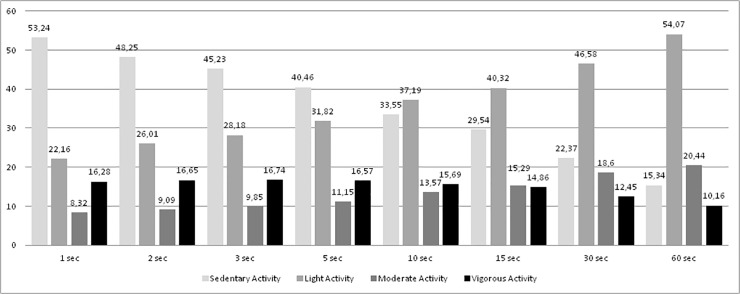
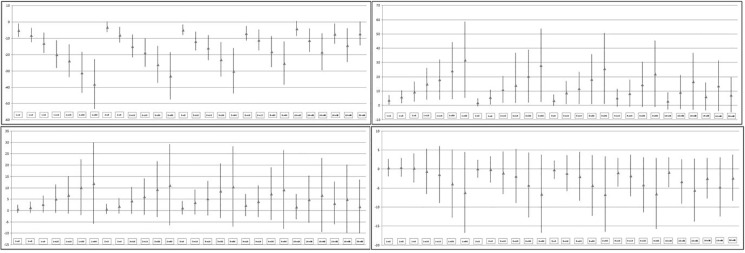
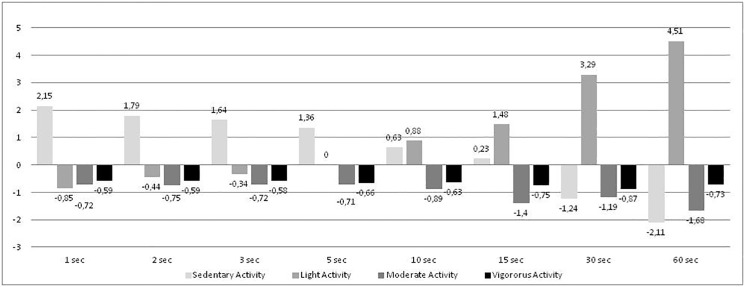
Results: Longer epochs were associated with higher levels of light (F = 8197.6, p < .001), moderate (F = 2708.17, p < .001), and moderate-to-vigorous physical activity (F = 888.08, p < .001). However, longer epochs showed lower levels of sedentary activity (F = 31714.33, p < .001) and vigorous physical activity (F = 1910.97, p < .001). Bias increased in all PA intensities when shorter epochs were compared with longer epochs. There were statistically significant differences in compliance with physical education guidelines (χ(2) = 989.27, p<.001), showing higher levels with longer epochs.
Conclusion: PA context may have some influence on the effects that epoch length have on PA estimates, more specifically on MVPA. Nevertheless, the use of a high-frequency sampling interval should be used to more accurately assess children's PA.
Conflict of interest statement
Figures
References
-
- Bailey RC, Olson J, Pepper SL, Porszasz J, Barstow TJ, Cooper DM. The level and tempo of children's physical activities: An observational study. Med Sci Sports Exerc. 1995; 27: 1033–1041. - PubMed
-
- Baquet G, Stratton G, Van Praagh E, Berthoin S. Improving physical activity assessment in prepubertal children with high-frequency accelerometry monitoring: A methodological issue. Prev Med. 2007; 44: 143–147. - PubMed
-
- Berman N, Bailey R, Barstow TJ, Cooper DM. Spectral and bout detection analysis of physical activity patterns in healthy, prepubertal boys and girls. Am J Hum Biol. 1998; 10: 289–97. - PubMed
Publication types
MeSH terms
LinkOut - more resources
Full Text Sources
Other Literature Sources
