Comparative Study
. 2015 Apr 14;13(4):2287-305.
doi: 10.3390/md13042287.

Piscidin is highly active against carbapenem-resistant Acinetobacter baumannii and NDM-1-producing Klebsiella pneumonia in a systemic Septicaemia infection mouse model

Affiliations
Comparative Study

Piscidin is highly active against carbapenem-resistant Acinetobacter baumannii and NDM-1-producing Klebsiella pneumonia in a systemic Septicaemia infection mouse model

Chieh-Yu Pan et al. Mar Drugs. .

Abstract

This study was designed to investigate the antimicrobial activity of two synthetic antimicrobial peptides from an aquatic organism, tilapia piscidin 3 (TP3) and tilapia piscidin 4 (TP4), in vitro and in a murine sepsis model, as compared with ampicillin, tigecycline, and imipenem. Mice were infected with (NDM-1)-producing K. pneumonia and multi-drug resistant Acinetobacter baumannii, and subsequently treated with TP3, TP4, or antibiotics for different periods of time (up to 168 h). Mouse survival and bacterial colony forming units (CFU) in various organs were measured after each treatment. Toxicity was determined based on observation of behavior and measurement of biochemical parameters. TP3 and TP4 exhibited strong activity against K. pneumonia and A. baumannii in vitro. Administration of TP3 (150 μg/mouse) or TP4 (50 μg/mouse) 30 min after infection with K. pneumonia or A. baumannii significantly increased survival in mice. TP4 was more effective than tigecycline at reducing CFU counts in several organs. TP3 and TP4 were shown to be non-toxic, and did not affect mouse behavior. TP3 and TP4 are able at potentiate anti-Acinetobacter baumannii or anti-Klebsiella pneumonia drug activity, reduce bacterial load, and prevent drug resistance, indicating their potential for use in combating multidrug-resistant bacteria.


Figures
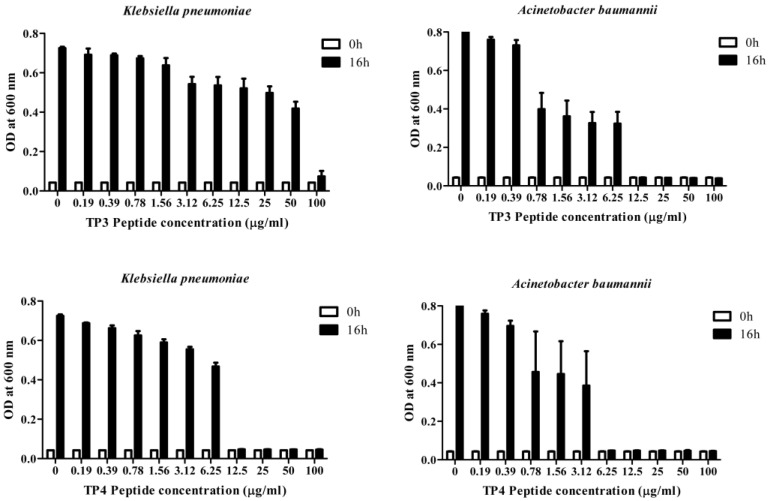
Figure 1
Figure 1
Dose-dependent growth inhibition of clinical isolates of carbapenem-resistant Acinetobacter baumannii (Sk44) and NDM-1-producing Klebsiella pneumonia (NDM-1) by incubation with TP3 or TP4 for 16 h. The data are expressed as means of three replicates. Error bars represent the standard derivation (SD). OD, optical density.
Figure 2
Figure 2
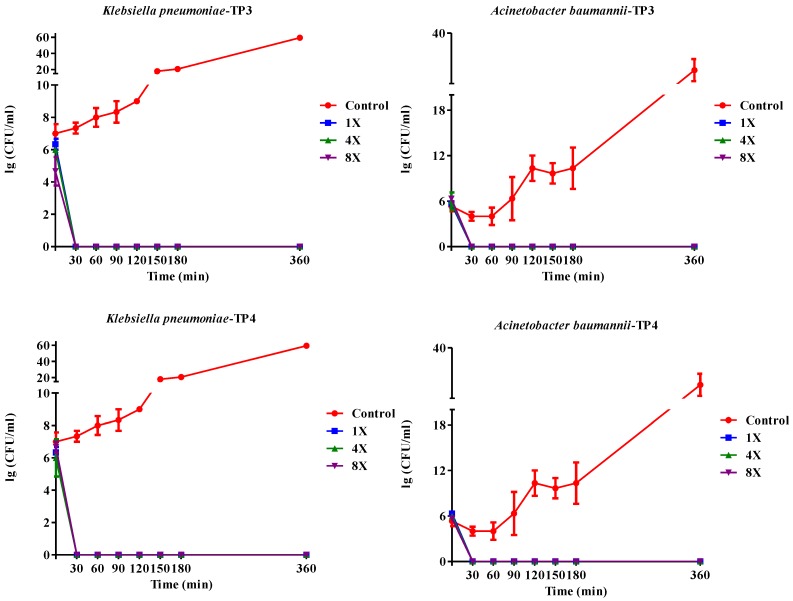
Kill kinetics of TP3 and TP4 against Acinetobacter baumannii (Sk44) and Klebsiella pneumonia (NDM-1). Controls were not treated with peptide. The peptide concentrations were 1 × MIC (1×), 4 × MIC (4×), or 8 × MIC (8×). Experiments were performed in triplicate and the bactericidal activities are presented as mean lg (CFU/mL). Error bars represent the standard deviations.
Figure 3
Figure 3
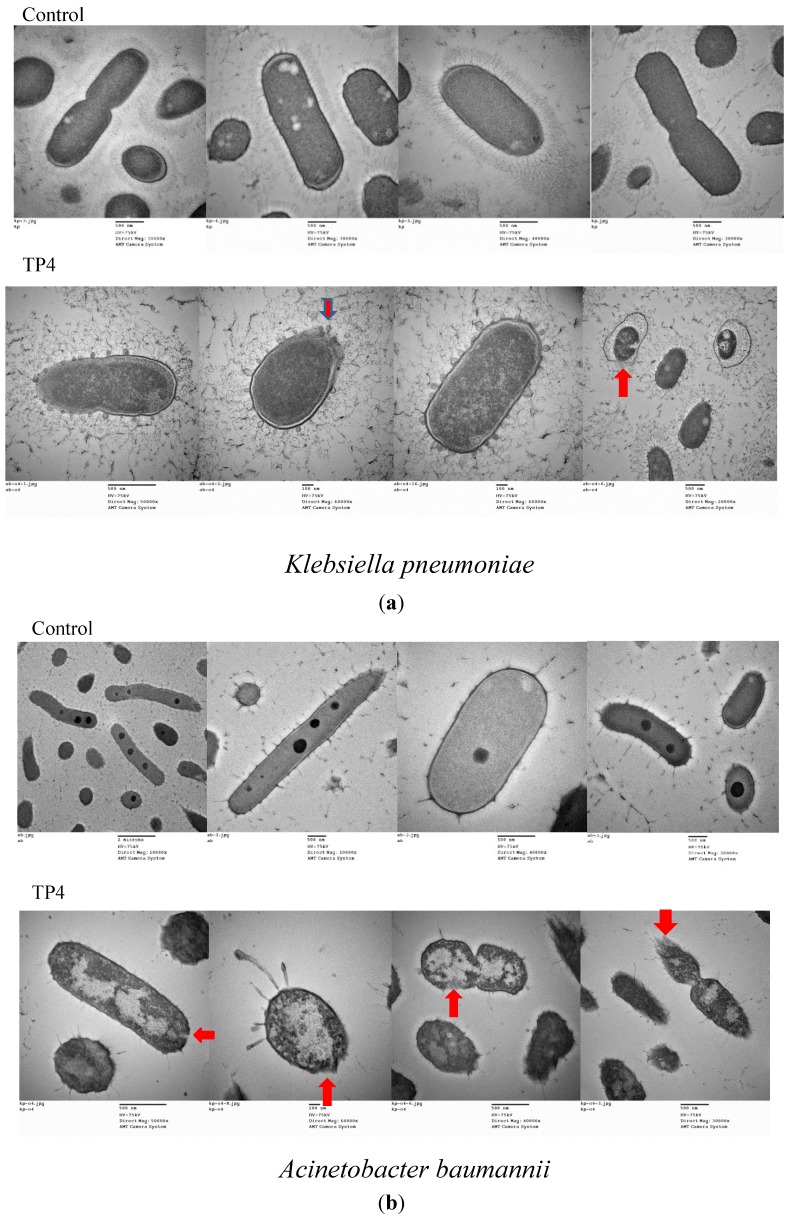
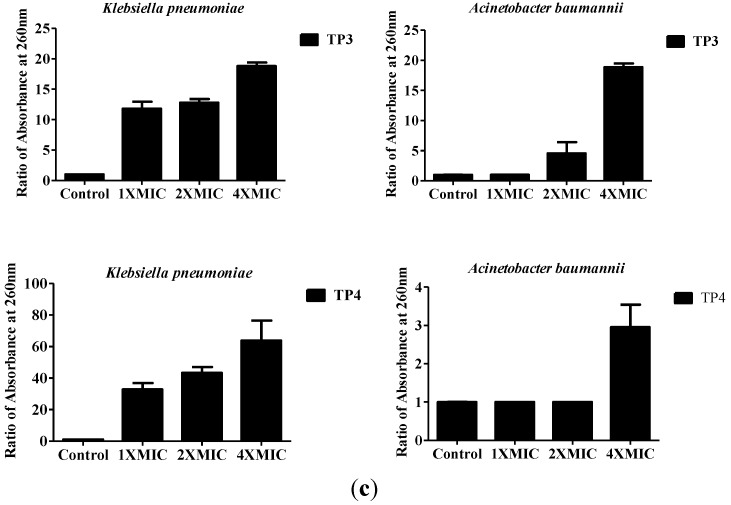
The effects of TP3 and TP4 on bacterial cytoplasmic membrane integrity. (a) Transmission electron microscopy (TEM) of Klebsiella pneumonia (NDM-1) incubated in control broth (Control) or broth containing TP4 (100 μg/mL) at 37 °C for 60 min; (b) TEM of Acinetobacter baumannii (Sk44) incubated in control broth (Control) or broth containing TP4 (100 μg/mL) at 37 °C for 60 min; (c) The effect of treatment with TP3 or TP4 on the release of DNA from the cytoplasm of Acinetobacter baumannii (Sk44) and Klebsiella pneumonia (NDM-1). Cells were treated with peptides at concentrations of 1 × MIC, 2 × MIC, or 4 × MIC. The data shown are the means of at least three independent experiments. Error bars represent the standard deviations.
Figure 3
Figure 3
The effects of TP3 and TP4 on bacterial cytoplasmic membrane integrity. (a) Transmission electron microscopy (TEM) of Klebsiella pneumonia (NDM-1) incubated in control broth (Control) or broth containing TP4 (100 μg/mL) at 37 °C for 60 min; (b) TEM of Acinetobacter baumannii (Sk44) incubated in control broth (Control) or broth containing TP4 (100 μg/mL) at 37 °C for 60 min; (c) The effect of treatment with TP3 or TP4 on the release of DNA from the cytoplasm of Acinetobacter baumannii (Sk44) and Klebsiella pneumonia (NDM-1). Cells were treated with peptides at concentrations of 1 × MIC, 2 × MIC, or 4 × MIC. The data shown are the means of at least three independent experiments. Error bars represent the standard deviations.
Figure 4
Figure 4
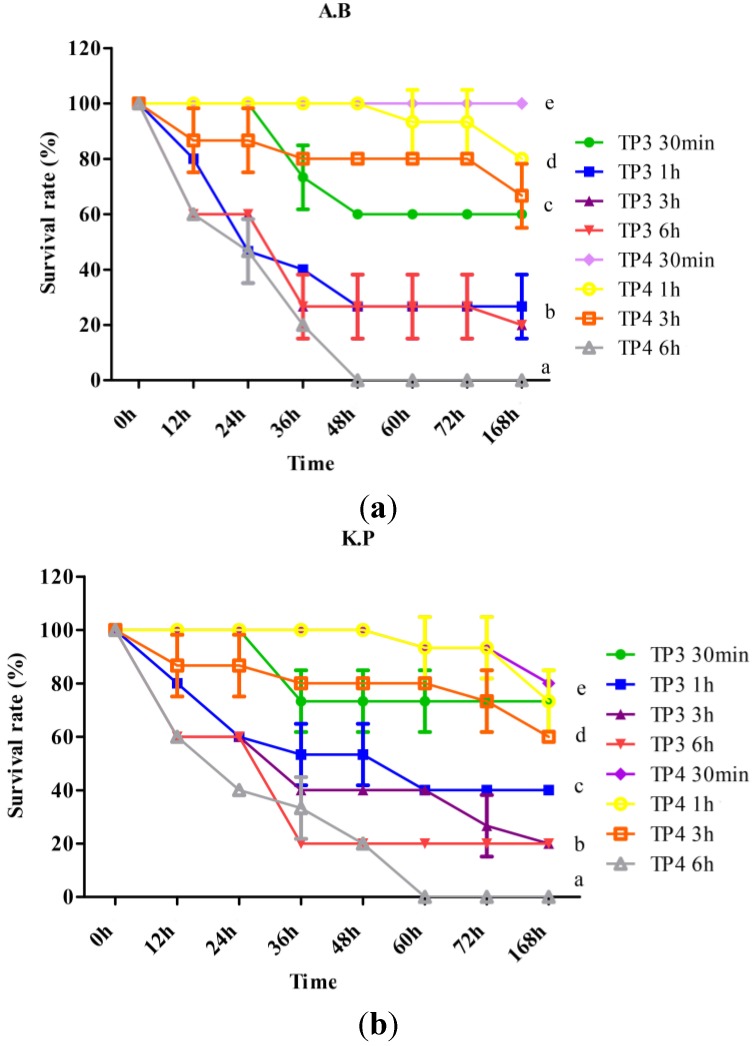
Effects of treatment with TP3 and TP4 on (a) Acinetobacter baumannii (Sk44) (A.B) and (b) Klebsiella pneumonia (NDM-1) (K.P) infection in mice. Mice were injected with bacteria, and TP3 or TP4 were subsequently injected at the indicated times (30 min, 1 h, 3 h, or 6 h) after infection (n = 5 for each group). The survival rate was monitored on a daily basis for up to 168 h. Data represent the means, and error bars represent standard deviations.

References

    1. Nordmann P., Poirel L., Toleman M.A., Walsh T.R. Does broad-spectrum beta-lactam resistance due to NDM-1 herald the end of the antibiotic era for treatment of infections caused by Gram-negative bacteria? J. Antimicrob. Chemother. 2011;66:689–692. doi: 10.1093/jac/dkq520. - DOI - PubMed
    1. Shakil S., Azhar E.I., Tabrez S., Kamal M.A., Jabir N.R., Abuzenadah A.M., Damanhouri G.A., Alam Q. New Delhi metallo-β-lactamase (NDM-1): An update. J. Chemother. 2011;23:263–265. doi: 10.1179/joc.2011.23.5.263. - DOI - PubMed
    1. Yong D., Toleman M.A., Giske C.G., Cho H.S., Sundman K., Lee K., Walsh T.R. Characterization of a new metallo-beta-lactamase gene, blaNDM-1, and a novel erythromycin esterase gene carried on a unique genetic structure in Klebsiella pneumoniae sequence type 14 from India. Antimicrob. Agents Chemother. 2009;53:5046–5054. doi: 10.1128/AAC.00774-09. - DOI - PMC - PubMed
    1. Fiett J., Baraniak A., Izdebski R., Sitkiewicz I., Żabicka D., Meler A., Filczak K., Hryniewicz W., Gniadkowski M. The first NDM metallo-β-lactamase-producing Enterobacteriaceae isolate in Poland: Evolution of IncFII-type plasmids carrying the blaNDM-1 gene. Antimicrob. Agents Chemother. 2014;58:1203–1207. doi: 10.1128/AAC.01197-13. - DOI - PMC - PubMed
    1. Abbo A., Navon-Venezia S., Hammer-Muntz O., Krichali T., Siegman-Igra Y., Carmeli Y. Multidrug-resistant Acinetobacter baumannii. Emerg. Infect. Dis. 2005;11:22–29. doi: 10.3201/eid1101.040001. - DOI - PMC - PubMed

Publication types

MeSH terms

LinkOut - more resources