


Soil bacterial community structure responses to precipitation reduction and forest management in forest ecosystems across Germany
- PMID: 25875835
- PMCID: PMC4397059
- DOI: 10.1371/journal.pone.0122539
Soil bacterial community structure responses to precipitation reduction and forest management in forest ecosystems across Germany
Erratum in
-
Correction: Soil bacterial community structure responses to precipitation reduction and forest management in forest ecosystems across Germany.PLoS One. 2015 Apr 30;10(4):e0127608. doi: 10.1371/journal.pone.0127608. eCollection 2015. PLoS One. 2015. PMID: 25928746 Free PMC article. No abstract available.
Abstract
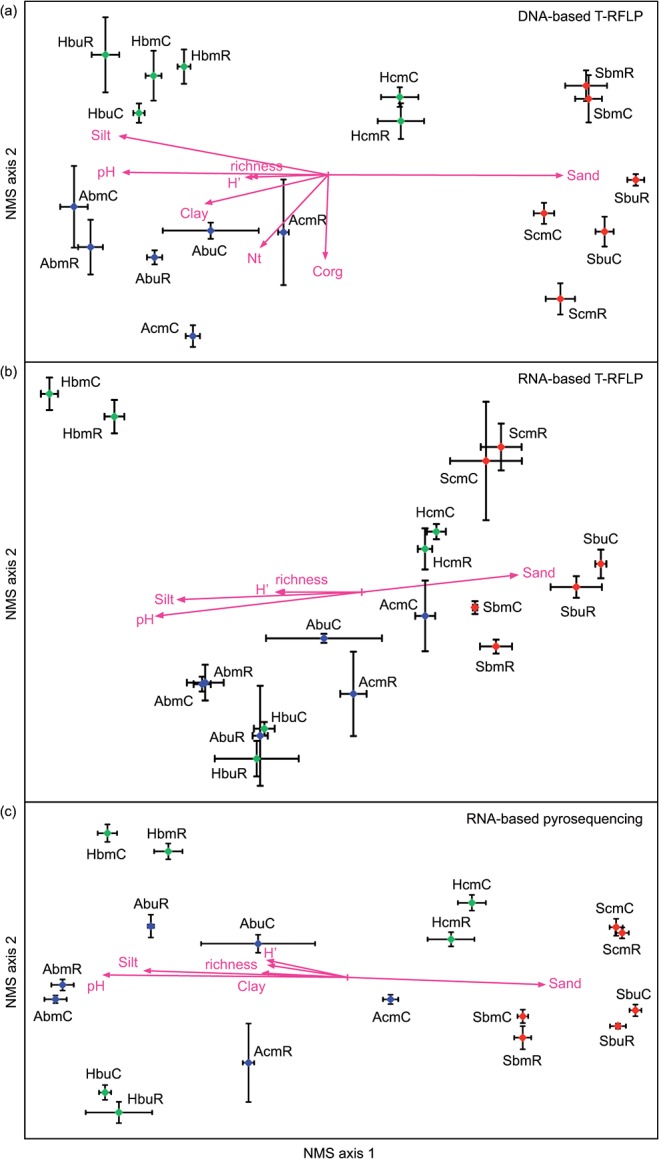
Soil microbial communities play an important role in forest ecosystem functioning, but how climate change will affect the community composition and consequently bacterial functions is poorly understood. We assessed the effects of reduced precipitation with the aim of simulating realistic future drought conditions for one growing season on the bacterial community and its relation to soil properties and forest management. We manipulated precipitation in beech and conifer forest plots managed at different levels of intensity in three different regions across Germany. The precipitation reduction decreased soil water content across the growing season by between 2 to 8% depending on plot and region. T-RFLP analysis and pyrosequencing of the 16S rRNA gene were used to study the total soil bacterial community and its active members after six months of precipitation reduction. The effect of reduced precipitation on the total bacterial community structure was negligible while significant effects could be observed for the active bacteria. However, the effect was secondary to the stronger influence of specific soil characteristics across the three regions and management selection of overstorey tree species and their respective understorey vegetation. The impact of reduced precipitation differed between the studied plots; however, we could not determine the particular parameters being able to modify the response of the active bacterial community among plots. We conclude that the moderate drought induced by the precipitation manipulation treatment started to affect the active but not the total bacterial community, which points to an adequate resistance of the soil microbial system over one growing season.
Conflict of interest statement
Figures



References
-
- IPCC. Summary for Policymakers: Managing the Risks of Extreme Events and Disasters to Advance Climate Change Adaptation In: Field CB, Barros V, Stocker TF, Qin D, Dokken DJ, Ebi KL, et al. , editors. A Special Report of Working Groups I and II of the Intergovernmental Panel on Climate Change. Cambridge, UK: Cambridge University Press; 2012. p. 1–19.
-
- Allen CD, Macalady AK, Chenchouni H, Bachelet D, McDowell N, Vennetier M, et al. A global overview of drought and heat-induced tree mortality reveals emerging climate change risks for forests. For Ecol Manage. 2010;259: 660–684.
-
- Breda N, Huc R, Granier A, Dreyer E. Temperate forest trees and stands under severe drought: a review of ecophysiological responses, adaptation processes and long-term consequences. Ann Forest Sci. 2006;63: 625–644.
Publication types
MeSH terms
Substances
LinkOut - more resources
Full Text Sources
Other Literature Sources
