


Estimating the number of people with hepatitis C virus who have ever injected drugs and have yet to be diagnosed: an evidence synthesis approach for Scotland
- PMID: 25876667
- PMCID: PMC4744705
- DOI: 10.1111/add.12948
Estimating the number of people with hepatitis C virus who have ever injected drugs and have yet to be diagnosed: an evidence synthesis approach for Scotland
Abstract
Aims: To estimate the number of people who have ever injected drugs (defined here as PWID) living in Scotland in 2009 who have been infected with the hepatitis C virus (HCV) and to quantify and characterize the population remaining undiagnosed.
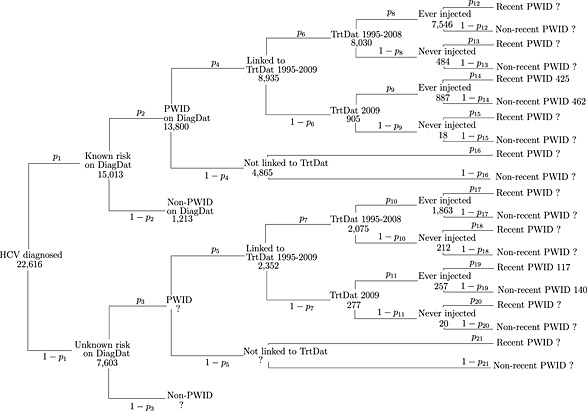
Methods: Information from routine surveillance (n=22616) and survey data (n=2511) was combined using a multiparameter evidence synthesis approach to estimate the size of the PWID population, HCV antibody prevalence and the proportion of HCV antibody prevalent cases who have been diagnosed, in subgroups defined by recency of injecting (in the last year or not), age (15-34 and 35-64 years), gender and region of residence (Greater Glasgow and Clyde and the rest of Scotland).
Results: HCV antibody-prevalence among PWID in Scotland during 2009 was estimated to be 57% [95% CI=52-61%], corresponding to 46657 [95% credible interval (CI)=33812-66803] prevalent cases. Of these, 27434 (95% CI=14636-47564) were undiagnosed, representing 59% [95% CI=43-71%] of prevalent cases. Among the undiagnosed, 83% (95% CI=75-89%) were PWID who had not injected in the last year and 71% (95% CI=58-85%) were aged 35-64 years.
Conclusions: The number of undiagnosed hepatitis C virus-infected cases in Scotland appears to be particularly high among those who have injected drugs more than 1 year ago and are more than 35 years old.
Keywords: Evidence synthesis; hepatitis C; people who inject drugs; prevalence.
© 2015 The Authors. Addiction published by John Wiley & Sons Ltd on behalf of Society for the Study of Addiction.
Figures
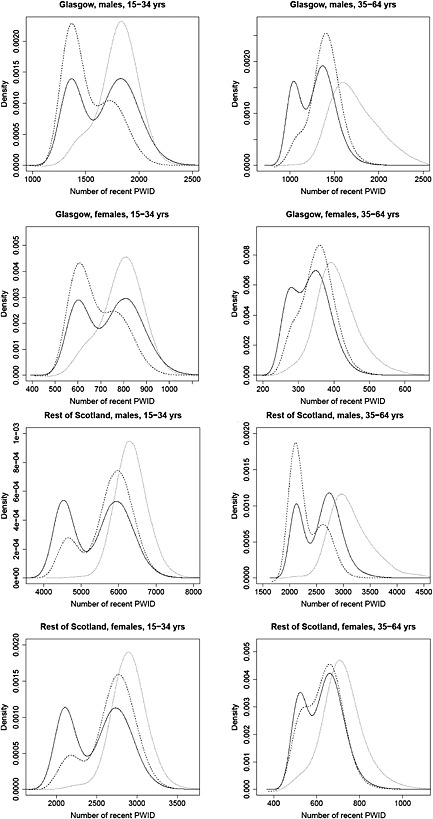
 CR prior distribution,
  posterior distribution for model with bias adjustment parameters (baseline model),
  posterior distribution for model without bias adjustment parameters (sensitivity 2)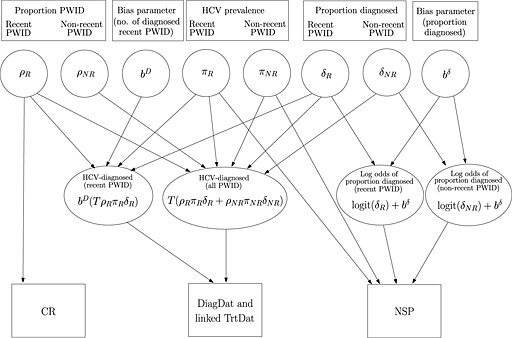
References
-
- Dore G. J., Freeman A. J., Law M., Kaldor J. M. Is severe liver disease a common outcome for people with chronic hepatitis C? J Gastroenterol Hepatol 2002; 17: 423–30. - PubMed
-
- Mathers B. M., Degenhardt L., Phillips B., Wiessing L., Hickman M., Strathdee S. A. et al. Global epidemiology of injecting drug use and HIV among people who inject drugs: a systematic review. Lancet 2008; 372: 1733–45. - PubMed
-
- Micallef J. M., Kaldor J. M., Dore G. J. Spontaneous viral clearance following acute hepatitis C infection: a systematic review of longitudinal studies. J Viral Hepatol 2006; 13: 34–41. - PubMed
-
- Dore G. J., Matthews G. V., Rockstroh J. Future of hepatitis C therapy: development of direct‐acting antivirals. Curr Opin HIV AIDS 2011; 6: 508–13. - PubMed
Publication types
MeSH terms
Substances
Grants and funding
LinkOut - more resources
Full Text Sources
Other Literature Sources
