


Electronic-cigarette use among young people in Wales: evidence from two cross-sectional surveys
- PMID: 25877272
- PMCID: PMC4420942
- DOI: 10.1136/bmjopen-2014-007072
Electronic-cigarette use among young people in Wales: evidence from two cross-sectional surveys
Abstract
Objectives: To examine the prevalence of electronic(e)-cigarette use, prevalence of e-cigarette and tobacco use by age, and associations of e-cigarette use with sociodemographic characteristics, tobacco and cannabis use among young people in Wales.
Design: Data from two nationally-representative cross-sectional surveys undertaken in 2013-2014. Logistic regression analyses, adjusting for school-level clustering, examined sociodemographic characteristics of e-cigarette use, and associations between e-cigarette use and smoking.
Setting: Primary and secondary schools in Wales.
Participants: Primary-school children aged 10-11 (n=1601) and secondary-school students aged 11-16 (n=9055).
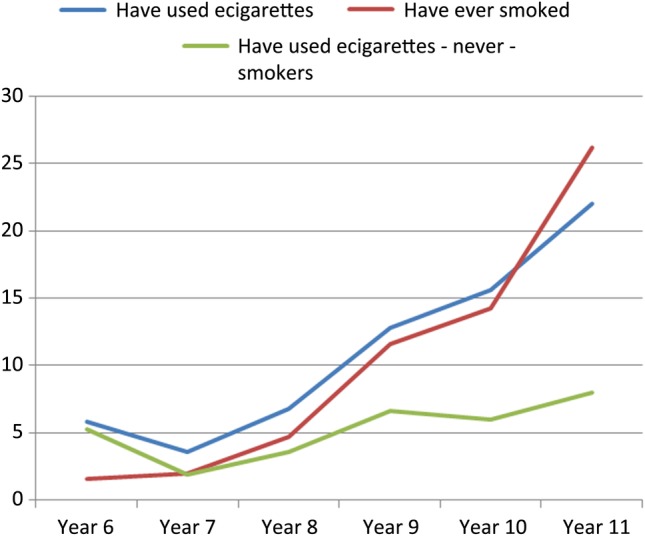
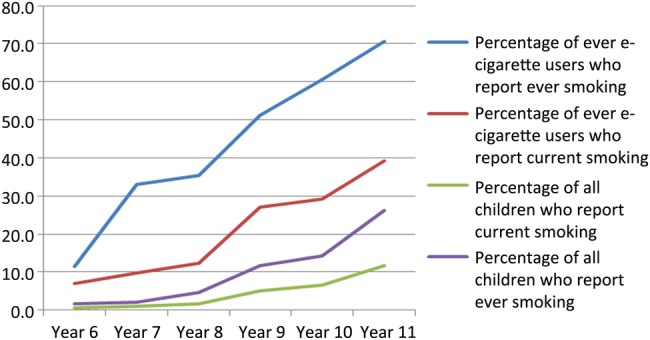
Results: Primary-school children were more likely to have used e-cigarettes (5.8%) than tobacco (1.6%). Ever use of e-cigarettes remained more prevalent than ever use of tobacco until age 14-15. Overall, 12.3% of secondary-school students (aged 11-16) reported ever using e-cigarettes, with no differences according to gender, ethnicity or family affluence. The percentage of 'never smokers' reporting having used e-cigarettes was 5.3% at age 10-11 to 8.0% at age 15-16. The proportion of children who had ever used an e-cigarette and reported currently smoking increased from 6.9% among 10-11 year olds to 39.2% in 15-16 year olds. Only 1.5% (n=125) of 11-16 year-olds, including 0.3% of never smokers, reported regular e-cigarette use (use at least once a month). Current weekly smokers were 100 times more likely than non-smokers to report regular e-cigarette use (relative risk ratio (RRR=121.15; 95% CI 57.56 to 254.97). Regular e-cigarette use was also more likely among those who had smoked cannabis (RRR 53.03; 95% CI 38.87 to 80.65).
Conclusions: Many young people (including never-smokers) have tried e-cigarettes. However, regular use is less common, and is associated with tobacco cigarette use. Longitudinal research is needed to understand age-related trajectories of e-cigarette use and to understand the temporal nature of relationships between e-cigarette and tobacco use.
Keywords: PREVENTIVE MEDICINE; PUBLIC HEALTH; Smoking.
Published by the BMJ Publishing Group Limited. For permission to use (where not already granted under a licence) please go to http://group.bmj.com/group/rights-licensing/permissions.
Figures
References
Publication types
MeSH terms
Grants and funding
- MR/KO232331/1/BHF_/British Heart Foundation/United Kingdom
- MR/L002787/1/MRC_/Medical Research Council/United Kingdom
- G0701735/MRC_/Medical Research Council/United Kingdom
- MR/KO232331/1/WT_/Wellcome Trust/United Kingdom
- WT_/Wellcome Trust/United Kingdom
- MR/K021400/1/MRC_/Medical Research Council/United Kingdom
- MC_UU_12017/14/MRC_/Medical Research Council/United Kingdom
- 13/42/02/DH_/Department of Health/United Kingdom
- MR/KO232331/1/CRUK_/Cancer Research UK/United Kingdom
- MR/KO232331/1/MRC_/Medical Research Council/United Kingdom
- SPHSU14/CSO_/Chief Scientist Office/United Kingdom
- MR/K023233/1/MRC_/Medical Research Council/United Kingdom
LinkOut - more resources
Full Text Sources
Other Literature Sources
Medical
