


Effects of a clinician referral and exercise program for men who have completed active treatment for prostate cancer: A multicenter cluster randomized controlled trial (ENGAGE)
- PMID: 25877784
- PMCID: PMC4654333
- DOI: 10.1002/cncr.29385
Effects of a clinician referral and exercise program for men who have completed active treatment for prostate cancer: A multicenter cluster randomized controlled trial (ENGAGE)
Abstract
Background: The purpose of this study was to determine the efficacy of a clinician referral and exercise program in improving exercise levels and quality of life for men with prostate cancer.
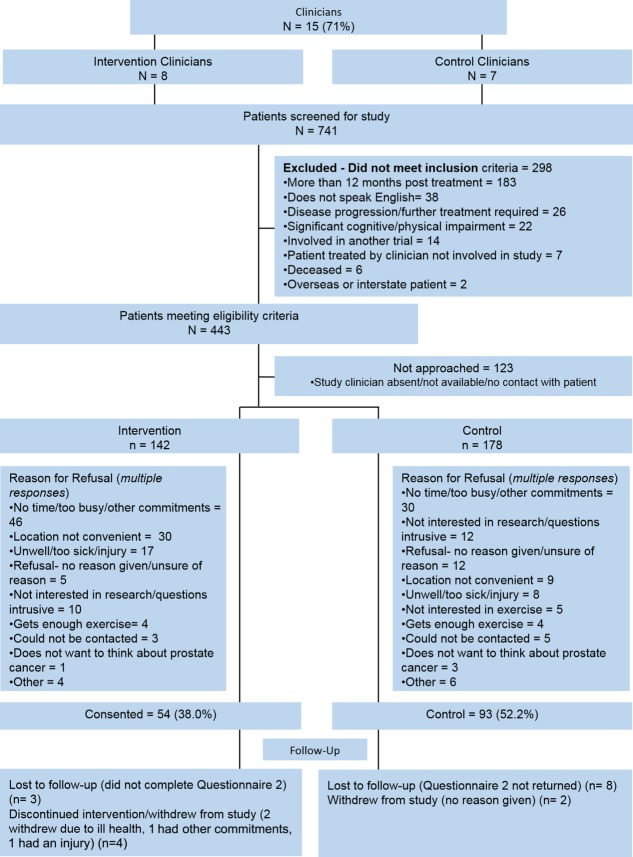
Methods: This was a multicenter cluster randomized controlled trial in Melbourne, Australia comprising 15 clinicians: 8 clinicians were randomized to refer eligible participants (n = 54) to a 12-week exercise program comprising 2 supervised gym sessions and 1 home-based session per week, and 7 clinicians were randomized to follow usual care (n = 93). The primary outcome was self-reported physical activity; the secondary outcomes were quality of life, anxiety, and symptoms of depression.
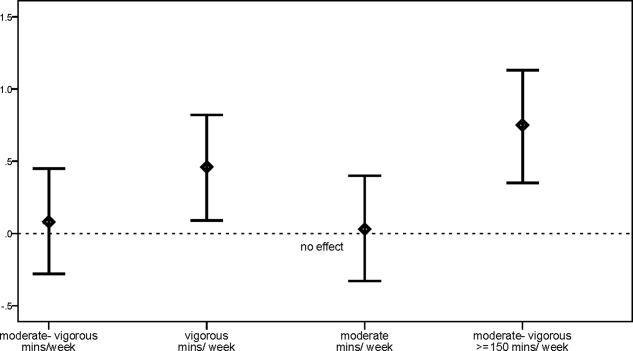
Results: A significant intervention effect was observed for vigorous-intensity exercise (effect size: Cohen's d, 0.46; 95% confidence interval [CI], 0.09-0.82; P = .010) but not for combined moderate and vigorous exercise levels (effect size: d, 0.08; 95% CI, -0.28 to 0.45; P = .48). Significant intervention effects were also observed for meeting exercise guidelines (≥150 min/wk; odds ratio, 3.9; 95% CI, 1.9-7.8; P = .002); positive intervention effects were observed in the intervention group for cognitive functioning (effect size: d, 0.34; 95% CI, -0.02 to 0.70; P = .06) and depression symptoms (effect size: d, -0.35; 95% CI, -0.71 to 0.02; P = .06). Eighty percent of participants reported that the clinician's referral influenced their decision to participate in the exercise program.
Conclusions: The clinician referral and 12-week exercise program significantly improved vigorous exercise levels and had a positive impact on mental health outcomes for men living with prostate cancer. Further research is needed to determine the sustainability of the exercise program and its generalizability to other cancer populations.
Keywords: clinician referral; exercise program; physical activity; prostate cancer; quality of life.
© 2015 The Authors. Cancer published by Wiley Periodicals, Inc. on behalf of American Cancer Society.
Figures
References
-
- Siegel R, Naishadham D, Jemal A. Cancer statistics. CA Cancer J Clin. 2013;63:11–30. - PubMed
-
- Australian Institute of Health and Welfare. Cancer Incidence Projections: Australia, 2011 to 2020. Canberra, Australia: Australian Institute of Health and Welfare; 2012. Cancer series 66.
-
- Drummond FJ, Kinnear H, O'Leary E, Donnelly, Gavin A, Sharp L. Long-term health-related quality of life of prostate cancer survivors varies by primary treatment. Results from the PiCTure (Prostate Cancer Treatment, Your Experience) study. J Cancer Surviv. In press. - PubMed
Publication types
MeSH terms
Associated data
LinkOut - more resources
Full Text Sources
Other Literature Sources
Medical
