


Corneal Confocal Microscopy Identifies Small-Fiber Neuropathy in Subjects With Impaired Glucose Tolerance Who Develop Type 2 Diabetes
- PMID: 25877814
- PMCID: PMC4512140
- DOI: 10.2337/dc14-2733
Corneal Confocal Microscopy Identifies Small-Fiber Neuropathy in Subjects With Impaired Glucose Tolerance Who Develop Type 2 Diabetes
Abstract
Objective: Impaired glucose tolerance (IGT) through to type 2 diabetes is thought to confer a continuum of risk for neuropathy. Identification of subjects at high risk of developing type 2 diabetes and, hence, worsening neuropathy would allow identification and risk stratification for more aggressive management.
Research design and methods: Thirty subjects with IGT and 17 age-matched control subjects underwent an oral glucose tolerance test, assessment of neuropathic symptoms and deficits, quantitative sensory testing, neurophysiology, skin biopsy, and corneal confocal microscopy (CCM) to quantify corneal nerve fiber density (CNFD), branch density (CNBD), and fiber length (CNFL) at baseline and annually for 3 years.
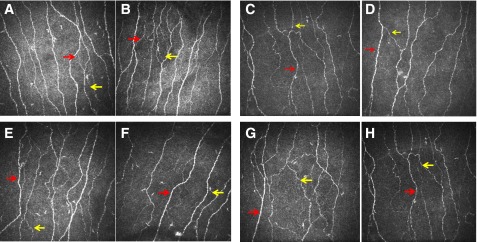
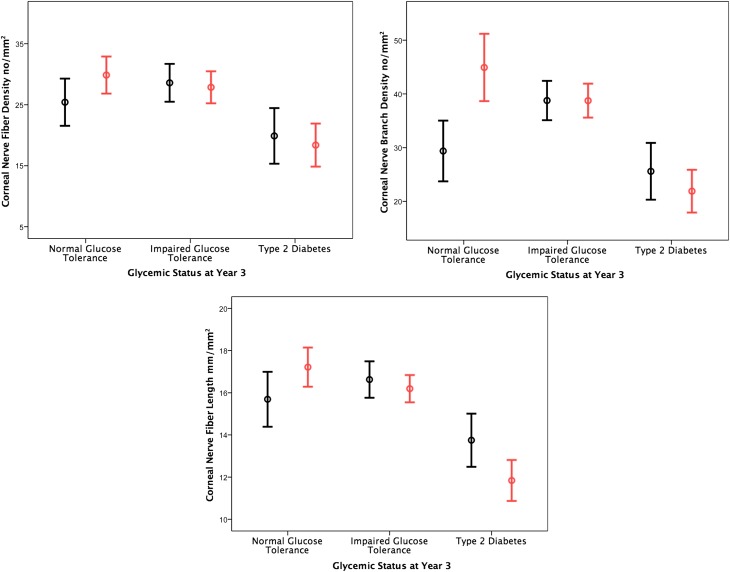
Results: Ten subjects who developed type 2 diabetes had a significantly lower CNFD (P = 0.003), CNBD (P = 0.04), and CNFL (P = 0.04) compared with control subjects at baseline and a further reduction in CNFL (P = 0.006), intraepidermal nerve fiber density (IENFD) (P = 0.02), and mean dendritic length (MDL) (P = 0.02) over 3 years. Fifteen subjects who remained IGT and 5 subjects who returned to normal glucose tolerance had no significant baseline abnormality on CCM or IENFD but had a lower MDL (P < 0.0001) compared with control subjects. The IGT subjects showed a significant decrease in IENFD (P = 0.02) but no change in MDL or CCM over 3 years. Those who returned to NGT showed an increase in CNFD (P = 0.05), CNBD (P = 0.04), and CNFL (P = 0.05), but a decrease in IENFD (P = 0.02), over 3 years.
Conclusions: CCM and skin biopsy detect a small-fiber neuropathy in subjects with IGT who develop type 2 diabetes and also show a dynamic worsening or improvement in corneal and intraepidermal nerve morphology in relation to change in glucose tolerance status.
© 2015 by the American Diabetes Association. Readers may use this article as long as the work is properly cited, the use is educational and not for profit, and the work is not altered.
Figures
References
-
- Aguiree F, Brown A, Cho NH, Dahlquist G, Dodd S, Dunning T, et al. IDF Diabetes Atlas. 2013
-
- Singleton JR, Smith AG, Russell JW, Feldman EL. Microvascular complications of impaired glucose tolerance. Diabetes 2003;52:2867–2873 - PubMed
-
- Manley S, Meyer L, Neil H, Ross I, Turner R, Holman R. UK Prospective Diabetes Study 6. Complications in newly diagnosed type 2 diabetic patients and their association with different clinical and biochemical risk factors. Diabetes Res 1990;13:1–11 - PubMed
Publication types
MeSH terms
Substances
Grants and funding
LinkOut - more resources
Full Text Sources
Other Literature Sources
Medical
