. 2015 Jul 15;21(14):3347-3355.
doi: 10.1158/1078-0432.CCR-15-0057. Epub 2015 Apr 15.

POLE Proofreading Mutations Elicit an Antitumor Immune Response in Endometrial Cancer

Affiliations

POLE Proofreading Mutations Elicit an Antitumor Immune Response in Endometrial Cancer

Inge C van Gool et al. Clin Cancer Res. .

Abstract

Purpose: Recent studies have shown that 7% to 12% of endometrial cancers are ultramutated due to somatic mutation in the proofreading exonuclease domain of the DNA replicase POLE. Interestingly, these tumors have an excellent prognosis. In view of the emerging data linking mutation burden, immune response, and clinical outcome in cancer, we investigated whether POLE-mutant endometrial cancers showed evidence of increased immunogenicity.

Experimental design: We examined immune infiltration and activation according to tumor POLE proofreading mutation in a molecularly defined endometrial cancer cohort including 47 POLE-mutant tumors. We sought to confirm our results by analysis of RNAseq data from the TCGA endometrial cancer series and used the same series to examine whether differences in immune infiltration could be explained by an enrichment of immunogenic neoepitopes in POLE-mutant endometrial cancers.

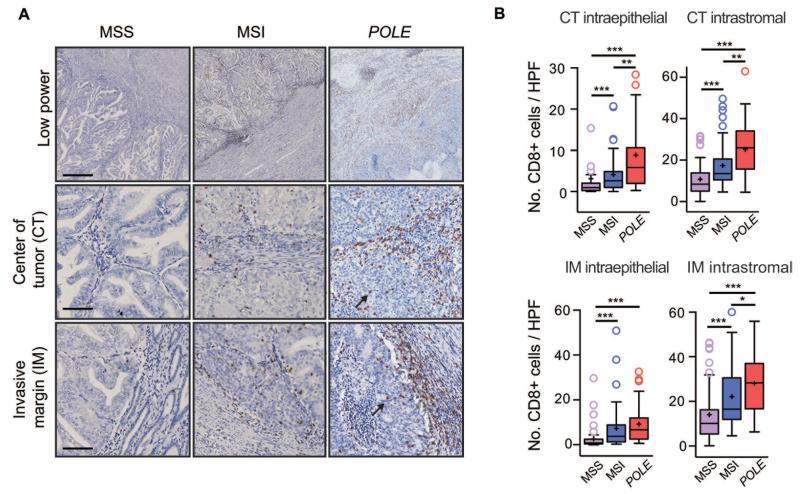
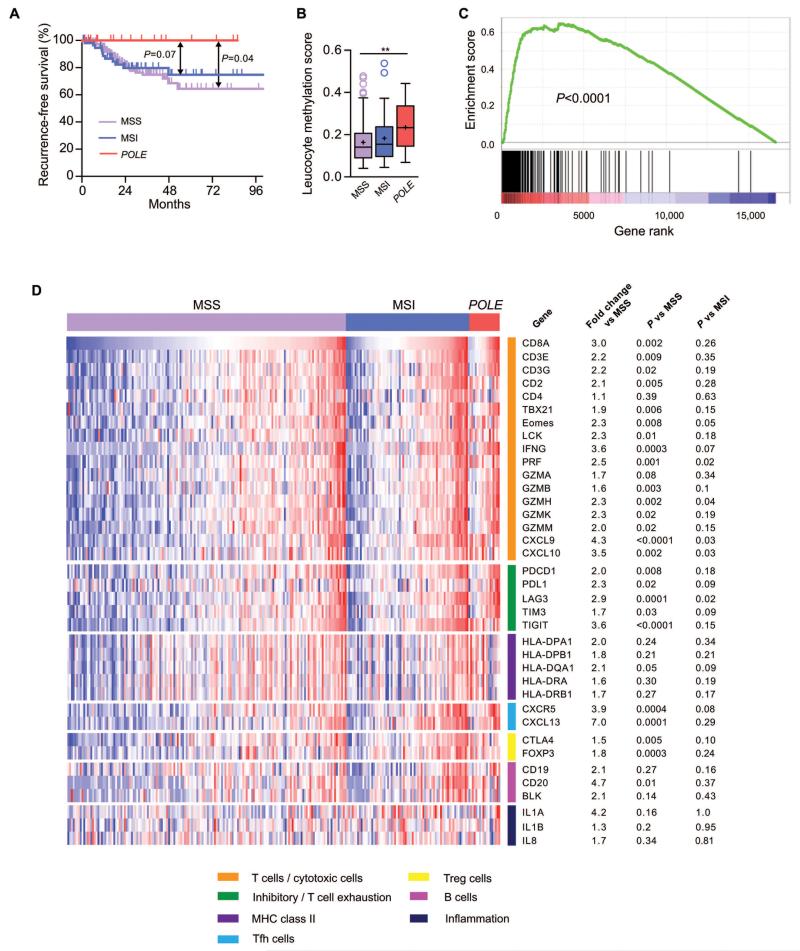
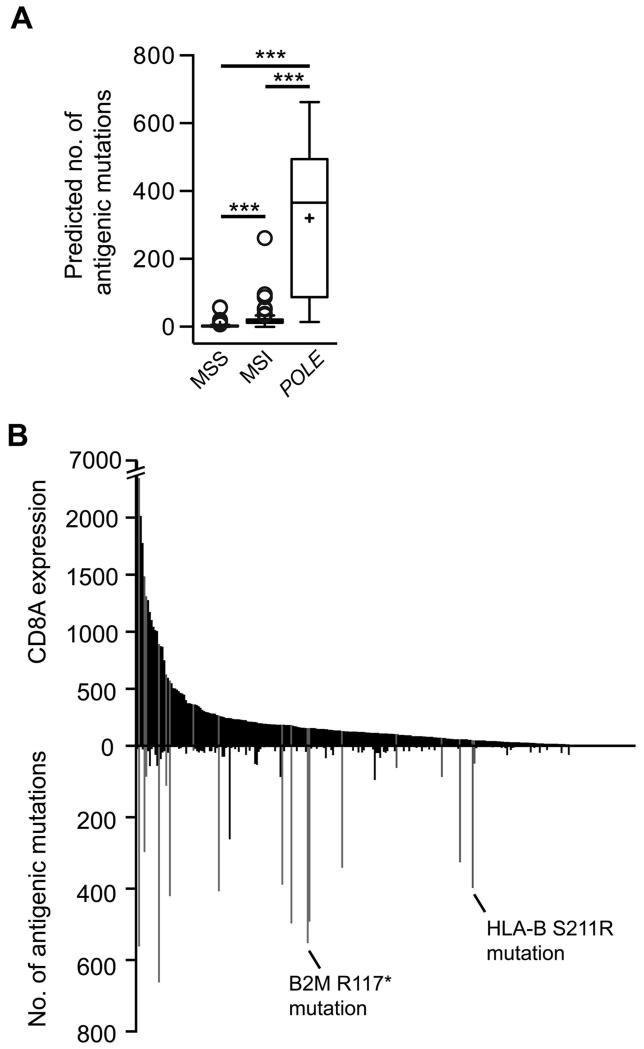
Results: Compared with other endometrial cancers, POLE mutants displayed an enhanced cytotoxic T-cell response, evidenced by increased numbers of CD8(+) tumor-infiltrating lymphocytes and CD8A expression, enrichment for a tumor-infiltrating T-cell gene signature, and strong upregulation of the T-cell cytotoxic differentiation and effector markers T-bet, Eomes, IFNG, PRF, and granzyme B. This was accompanied by upregulation of T-cell exhaustion markers, consistent with chronic antigen exposure. In silico analysis confirmed that POLE-mutant cancers are predicted to display more antigenic neoepitopes than other endometrial cancers, providing a potential explanation for our findings.

Conclusions: Ultramutated POLE proofreading-mutant endometrial cancers are characterized by a robust intratumoral T-cell response, which correlates with, and may be caused by an enrichment of antigenic neopeptides. Our study provides a plausible mechanism for the excellent prognosis of these cancers.


Figures

Figure 1
Figure 1. Increased CD8+ lymphocyte infiltration in POLE-mutant endometrial cancers
(A) Results of CD8 immunohistochemistry by EC molecular subtype shown at low magnification (upper panels) and high power views of the center of the tumor (CT) and invasive margin (IM). Arrows highlight intraepithelial CD8+ cells in POLE-mutant tumor. Scale bars correspond to 500 μm in upper panel and 100 μm in the middle and lower panels. (B) Quantification of CD8+ cell number in intraepithelial and intrastromal compartments in the CT and IM by EC molecular subtype. Boxes represent the interquartile range (IQR), with upper whisker indicating the 75th percentile plus 1.5 × IQR, and the lower whisker the 25th percentile minus 1.5 × IQR. The median and mean values are indicated by a horizontal line and cross respectively. Statistical comparison between groups was made by unadjusted two-sided Mann-Whitney test, *, **, and *** correspond to P<0.05, P<0.01, and P<0.001 respectively.
Figure 2
Figure 2. CD8+ infiltrating lymphocytes in POLE-mutant tumors show cytolytic potential
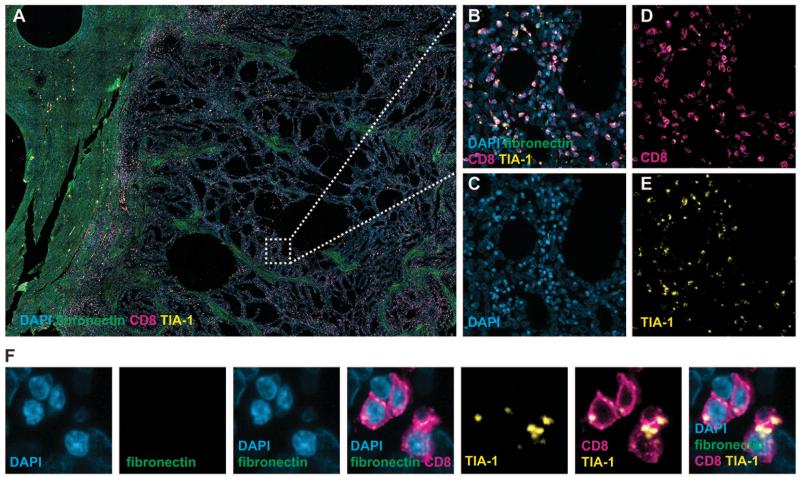
(A) Low-magnification image of POLE-mutant tumor following co-immunofluorescence (Co-IF) staining for DAPI (nuclei), fibronectin (extracellular matrix), CD8 and the cytolytic marker TIA-1. (B-E) Co-IF images of the tumor center following staining for all markers (B), DAPI (C), CD8 (D) and TIA-1 (E) confirming co-expression of TIA-1 by tumor-infiltrating CD8+ lymphocytes, also shown at high magnification (F).
Figure 3
Figure 3. Clinical outcome and T cell response according to tumor molecular subtype in TCGA endometrial cancers
(A) Kaplan-Meier curves demonstrating recurrence-free survival of POLE wild-type, microsatellite stable (MSS, n=147), microsatellite unstable (MSI, n=63) and POLE proofreading mutant (POLE, n=18) ECs in the TCGA series (note that survival data were not available for all cases). Comparison between subgroups was made by two-sided log-rank test. (B) Leucocyte methylation scores according to EC molecular subtype. Unadjusted comparison between groups was made by two-sided Mann-Whitney test. ** indicates P<0.01. (C) Gene set enrichment analysis (GSEA) of 200-gene tumor-associated T cell signature (Ref. 18) in POLE-mutant ECs compared to other tumors. Raw RNAseq counts were normalized and ranked using DESeq prior to GSEA analysis with pre-ranking. (D) Heatmap showing expression of immunological genes according to EC molecular subtype. RSEM-normalised RNAseq expression data were log2 transformed, zero centred and assigned unit variance. For each gene, the mean fold change in expression in POLE mutants relative to MSS ECs was calculated and expression compared between POLE mutants, MSS and MSI ECs by unadjusted, two-sided Mann-Whitney test.
Figure 4
Figure 4. Antigenic mutation burden and tumor CD8A expression according to POLE mutation
(A) The number of mutations predicted to generate antigenic neo-peptides in individual TCGA tumors was calculated using exome and RNAseq data (see Methods). Box and whisker plots signify IQR ± 1.5 × IQR, mean and median as previously. Comparison between groups was made by unadjusted two-sided Mann-Whitney test, *** denotes P<0.0001. (B) Relationship between number of antigenic missense tumor mutations and tumor CD8A expression. POLE-mutant samples are highlighted in gray, together with possible mechanisms of immune escape in two cases.

References

    1. Ferlay J, Steliarova-Foucher E, Lortet-Tieulent J, Rosso S, Coebergh JW, Comber H, et al. Cancer incidence and mortality patterns in Europe: estimates for 40 countries in 2012. Eur J Cancer. 2013;49:1374–403. - PubMed
    1. TCGA Network Integrated genomic characterization of endometrial carcinoma. Nature. 2013;497:67–73. - PMC - PubMed
    1. Murali R, Soslow RA, Weigelt B. Classification of endometrial carcinoma: more than two types. Lancet Oncol. 2014;15:e268–e278. - PubMed
    1. Church DN, Briggs SE, Palles C, Domingo E, Kearsey SJ, Grimes JM, et al. DNA polymerase epsilon and delta exonuclease domain mutations in endometrial cancer. Hum Mol Genet. 2013;22:2820–8. - PMC - PubMed
    1. Church DN, Stelloo E, Nout RA, Valtcheva N, Depreeuw J, Ter Haar N, et al. Prognostic Significance of POLE Proofreading Mutations in Endometrial Cancer. J Natl Cancer Inst. 2015:107. - PMC - PubMed

Publication types

Substances