


RAS Synthetic Lethal Screens Revisited: Still Seeking the Elusive Prize?
- PMID: 25878361
- PMCID: PMC4413026
- DOI: 10.1158/1078-0432.CCR-14-2180
RAS Synthetic Lethal Screens Revisited: Still Seeking the Elusive Prize?
Abstract
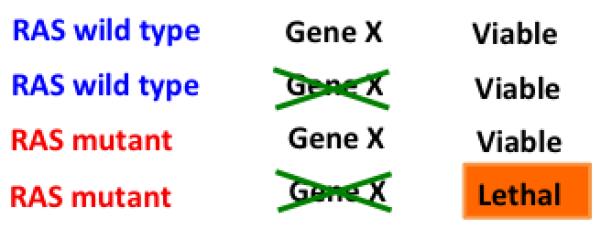
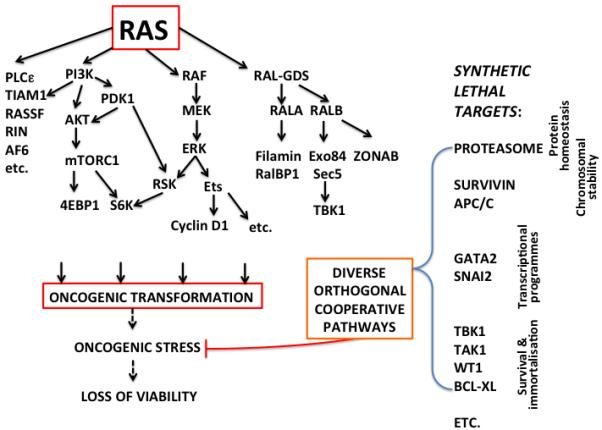
The RAS genes are critical oncogenic drivers activated by point mutation in some 20% of human malignancies. However, no pharmacologic approaches to targeting RAS proteins directly have yet succeeded, leading to suggestions that these proteins may be "undruggable." This has led to two alternative indirect approaches to targeting RAS function in cancer. One has been to target RAS signaling pathways downstream at tractable enzymes such as kinases, particularly in combination. The other, which is the focus of this review, has been to seek targets that are essential in cells bearing an activated RAS oncogene, but not those without. This synthetic lethal approach, while rooted in ideas from invertebrate genetics, has been inspired most strongly by the successful use of PARP inhibitors, such as olaparib, in the clinic to treat BRCA defective cancers. Several large-scale screens have been carried out using RNA interference-mediated expression silencing to find genes that are uniquely essential to RAS-mutant but not wild-type cells. These screens have been notable for the low degree of overlap between their results, with the possible exception of proteasome components, and have yet to lead to successful new clinical approaches to the treatment of RAS-mutant cancers. Possible reasons for these disappointing results are discussed here, along with a reevaluation of the approaches taken. On the basis of experience to date, RAS synthetic lethality has so far fallen some way short of its original promise and remains unproven as an approach to finding effective new ways of tackling RAS-mutant cancers. Clin Cancer Res; 21(8); 1802-9. ©2015 AACR. See all articles in this CCR Focus section, "Targeting RAS-Driven Cancers."
©2015 American Association for Cancer Research.
Figures
References
-
- Malumbres M, Barbacid M. RAS oncogenes: the first 30 years. Nat Rev Cancer. 2003;3:459–65. - PubMed
-
- Downward J. Targeting RAS signalling pathways in cancer therapy. Nat Rev Cancer. 2003;3:11–22. - PubMed
-
- Stephen AG, Esposito D, Bagni RK, McCormick F. Dragging ras back in the ring. Cancer Cell. 2014;25:272–81. - PubMed
Publication types
MeSH terms
Substances
Grants and funding
LinkOut - more resources
Full Text Sources
