


Signal and Charge Enhancement for Protein Analysis by Liquid Chromatography-Mass Spectrometry with Desorption Electrospray Ionization
- PMID: 25878557
- PMCID: PMC4394628
- DOI: 10.1016/j.ijms.2012.06.006
Signal and Charge Enhancement for Protein Analysis by Liquid Chromatography-Mass Spectrometry with Desorption Electrospray Ionization
Abstract
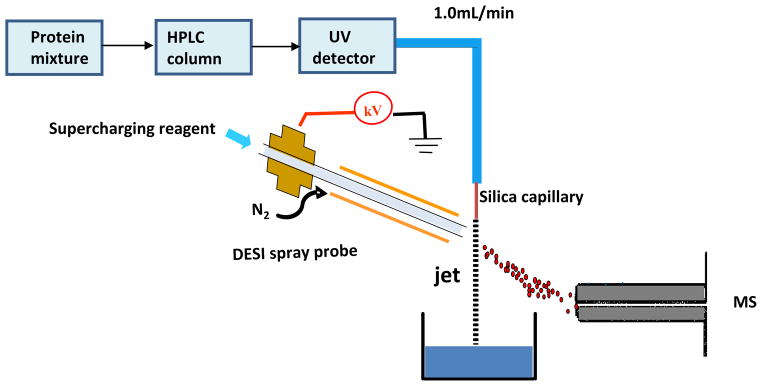
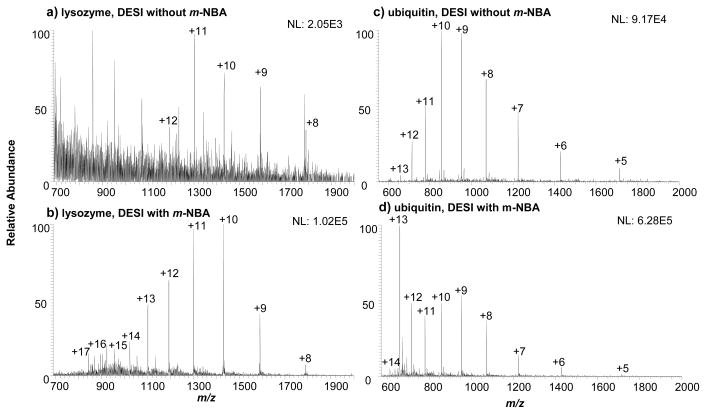
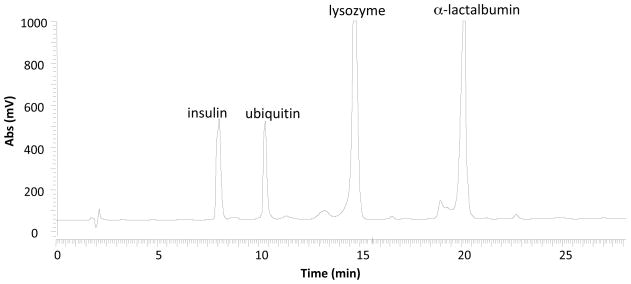
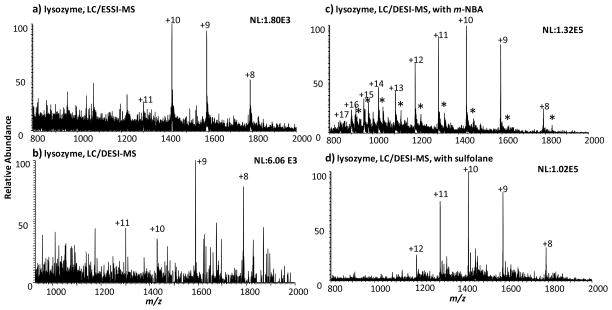
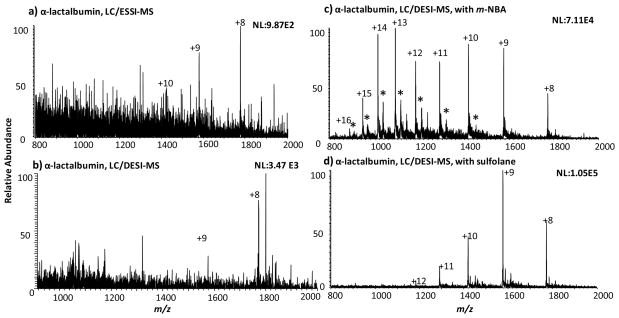
We recently reported the use of desorption electrospray ionization (DESI) as a novel interface to couple high-performance liquid chromatography (HPLC) with mass spectrometry (MS) (Chem. Commun. 2011, 47, 4171). One of the benefits of such an interface is that post-column derivatization of separated analytes can be integrated with ionization via a "reactive" DESI approach in which a derivatizing reagent is doped into the spray solvent. The reactive DESI interface allows analyte desorption/ionization from the end of the chromatographic column with prompt MS detection; a short time delay of ~20 ms was demonstrated. In this study, we extended this application by "supercharging" proteins following HPLC separation using a DESI spray solvent containing supercharging reagents, m-nitrobenzyl alcohol (m-NBA) or sulfolane. Proteins (insulin, ubiquitin, lysozyme and α-lactalbumin) eluted out of the LC column can be supercharged with the protein charge state distributions (CSDs) significantly increased (to higher charge), which would be advantageous for subsequent top-down MS analysis of proteins. Interestingly, supercharging combined with reactive DESI enhances tolerance towards trifluoroacetic acid (TFA), which is known to be a superior additive in the mobile phase for premium peptide/protein chromatographic separation but has severe signal suppression effects for conventional electrospray ionization (ESI). In comparison to electrosonic spray ionization (ESSI), a variant form of ESI, the sensitivity of protein analysis using LC/DESI-MS with the mobile phase containing TFA can be improved by up to 70-fold for lysozyme and α-lactalbumin by including m-NBA in the DESI spray solvent. Presumably, by reducing TFA dissociation in the droplet, supercharging agents lower trifluoroacetate anion concentrations and concomitantly reduce ion pairing to analyte cationic sites. The reduced ion pairing therefore decreases the TFA signal suppression effect. The supercharging capability and the reduction of TFA signal suppression suggest that LC/DESI-MS is a valuable method for protein analysis.
Keywords: Liquid chromatography/mass spectrometry; TFA ion suppression; protein supercharging; reactive DESI.
Figures
References
-
- Whitehouse CM, Dreyer RN, Yamashita M, Fenn JB. Electrospray Interface for Liquid Chromatographs and Mass Spectrometers. Anal Chem. 1985;57:675–679. - PubMed
-
- Takats Z, Wiseman JM, Gologan B, Cooks RG. Mass Spectrometry Sampling under Ambient Conditions with Desorption Electrospray Ionization. Science. 2004;306:471–473. - PubMed
-
- Cody RB, Laramee JA, Durst HD. Versatile New Ion Source for the Analysis of Materials in Open Air under Ambient Conditions. Anal Chem. 2005;77:2297–2302. - PubMed
-
- Eberherr W, Buchberger W, Hertsens R, Klampfl CW. Investigations on the Coupling of High-Performance Liquid Chromatography to Direct Analysis in Real Time Mass Spectrometry. Anal Chem. 2010;82:5792–5796. - PubMed
-
- Zhang Y, Yuan ZQ, Dewald HD, Chen H. Coupling of Liquid Chromatography with Mass Spectrometry by Desorption Electrospray Ionization (DESI) Chem Commun. 2011;47:4171–4173. - PubMed
Grants and funding
LinkOut - more resources
Full Text Sources
Other Literature Sources