


An in vitro comparison of diagnostic accuracy of cone beam computed tomography and phosphor storage plate to detect simulated occlusal secondary caries under amalgam restoration
- PMID: 25878682
- PMCID: PMC4387629
An in vitro comparison of diagnostic accuracy of cone beam computed tomography and phosphor storage plate to detect simulated occlusal secondary caries under amalgam restoration
Abstract
Background: This study was aimed to compare the diagnostic accuracy and feasibility of cone beam computed tomography (CBCT) with phosphor storage plate (PSP) in detection of simulated occlusal secondary caries.
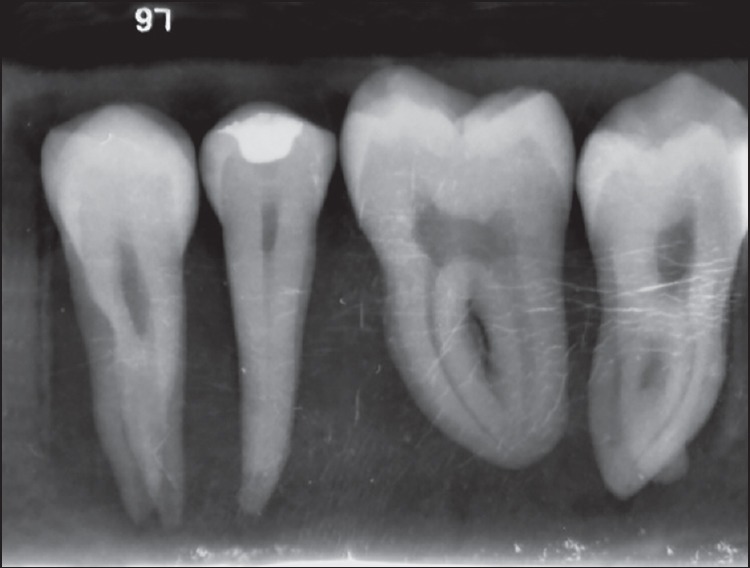
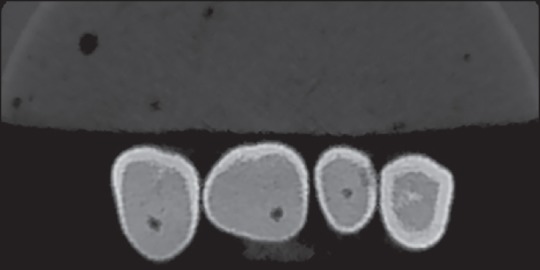
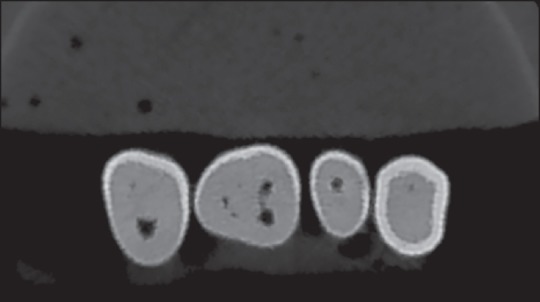
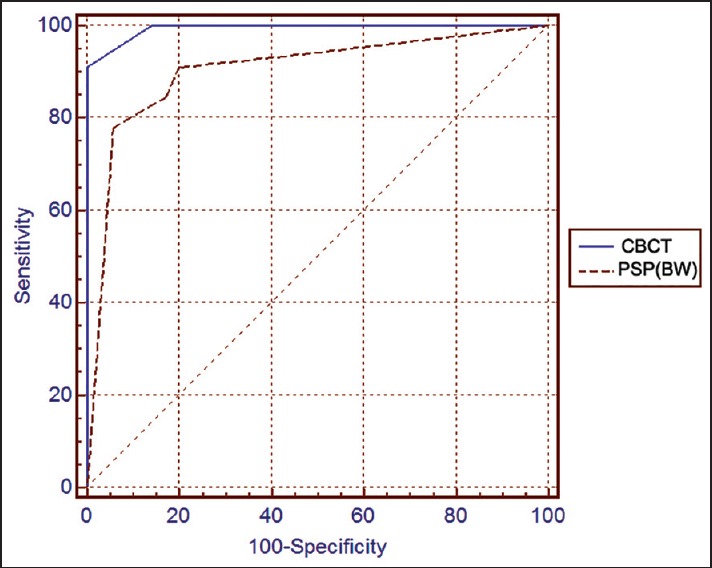
Materials and methods: In this in vitro descriptive-comparative study, a total of 80 slots of class I cavities were prepared on 80 extracted human premolars. Then, 40 teeth were randomly selected out of this sample and artificial carious lesions were created on these teeth by a round diamond bur no. 1/2. All 80 teeth were restored with amalgam fillings and radiographs were taken, both with PSP system and CBCT. All images were evaluated by three calibrated observers. The area under the receiver operating characteristic curve was used to compare the diagnostic accuracy of two systems. SPSS (SPSS Inc., Chicago, IL, USA) was adopted for statistical analysis. The difference between Az value of bitewing and CBCT methods were compared by pairwise comparison method. The inter- and intra-operator agreement was assessed by kappa analysis (P < 0.05).
Results: The mean Az value for bitewings and CBCT was 0.903 and 0.994, respectively. Significant differences were found between PSP and CBCT (P = 0.010). The kappa value for inter-observer agreement was 0.68 and 0.76 for PSP and CBCT, respectively. The kappa value for intra-observer agreement was 0.698 (observer 1, P = 0.000), 0.766 (observer 2, P = 0.000) and 0.716 (observer 3, P = 0.000) in PSP method, and 0.816 (observer 1, P = 0.000), 0.653 (observer 2, P = 0.000) and 0.744 (observer 3, P = 0.000) in CBCT method.
Conclusion: This in vitro study, with a limited number of samples, showed that the New Tom VGI Flex CBCT system was more accurate than the PSP in detecting the simulated small secondary occlusal caries under amalgam restoration.
Keywords: Cone-beam computed tomography; dental caries; dental radiograph; digital radiograph.
Conflict of interest statement
Figures
References
-
- White SC, Pharoah MJ. 6th ed. St. Louis: Mosby; 2009. Oral radiology principles and interpretation.
-
- Roberson TM, Heymann HO, Swift EJ. 6th ed. St. Louis: Mosby; 2012. Sturdevant's Art and Science of Operative Dentistry.
-
- Hintze H, Wenzel A. Influence of the validation method on diagnostic accuracy for caries. A comparison of six digital and two conventional radiographic systems. Dentomaxillofac Radiol. 2002;31:44–9. - PubMed
-
- Hintze H, Wenzel A, Frydenberg M. Accuracy of caries detection with four storage phosphor systems and E-speed radiographs. Dentomaxillofac Radiol. 2002;31:170–5. - PubMed
-
- Møystad A, Svanaes DB, Risnes S, Larheim TA, Gröndahl HG. Detection of approximal caries with a storage phosphor system. A comparison of enhanced digital images with dental X-ray film. Dentomaxillofac Radiol. 1996;25:202–6. - PubMed
LinkOut - more resources
Full Text Sources
Miscellaneous