. 2015 Apr 1:15:63.
doi: 10.1186/s12909-015-0346-x.

Teaching differential diagnosis in primary care using an inverted classroom approach: student satisfaction and gain in skills and knowledge

Affiliations

Teaching differential diagnosis in primary care using an inverted classroom approach: student satisfaction and gain in skills and knowledge

Stefan Bösner et al. BMC Med Educ. .

Abstract

Background: Differential diagnosis is a crucial skill for primary care physicians. General practice plays an increasing important role in undergraduate medical education. Via general practice, students may be presented with an overview of the whole spectrum of differential diagnosis in regard to common symptoms encountered in primary care. This project evaluated the impact of a blended learning program (using the inverted classroom approach) on student satisfaction and development of skills and knowledge.

Methods: An elective seminar in differential diagnosis in primary care, which utilized an inverted classroom design, was offered to students. Evaluation followed a mixed methods design: participants completed a pre- and post-test, a questionnaire, and a focus group discussion. Interviews were transcribed verbatim and answers were grouped according to different themes. Test results were analysed using the Wilcoxon matched-pairs signed-ranks test.

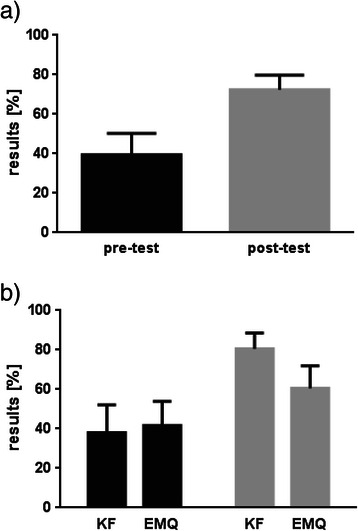
Results: Participants (n = 17) rated the course concept very positively. Especially the inverted classroom approach was appreciated by all students, as it allowed for more time during the seminar to concentrate on interactive and practice based learning. Students (n = 16) showed a post-test significant overall gain in skills and knowledge of 33%.

Conclusions: This study showed a positive effect of the inverted classroom approach on students' satisfaction and skills and knowledge. Further research is necessary in order to explore the potentials of this approach, especially the impact on development of clinical skills.


Figures
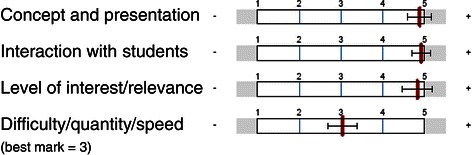
Figure 1
Figure 1
Global results of the summative evaluation (n = 17). 5 points are the best possible result; the category ‘difficulty/quantity/speed’ has 3 points as the best possible result. Red bars reflect mean values and horizontal bars reflect standard deviations.
Figure 2
Figure 2
Overall absolute gain in skills and knowledge and test results stratified according to test format (n = 16). KF = Key feature questions, EMQ = Extended Matching Questions. Upper part: Overall results of the written pre- and post-test including confidence intervals. Percentages of the total number of possible points are presented indicating absolute gain in skills and knowledge. Students showed significant improvement (p < 0.01). Lower part: Results of the written pre- (black color) and post-test (grey color) stratified by test format. For both formats a significant improvement could be demonstrated (p < 0.01).
Figure 3
Figure 3
Individual gain of participating students (n = 16). Gain in skills and knowledge of each individual course participant.

References

    1. Heneghan C, Glasziou P, Thompson M, Rose P, Balla J, Lasserson D, et al. Diagnostic strategies used in primary care. BMJ. 2009;338:b946. doi: 10.1136/bmj.b946. - DOI - PMC - PubMed
    1. Wübken M, Oswald J, Schneider A. Umgang mit diagnostischer Unsicherheit in der Hausarztpraxis. Z Evid Fortbild Qual Gesundhwes. 2013;107:632–637. doi: 10.1016/j.zefq.2013.10.017. - DOI - PubMed
    1. Brekke M, Carelli F, Zarbailov N, Javashvili G, Wilm S, Timonen M, et al. Undergraduate medical education in general practice/family medicine throughout Europe – a descriptive study. BMC Med Educ. 2013;13:157. doi: 10.1186/1472-6920-13-157. - DOI - PMC - PubMed
    1. Hull P, Chaudry A, Prasthofer A, Pattison G. Optimal sequencing of bedside teaching and computer-based learning: a randomised trial. Med Educ. 2009;43:108–112. doi: 10.1111/j.1365-2923.2008.03261.x. - DOI - PubMed
    1. Woltering V, Herrler A, Spitzer K, Spreckelsen C. Blended learning positively affects students’ satisfaction and the role of the tutor in the problem-based learning process: results of a mixed-method evaluation. Adv in Health Sci Educ. 2009;14:725–738. doi: 10.1007/s10459-009-9154-6. - DOI - PubMed

LinkOut - more resources