


Strengthening mental health systems in low- and middle-income countries: the Emerald programme
- PMID: 25879831
- PMCID: PMC4393637
- DOI: 10.1186/s12916-015-0309-4
Strengthening mental health systems in low- and middle-income countries: the Emerald programme
Abstract
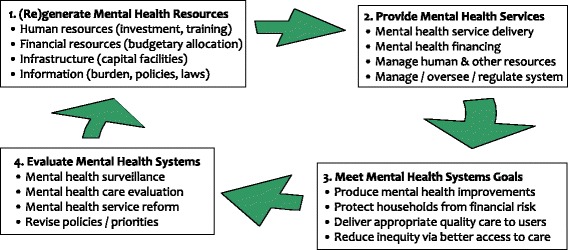
There is a large treatment gap for mental health care in low- and middle-income countries (LMICs), with the majority of people with mental, neurological, and substance use (MNS) disorders receiving no or inadequate care. Health system factors are known to play a crucial role in determining the coverage and effectiveness of health service interventions, but the study of mental health systems in LMICs has been neglected. The 'Emerging mental health systems in LMICs' (Emerald) programme aims to improve outcomes of people with MNS disorders in six LMICs (Ethiopia, India, Nepal, Nigeria, South Africa, and Uganda) by generating evidence and capacity to enhance health system performance in delivering mental health care. A mixed-methods approach is being applied to generate evidence on: adequate, fair, and sustainable resourcing for mental health (health system inputs); integrated provision of mental health services (health system processes); and improved coverage and goal attainment in mental health (health system outputs). Emerald has a strong focus on capacity-building of researchers, policymakers, and planners, and on increasing service user and caregiver involvement to support mental health systems strengthening. Emerald also addresses stigma and discrimination as one of the key barriers for access to and successful delivery of mental health services.
Figures
References
-
- World Health Organization. Q&As: Health systems. http://www.who.int/topics/health_systems/qa/en/index.html.
-
- United Nations General Assembly. Convention on the rights of persons with disabilities. UN, A/RES/61/106; 2006.
-
- Wolff J. The human right to health. New York: W.W. Norton & Company, Inc.; 2012.
-
- Murray CJL, Vos T, Lozano R, Naghavi M, Flaxman AD, Michaud C, et al. Disability-adjusted life years (DALYs) for 291 diseases and injuries in 21 regions, 1990–2010: a systematic analysis for the Global Burden of Disease study 2010. Lancet. 2012;380:2197–223. doi: 10.1016/S0140-6736(12)61689-4. - DOI - PubMed
-
- World Health Organization. Global Health Estimates (GHE). http://www.who.int/healthinfo/global_burden_disease/en/.
Publication types
MeSH terms
Grants and funding
LinkOut - more resources
Full Text Sources
Other Literature Sources
Medical
Miscellaneous
