


Economic evaluation of a group-based exercise program for falls prevention among the older community-dwelling population
- PMID: 25879871
- PMCID: PMC4404560
- DOI: 10.1186/s12877-015-0028-x
Economic evaluation of a group-based exercise program for falls prevention among the older community-dwelling population
Abstract
Background: Falls among older people are of growing concern globally. Implementing cost-effective strategies for their prevention is of utmost importance given the ageing population and associated potential for increased costs of fall-related injury over the next decades. The purpose of this study was to undertake a cost-utility analysis and secondary cost-effectiveness analysis from a healthcare system perspective, of a group-based exercise program compared to routine care for falls prevention in an older community-dwelling population.
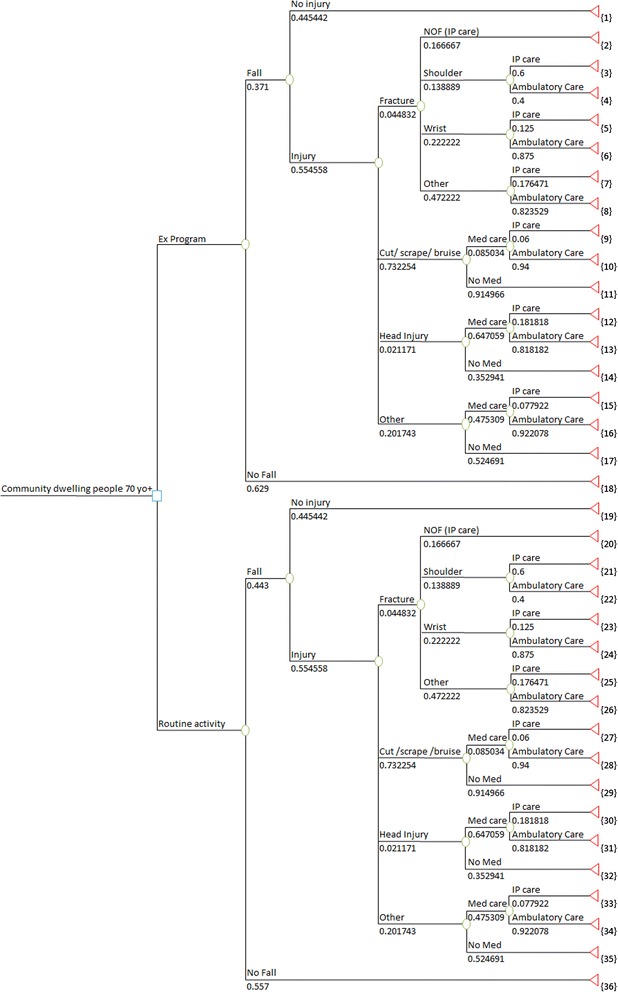
Methods: A decision analysis using a decision tree model was based on the results of a previously published randomised controlled trial with a community-dwelling population aged over 70. Measures of falls, fall-related injuries and resource use were directly obtained from trial data and supplemented by literature-based utility measures. A sub-group analysis was performed of women only. Cost estimates are reported in 2010 British Pound Sterling (GBP).
Results: The ICER of GBP£51,483 per QALY for the base case analysis was well above the accepted cost-effectiveness threshold of GBP£20,000 to £30,000 per QALY, but in a sensitivity analysis with minimised program implementation the incremental cost reached GBP£25,678 per QALY. The ICER value at 95% confidence in the base case analysis was GBP£99,664 per QALY and GBP£50,549 per QALY in the lower cost analysis. Males had a 44% lower injury rate if they fell, compared to females resulting in a more favourable ICER for the women only analysis. For women only the ICER was GBP£22,986 per QALY in the base case and was below the cost-effectiveness threshold for all other variations of program implementation. The ICER value at 95% confidence was GBP£48,212 in the women only base case analysis and GBP£23,645 in the lower cost analysis. The base case incremental cost per fall averted was GBP£652 (GBP£616 for women only). A threshold analysis indicates that this exercise program cannot realistically break even.
Conclusions: The results suggest that this exercise program is cost-effective for women only. There is no evidence to support its cost-effectiveness in a group of mixed gender unless the costs of program implementation are minimal. Conservative assumptions may have underestimated the true cost-effectiveness of the program.
Figures
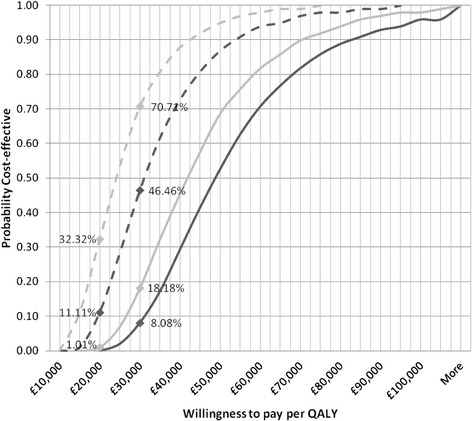
 AHA: Base Case.
  AHA: No Venue and minimal equipment cost.
  Fitness Instructor: Base Case.
  Fitness Instructor: No venue and minimal equipment cost.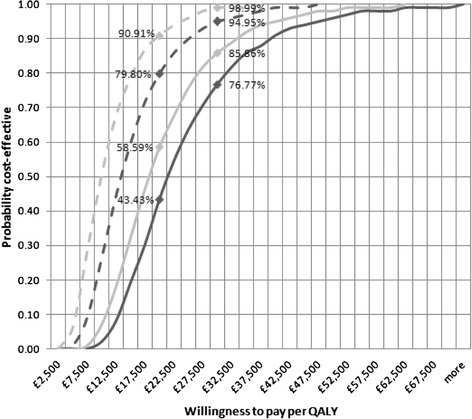
 AHA: Base Case.
  AHA: No Venue and minimal equipment cost.
  Fitness Instructor: Base Case.
  Fitness Instructor: No venue and minimal equipment cost.
References
-
- World Health Organization (2007). WHO global report on falls prevention in older age. [http://www.who.int/ageing/publications/Falls_prevention7March.pdf]
-
- Australian Government Department of Health and Ageing. An analysis of research on preventing falls and falls injury in older people: Community, residential care and hospital settings (2004 update). [http://www.health.gov.au/internet/main/publishing.nsf/Content/health-pub...]
Publication types
MeSH terms
LinkOut - more resources
Full Text Sources
Other Literature Sources
Medical
Research Materials
