. 2015 Aug:482:218-24.
doi: 10.1016/j.virol.2015.03.035. Epub 2015 Apr 14.

Canine distemper virus neutralization activity is low in human serum and it is sensitive to an amino acid substitution in the hemagglutinin protein

Affiliations

Canine distemper virus neutralization activity is low in human serum and it is sensitive to an amino acid substitution in the hemagglutinin protein

Xinsheng Zhang et al. Virology. 2015 Aug.

Abstract

Serum was analyzed from 146 healthy adult volunteers in eastern Africa to evaluate measles virus (MV) and canine distemper virus (CDV) neutralizing antibody (nAb) prevalence and potency. MV plaque reduction neutralization test (PRNT) results indicated that all sera were positive for MV nAbs. Furthermore, the 50% neutralizing dose (ND50) for the majority of sera corresponded to antibody titers induced by MV vaccination. CDV nAbs titers were low and generally were detected in sera with high MV nAb titers. A mutant CDV was generated that was less sensitive to neutralization by human serum. The mutant virus genome had 10 nucleotide substitutions, which coded for single amino acid substitutions in the fusion (F) and hemagglutinin (H) glycoproteins and two substitutions in the large polymerase (L) protein. The H substitution occurred in a conserved region involved in receptor interactions among morbilliviruses, implying that this region is a target for cross-reactive neutralizing antibodies.

Keywords: Canine distemper virus; Cross-neutralization; Hemagglutinin; Measles virus; Neutralizing antibody; Plaque reduction neutralization test; Pre-existing immunity.


Figures

Fig. 1
Fig. 1
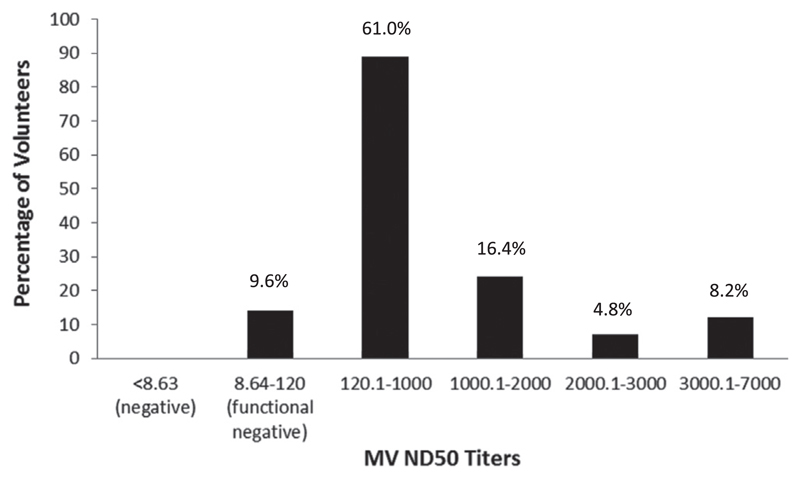
Distribution of MV nAb titers. Negative threshold was defined as the average nAb titer of unvaccinated monkey serum plus 3 × standard deviation. Functional negative threshold was ND50 titers 120 since MV ND50 titer slower than that do not prevent measles (Chen et al., 1990). For the 146 volunteers, 90.4% had MV titers higher than 120 and majority of the titers were in ranges of 120.1–1000(61.0%) and 1000–2000 (16.4%), which correspond to MV antibodies induced by vaccinations (Hussain et al., 2013; Leuridan et al., 2010).
Fig. 2
Fig. 2
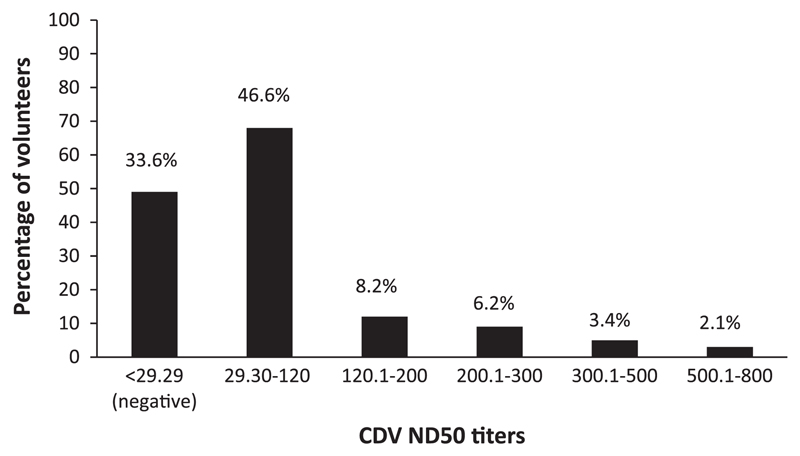
Distribution of CDV nAb titers. Negative threshold was defined as the average ND50 titer of unvaccinated ferret serum plus 3 × standard deviation. Total 80.2% of the volunteers had CDV ND50 titers either below the negative threshold or in 29.30–120 range.
Fig. 3
Fig. 3
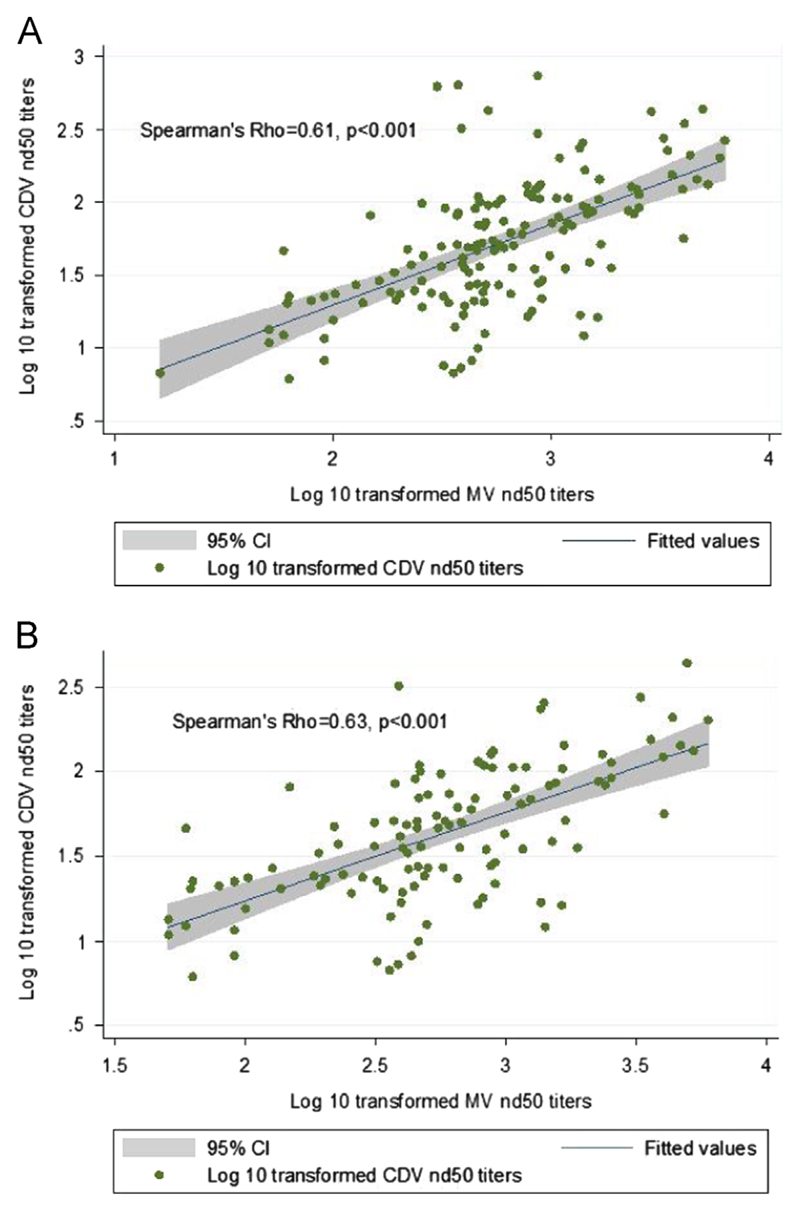
Strong correlation was found between MV and CDV nAb using Spearman's rank correlation analysis. (A) Correlation statistics from analyzing MV and CDV nAb titers of all 146 volunteers (Spearman's coefficient ρ=0.61, p < 0.001) suggest that CDV neutralization is due to cross-reactive MV nAbs that are present at low quantities in the volunteers who had relatively high MV nAb titers. Relationship between log 10 transformed MV and CDV ND50 titers is shown by the fitted line. The shaded area represented 95% confidence interval of the fitted values. (B) Analysis of the nAb values from the remaining 116 volunteers after excluding data points of Masaka CRC still showed a strong correlation between the MV and CDV nAb titers (Spearman's coefficient ρ=0.63, p < 0.001) and thus indicated that the observed correlation was general and was not due to the individual CRC in which the volunteers had relatively high level of CDV nAbs.
Fig. 4
Fig. 4
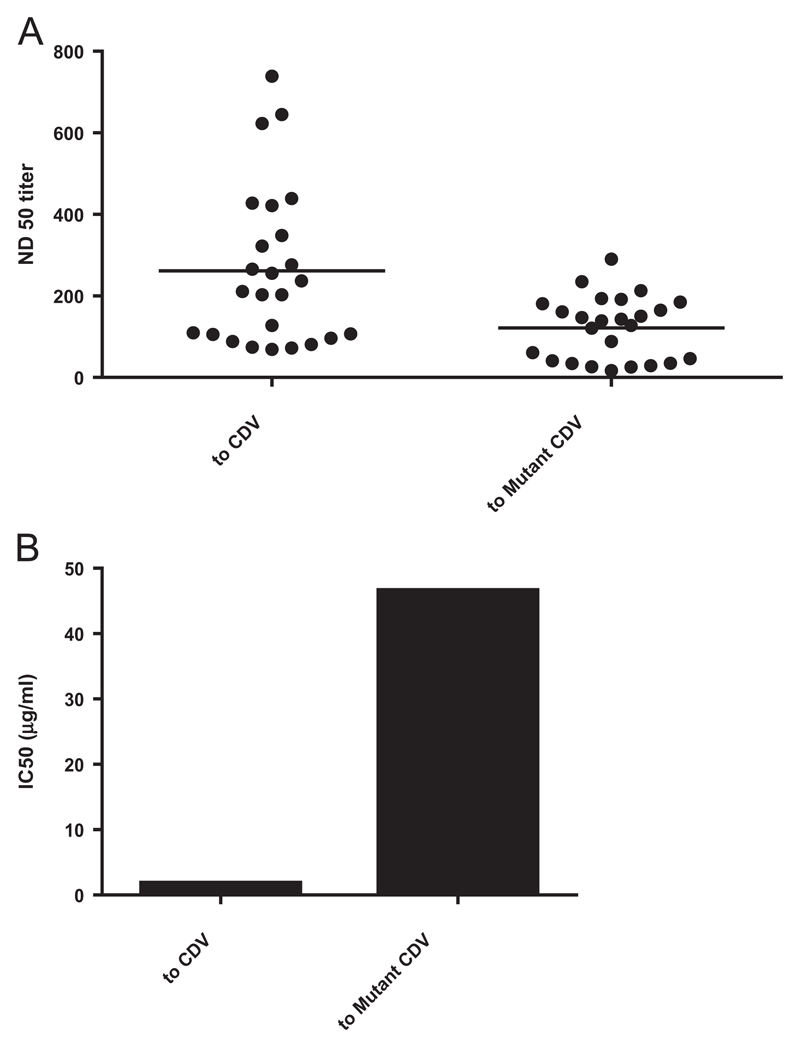
Neutralization of CDV and the neutralization-resistant mutant by human serum and mAb 2F4. (A) ND50 titers of serum. Dots on the left represent 25 serum samples randomly selected from the 146 volunteers and the two lines represented mean ND50 values to each virus. The average ND50 titer to mutant CDV was 2.1 fold lower than that to CDV indicating the mutant CDV was more resistant to the serum neutralization. (B) IC50 of the 2F4 antibody. The bars represented concentrations of the 2F4 antibody needed to neutralize 50% of the input CDV or the CDV mutant. The highest dilution of the monoclonal antibody causing 50% neutralization of CDV was 1017 and calculated IC50 was 1.8 μg/ml based on this dilution. In contrast, the maximal dilution to neutralize 50% of the mutant virus was only 39.7, which was equivalent to IC50 of 46.6 μg/ml, suggesting the Y to D substitution in the receptor binding site of H diminished the antibody binding.
Fig. 5
Fig. 5
Mutation in F gene of the neutralization escape CDV isolate. A point mutation changed the tyrosine to serine at aa position 48 as highlighted in bold. The mutation locates in signal peptide region of CDV F. The signal peptide is from amino acid 1–135 in precursor F protein (Plattet et al., 2007) and residues 1–50 are shown.
Fig. 6
Fig. 6
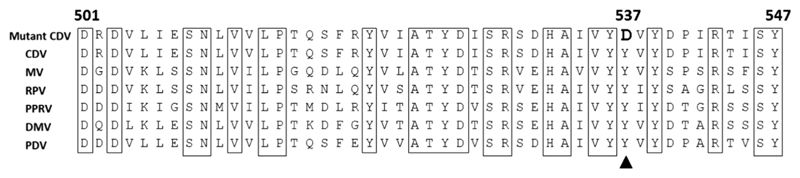
Alignment of aa 501–547 of CDV H and corresponding regions in H proteins of MV, rinderpest virus (P09460), peste des petits ruminants virus (PPRV AHA58209), dolphin morbillivirus (DMV Q66411) and phocine distemper virus (PDV P28882). Amino acid residues conserved among all 6 morbilliviruses are boxed. The CDV H is 607 aa in length and the point mutation changed Y to D at aa position 537 (pointed by the triangular arrow) in H of the neutralization-resistant mutant. This sequence corresponds to aa 505–551 in MV H (Masse et al., 2004), which is involved in H binding to MV receptors and is fully conserved among a variety of MV isolates including Edmonston, Schwarz, Moraten and Zagreb vaccine viruses (H protein sequence accession # in GenBank: P08362, AAA566657, CAL40872, and AM237414, respectively).

References

    1. Appel MJ, Shek WR, Shesberadaran H, Norrby E. Measles virus and inactivated canine distemper virus induce incomplete immunity to canine distemper. Arch Virol. 1984;82:73–82. - PubMed
    1. Blixenkrone-Moller M. Biological properties of phocine distemper virus and canine distemper virus. APMIS Suppl. 1993;36:1–51. - PubMed
    1. Brandler S, Lucas-Hourani M, Moris A, Frenkiel MP, Combredet C, Fevrier M, Bedouelle H, Schwartz O, Despres P, Tangy F. Pediatric measles vaccine expressing a dengue antigen induces durable serotype-specific neutralizing antibodies to dengue virus. PLoS Negl Trop Dis. 2007;1:e96. - PMC - PubMed
    1. Brandler S, Tangy F. Recombinant vector derived from live attenuated measles virus: potential for flavivirus vaccines. Comp Immunol Microbiol Infect Dis. 2008;31:271–291. - PubMed
    1. Buczkowski H, Muniraju M, Parida S, Banyard AC. Morbillivirus vaccines: recent successes and future hopes. Vaccine. 2014;32:3155–3161. - PMC - PubMed

Publication types

MeSH terms

Associated data