


Impact on glycated haemoglobin of a biological response-based measure of medication adherence
- PMID: 25880136
- PMCID: PMC5033018
- DOI: 10.1111/dom.12476
Impact on glycated haemoglobin of a biological response-based measure of medication adherence
Abstract
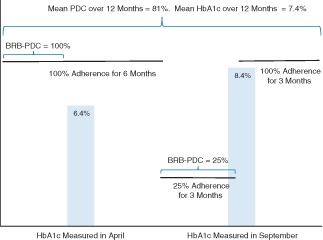
Aims: The aim of this study was to examine the relationship between a specific glycated haemoglobin (HbA1c) measurement and a pharmaceutical dispensings-based measure of adherence calculated over the 90 days before each HbA1c measure among patients who have newly initiated metformin therapy.
Methods: We identified 3109 people with type 2 diabetes who initiated metformin as their first-ever antihyperglycaemic drug, analysing all 9918 HbA1c measurements that were taken over the next 2 years. We used an adaptation of the 'proportion of days covered' method for assessing medication adherence that corresponded to an ∼90-day interval preceding an HbA1c measurement, terming the adaptation the 'biological response-based proportion of days covered' (BRB-PDC). To account for multiple observations per patient, we analysed the association between HbA1c and BRB-PDC within the generalized estimating equation framework. Analyses were stratified by HbA1c level before metformin initiation using a threshold of 8% (64 mmol/mol).
Results: After multivariable adjustment using 0% adherence as the reference category, BRB-PDC in the range 50-79% was associated with HbA1c values lower by -0.113 [95% confidence interval (CI) -0.202, -0.025] among patients with pre-metformin HbA1c <8%, and by -0.247 (95% CI -0.390, -0.104) among those with HbA1c ≥8% at metformin initiation. Full adherence (≥80%) was associated with HbA1c values lower by -0.175% (95% CI -0.257, -0.093) and by -0.453% (95% CI -0.586, -0.320).
Conclusions: Using this novel short-interval approach that more closely associates adherence with the expected biological response, the association between better adherence and HbA1c levels was considerably stronger than has been previously reported; however, the strength of the impact was dependent upon the HbA1c level before initiating metformin.
Keywords: glycaemic control; metformin; observational study; pharmaco-epidemiology.
© 2015 The Authors. Diabetes, Obesity and Metabolism published by John Wiley & Sons Ltd.
Figures
References
-
- Cramer JA. A systematic review of adherence with medications for diabetes. Diabetes Care 2004; 27: 1218–1224. - PubMed
-
- Asche C, LaFleur J, Conner CA. Review of diabetes treatment adherence and the association with clinical and economic outcomes. Clin Ther 2011; 33: 74–109. - PubMed
-
- Sacks DB, John WG. Interpretation of hemoglobin A1c values. JAMA 2014; 311: 2271–2272. - PubMed
Publication types
MeSH terms
Substances
LinkOut - more resources
Full Text Sources
Other Literature Sources
Medical
