. 2015 Mar 13:16:6.
doi: 10.1186/s12867-015-0036-6.

Mechanical stimulation of human tendon stem/progenitor cells results in upregulation of matrix proteins, integrins and MMPs, and activation of p38 and ERK1/2 kinases

Affiliations

Mechanical stimulation of human tendon stem/progenitor cells results in upregulation of matrix proteins, integrins and MMPs, and activation of p38 and ERK1/2 kinases

Cvetan Popov et al. BMC Mol Biol. .

Abstract

Background: Tendons are dense connective tissues subjected periodically to mechanical stress upon which complex responsive mechanisms are activated. These mechanisms affect not only the development of these tissues but also their healing. Despite of the acknowledged importance of the mechanical stress for tendon function and repair, the mechanotransduction mechanisms in tendon cells are still unclear and the elucidation of these mechanisms is a key goal in tendon research. Tendon stem/progenitor cells (TSPC) possess common adult stem cell characteristics, and are suggested to actively participate in tendon development, tissue homeostasis as well as repair. This makes them an important cell population for tendon repair, and also an interesting research target for various open questions in tendon cell biology. Therefore, in our study we focused on TSPC, subjected them to five different mechanical protocols, and investigated the gene expression changes by using semi-quantitative, quantitative PCR and western blotting technologies.

Results: Among the 25 different genes analyzed, we can convincingly report that the tendon-related genes - fibromodulin, lumican and versican, the collagen I-binding integrins - α1, α2 and α11, the matrix metalloproteinases - MMP9, 13 and 14 were strongly upregulated in TSPC after 3 days of mechanical stimulation with 8% amplitude. Molecular signaling analyses of five key integrin downstream kinases suggested that mechanical stimuli are mediated through ERK1/2 and p38, which were significantly activated in 8% biaxial-loaded TSPC.

Conclusions: Our results demonstrate the positive effect of 8% mechanical loading on the gene expression of matrix proteins, integrins and matrix metalloproteinases, and activation of integrin downstream kinases p38 and ERK1/2 in TSPC. Taken together, our study contributes to better understanding of mechanotransduction mechanisms in TPSC, which in long term, after further translational research between tendon cell biology and orthopedics, can be beneficial to the management of tendon repair.


Figures
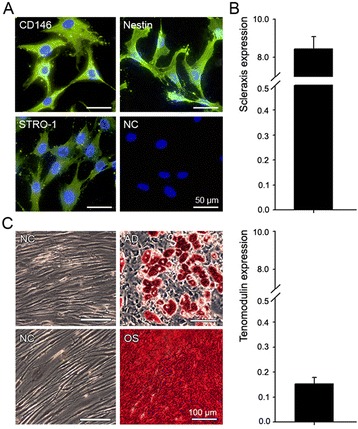
Figure 1
Figure 1
Characterization of the human TSPC. (A) Expression of CD146, Nesitn and STRO-1 stem cell markers demonstrated by immunocytochemistry; NC – negative control, cells incubated only with secondary antibody. Bar 50 μm. (B) Quantitative PCR analyses for Scleraxis and tenomodulin gene expression in TSPC, demonstrated as a ratio to HPRT housekeeping gene. (C) Adipogenic and osteogenic stimulation of TSPC for 21 days. Adipogenic (AD) and osteogenic (OS) differentiation visualized by Oil Red-O and Alizarin red staining, correspondingly; NC – negative control, unstimulated cells. Bar 100 μm. Data is representative of 3 donors, each used in 3 independent experiments.
Figure 2
Figure 2
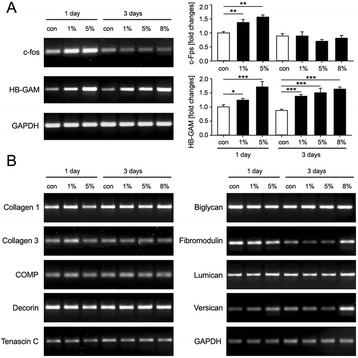
Expression of mechanoresponsive and extracellular matrix genes upon mechanical stimulation of TSPC. (A) RT-PCR for c-fos and HB-GAM expression changes after 1 and 3 days stimulation with 1, 5 and 8% mechanical stress. PCR densitometric quantification is shown as fold changes to the unstimulated controls; *p < 0.1, **p < 0.05, ***p < 0.01. (B) RT-PCR analysis for collagen 1 and 3, and tendon-related proteoglycans (COMP, decorin, tenascin C, biglycan, fibromodulin, lumican and versican). Data is representative of 3 donors, each used in 3 independent experiments.
Figure 3
Figure 3
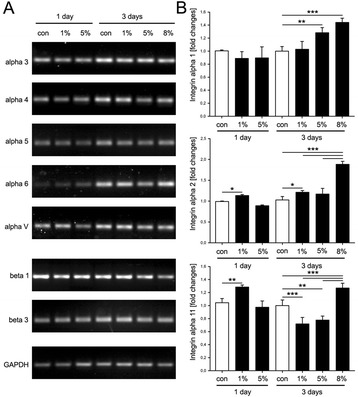
Integrin expression changes after mechanical stimulation of TSPC. (A) RT-PCR analysis of integrin alpha 3, 4, 5, 6 and V, and beta 1 and 3 in TSPC stimulated with 1, 5 and 8% strain for 1 and 3 days. (B) Quantitative PCR analysis for integrin alpha 1, 2 and 11 (fold change to the non-stimulated TSPC at day 1). Data is representative of 3 donors each used in 3 independent experiments; *p < 0.1, **p < 0.05, ***p < 0.01.
Figure 4
Figure 4
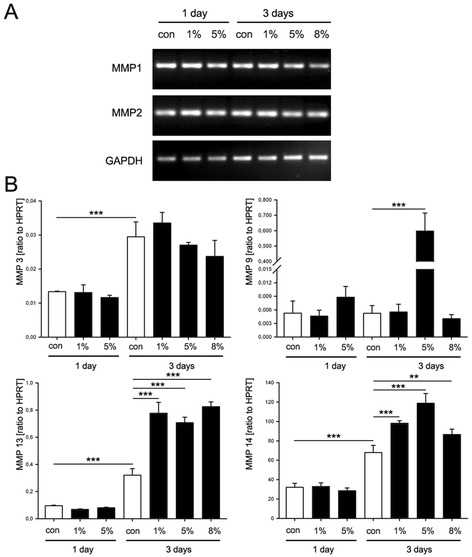
Gene expression of matrix metalloproteinases upon mechanical stimulation of TSPC. (A) RT-PCR analysis for MMP1 and MMP2. (B) Quantitative PCR analysis for MMP3, MMP9, MMP13 and MMP14 (ratio to HPRT housekeeping gene). Data is representative of 3 donors, each used in 3 independent experiments; *p < 0.1, **p < 0.05, ***p < 0.01.
Figure 5
Figure 5
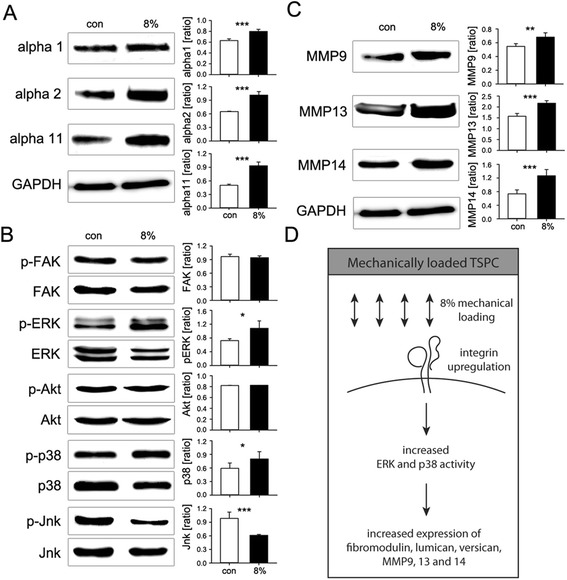
Western blotting analysis for collagen-binding integrins, integrin-downstream kinases and matrix metalloproteinases upon 8% mechanical stimulation of TSPC. (A) Collagen I-binding integrins α1, α2 and α11 (ratio to GAPDH protein expression); (B) Phosphorylated and total levels of FAK, ERK, Akt, p38 and Jnk (ratio phospho-/total protein); (C) MMP9, 13 and 14 (ratio to GAPDH). (D) Schematic summary of the changes occurring in TSPC upon 8% biaxial mechanical loading. Data is representative of 3 donors, each used in 3 independent experiments; *p < 0.1, **p < 0.05, ***p < 0.01.

References

    1. Bi Y, Ehirchiou D, Kilts TM, Inkson CA, Embree MC, Sonoyama W, et al. Identification of tendon stem/progenitor cells and the role of the extracellular matrix in their niche. Nat Med. 2007;13(10):1219–27. doi: 10.1038/nm1630. - DOI - PubMed
    1. Docheva D, Popov C, Alberton P, Aszodi A. Integrin signaling in skeletal development and function. Birth defects research Part C, Embryo today: reviews. 2014;102(1):13–36. doi: 10.1002/bdrc.21059. - DOI - PubMed
    1. Mammoto A, Mammoto T, Ingber DE. Mechanosensitive mechanisms in transcriptional regulation. J Cell Sci. 2012;125(Pt 13):3061–73. doi: 10.1242/jcs.093005. - DOI - PMC - PubMed
    1. Kjaer M. Role of extracellular matrix in adaptation of tendon and skeletal muscle to mechanical loading. Physiol Rev. 2004;84(2):649–98. doi: 10.1152/physrev.00031.2003. - DOI - PubMed
    1. Maeda E, Shelton JC, Bader DL, Lee DA. Differential regulation of gene expression in isolated tendon fascicles exposed to cyclic tensile strain in vitro. J Appl Physiol. 2009;106(2):506–12. doi: 10.1152/japplphysiol.90981.2008. - DOI - PubMed

Publication types