


Performance of a multiplexed dual analyte immunoassay for the early detection of non-small cell lung cancer
- PMID: 25880432
- PMCID: PMC4335536
- DOI: 10.1186/s12967-015-0419-y
Performance of a multiplexed dual analyte immunoassay for the early detection of non-small cell lung cancer
Abstract
Objectives: "PAULA's" test (Protein Assays Utilizing Lung cancer Analytes) is a novel multiplex immunoassay blood test that incorporates both tumor antigens and autoantibodies to determine the risk that lung cancer (LC) is present in individuals from a high-risk population. The test's performance characteristics were evaluated in a study using 380 retrospective clinical serum samples.
Methods: PAULA's test is performed on the Luminex xMAP technology platform, and detects a panel of 3 tumor antigens (CEA, CA-125, and CYFRA 21-1) and 1 autoantibody marker (NY-ESO-1). A training set (n = 230) consisting of 115 confirmed diagnoses of non-small cell lung carcinoma (NSCLC) cases and 115 age- and smoking history-matched controls was used to develop the LC predictive model. Data from an independent matched validation set (n = 150) was then used to evaluate the model developed, and determine the ability of the test to distinguish NSCLC cases from controls.
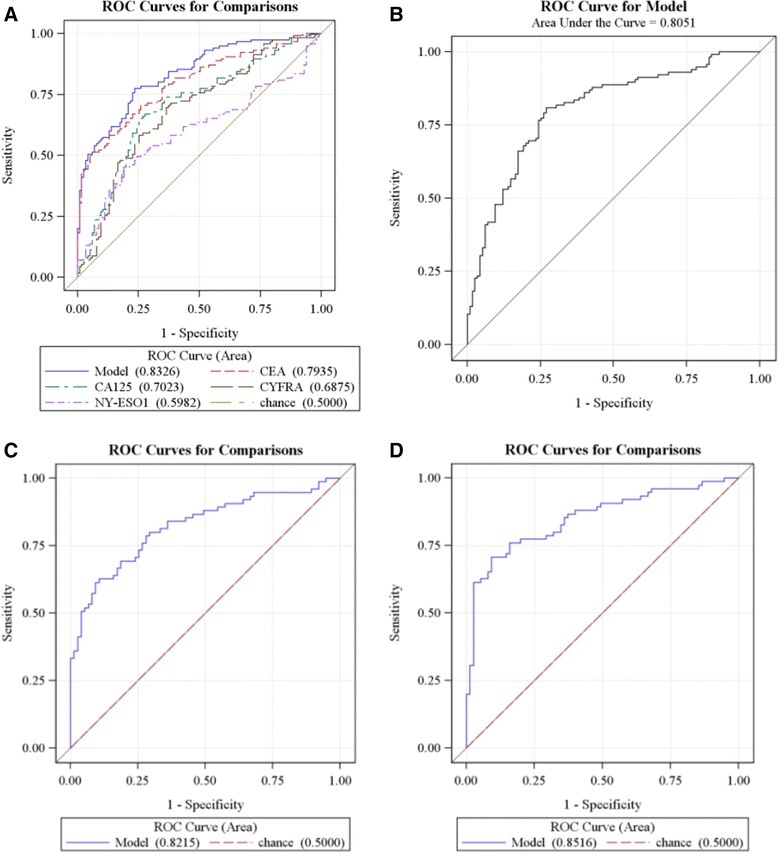
Results: The 4-biomarker panel was able to discriminate NSCLC cases from controls with 74% sensitivity, 80% specificity, and 0.81 AUC in the training set and with 77% sensitivity, 80% specificity, and 0.85 AUC in the independent validation set. The use of NY-ESO-1 autoantibodies substantially increased the overall sensitivity of NSCLC detection as compared to the 3 tumor markers alone. Overall, the multiplexed 4-biomarker panel assay demonstrated comparable performance to a previously employed 8-biomarker non-multiplexed assay.
Conclusions: These studies confirm the value of using a mixed panel of tumor antigens and autoantibodies in the early detection of NSCLC in high-risk individuals. The results demonstrate that the performance of PAULA's test makes it suitable for use as an aid to determine which high-risk patients need to be directed to appropriate noninvasive diagnostic follow-up testing, especially low-dose CT (LDCT).
Figures

References
-
- American Cancer Society. Cancer Facts and Figures 2014. Atlanta, GA; (http://www.cancer.org/research/cancerfactsstatistics/cancerfactsfigures2...)
-
- Centers for Disease Control and Prevention Smoking-attributable mortality, years of potential life lost, and productivity losses – United States, 2000–2004. MMWR Morb Mortal Wkly Rep. 2008;57(45):1226–8. - PubMed
-
- US Department of Health and Human Services . The Health Consequences of Smoking—50 Years of Progress. A Report of the Surgeon General. Atlanta, GA: US Department of Health and Human Services, Centers for Disease Control and Prevention, National Center for Chronic Disease Prevention and Health Promotion, Office on Smoking and Health; 2014.
MeSH terms
Substances
LinkOut - more resources
Full Text Sources
Other Literature Sources
Medical
Research Materials
Miscellaneous
