


Ranibizumab for macular edema secondary to retinal vein occlusion: a meta-analysis of dose effects and comparison with no anti-VEGF treatment
- PMID: 25881069
- PMCID: PMC4381461
- DOI: 10.1186/s12886-015-0017-z
Ranibizumab for macular edema secondary to retinal vein occlusion: a meta-analysis of dose effects and comparison with no anti-VEGF treatment
Abstract
Background: To compare the efficacy and tolerability of intravitreal ranibizumab (IVR) 0.5 mg or 0.3 mg with non-anti-vascular endothelial growth factor (VEGF), and to compare the efficacy of IVR 0.5 mg with IVR 0.3 mg in the treatment of macular edema secondary to retinal vein occlusion.
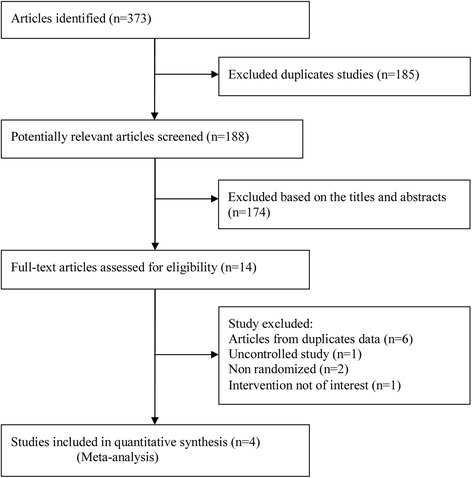
Methods: Relevant studies were selected after an extensive search using the PubMed, EMBASE, Web of Science, and Cochrane Library databases. Outcomes of interest included visual outcomes, anatomic variables, and adverse events.
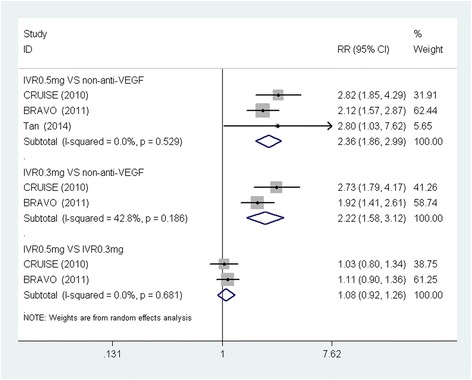
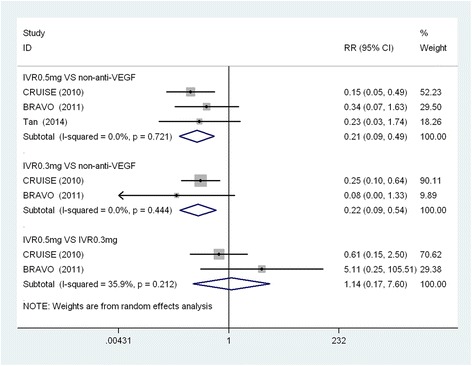
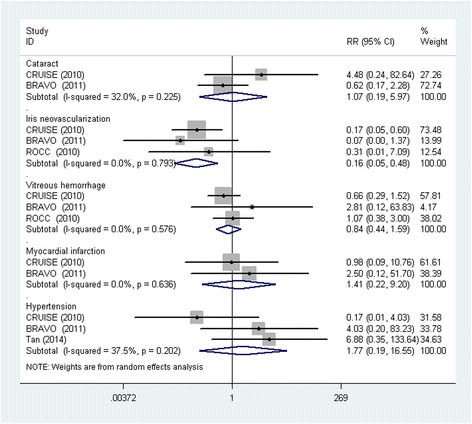
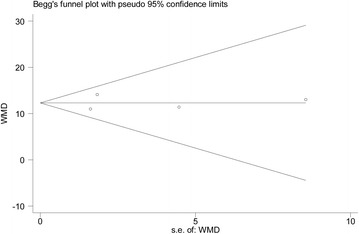
Results: Four randomized controlled trials (RCTs) met our inclusion criteria. IVR 0.5 mg produced a significantly higher improvement in visual acuity at six months, with pooled weighted mean differences (WMDs) of 12.30 early treatment diabetic retinopathy study (ETDRS) letters (95% CI:10.03, 14.58) (P < 0.001),and led to a higher proportion of patients gaining ≥ 15 letters (RR, 2.36; 95%CI: 1.86, 2.99; P < 0.001) at the follow-up endpoint, compared with non-anti-VEGF. A more obvious reduction in central foveal thickness (CFT) was observed in the IVR 0.5 mg group than the non-anti-VEGF group, and the mean difference in CFT was statistically significant (WMD, -216.86 μm; 95%CI: -279.01, -154.71; P < 0.001). A similar efficacy was found between the IVR 0.3 mg group and the non-anti-VEGF group. No significant differences were found between IVR 0.5 mg and 0.3 mg. The incidence of iris neovascularization in the non-anti-VEGF group was significantly higher than that of the IVR group.
Conclusions: IVR 0.5 mg or 0.3 mg was more effective than sham injection and laser treatment. IVR 0.3 mg is as effective as IVR 0.5 mg in the treatment of macular edema secondary to retinal vein occlusion.
Figures
References
Publication types
MeSH terms
Substances
LinkOut - more resources
Full Text Sources
Other Literature Sources
Miscellaneous
