


Adipose Tissue Free Fatty Acid Storage In Vivo: Effects of Insulin Versus Niacin as a Control for Suppression of Lipolysis
- PMID: 25883112
- PMCID: PMC4512218
- DOI: 10.2337/db14-1409
Adipose Tissue Free Fatty Acid Storage In Vivo: Effects of Insulin Versus Niacin as a Control for Suppression of Lipolysis
Abstract
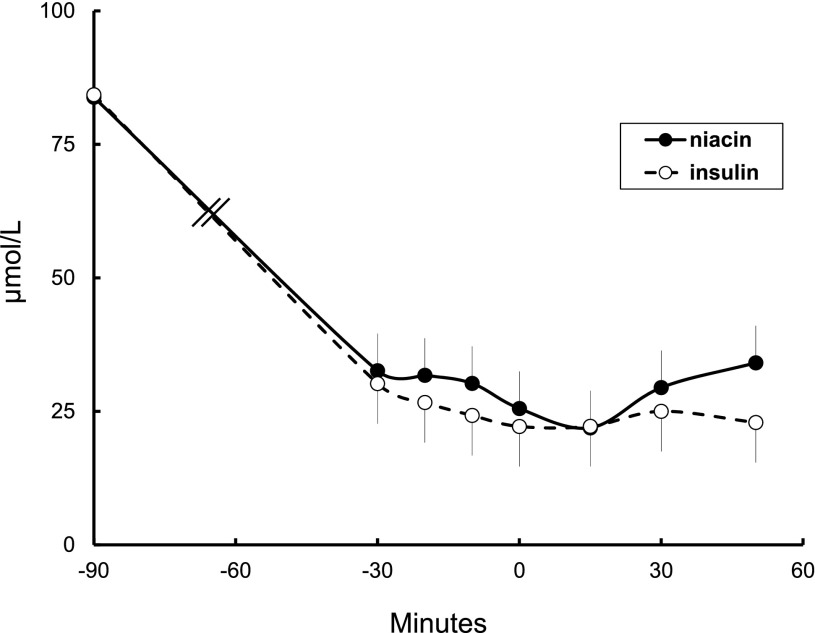
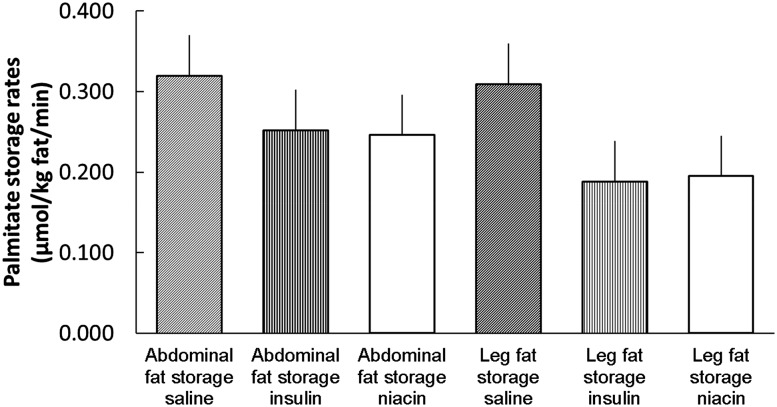
Insulin stimulates the translocation fatty acid transport protein 1 (FATP1) to plasma membrane, and thus greater free fatty acid (FFA) uptake, in adipocyte cell models. Whether insulin stimulates greater FFA clearance into adipose tissue in vivo is unknown. We tested this hypothesis by comparing direct FFA storage in subcutaneous adipose tissue during insulin versus niacin-medicated suppression of lipolysis. We measured direct FFA storage in abdominal and femoral subcutaneous fat in 10 and 11 adults, respectively, during euglycemic hyperinsulinemia or after oral niacin to suppress FFA compared with 11 saline control experiments. Direct palmitate storage was assessed using a [U-(13)C]palmitate infusion to measure palmitate kinetics and an intravenous palmitate radiotracer bolus/timed biopsy. Plasma palmitate concentrations and flux were suppressed to 23 ± 3 and 26 ± 5 µmol ⋅ L(-1) (P = 0.91) and 44 ± 4 and 39 ± 5 µmol ⋅ min(-1) (P = 0.41) in the insulin and niacin groups, respectively, much less (P < 0.001) than the saline control group (102 ± 8 and 104 ± 12 µmol ⋅ min(-1), respectively). In the insulin, niacin, and saline groups, abdominal palmitate storage rates were 0.25 ± 0.05 vs. 0.25 ± 0.07 vs. 0.32 ± 0.05 µmol ⋅ kg adipose lipid(-1) ⋅ min(-1), respectively (P = NS), and femoral adipose storage rates were 0.19 ± 0.06 vs. 0.20 ± 0.05 vs. 0.31 ± 0.05 µmol ⋅ kg adipose lipid(-1) ⋅ min(-1), respectively (P = NS). In conclusion, insulin does not increase FFA storage in adipose tissue compared with niacin, which suppresses lipolysis via a different pathway.
© 2015 by the American Diabetes Association. Readers may use this article as long as the work is properly cited, the use is educational and not for profit, and the work is not altered.
Figures
References
-
- Björntorp P. Adipose tissue distribution and function. Int J Obes 1991;15(Suppl. 2):67–81 - PubMed
-
- Kissebah AH, Krakower GR. Regional adiposity and morbidity. Physiol Rev 1994;74:761–811 - PubMed
-
- Romanski SA, Nelson RM, Jensen MD. Meal fatty acid uptake in adipose tissue: gender effects in nonobese humans. Am J Physiol Endocrinol Metab 2000;279:E455–E462 - PubMed
Publication types
MeSH terms
Substances
Grants and funding
LinkOut - more resources
Full Text Sources
Other Literature Sources
Medical
Research Materials
Miscellaneous
