


Rationale and methods of a randomised cross-over cluster trial to assess the effectiveness of MOVI-KIDS on preventing obesity in pre-schoolers
- PMID: 25884885
- PMCID: PMC4350633
- DOI: 10.1186/s12889-015-1512-0
Rationale and methods of a randomised cross-over cluster trial to assess the effectiveness of MOVI-KIDS on preventing obesity in pre-schoolers
Abstract
Background: Childhood obesity has become an alarming worldwide increasing public health problem. The earlier adiposity rebound occurs, the greater the risk of becoming obese during puberty and adolescence. It has been speculated about the potential influence of vigorous physical activity on modifying the age of onset of adiposity rebound. Moreover, studies aimed to evaluate the effectiveness of physical activity interventions programs on reducing adiposity and other cardiovascular risk factors in children younger than 6 years are scarce. This paper describes the rationale and methods of a study aimed to test the effectiveness of a two-years multidimensional pre-school intervention on preventing obesity and improving physical fitness during the adiposity rebound period.
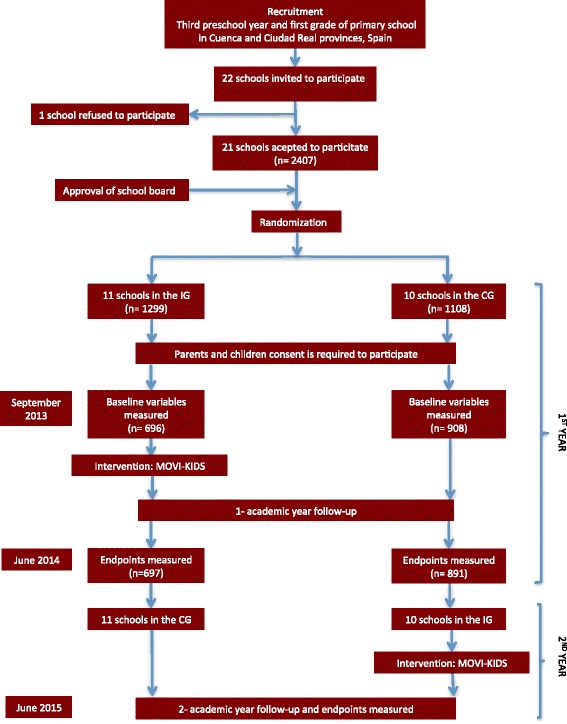
Methods/design: Twenty-one schools from the provinces of Cuenca and Ciudad Real, Spain, were randomised to an intervention and a control arm. In the first academic year, children in third grade of pre-school and first grade of primary school in the intervention group received the physical activity intervention (MOVI-KIDS). After an academic year schools were crossed over to the alternative arm. According to the socio-ecological model, the intervention included children, their parents and teachers, and the school environment where MOVI-KIDS was conducted. MOVI-KIDS consisted of: i) three-h/week sessions of recreational non-competitive physical activity in after-school time; ii) educational materials to parents and teachers about physical activity benefits and sedentary lifestyle risks; and iii) modifications in the playground to promote physical activity during recess. Baseline and post-intervention outcomes are going to be measured in both arms three times, at the beginning and at the end of first academic year, and at the end of the second academic year. Primary outcomes included body mass index, waist circumference, triceps skinfold thickness, percentage of both body fat and fat-free mass, and blood pressure. Secondary end points were physical activity, fitness, and carotid intima-media thickness.
Discussion: This paper reports the design of a randomised cross-over cluster trial aimed at assessing the effectiveness of the multidimensional physical activity intervention (MOVI-KIDS) during two years in pre-school children.
Trial registration: Clinical trials.gov: NCT01971840 . (Date of registration: Initial Release: 10/07/2013; Record Verification: 23/10/2013).
Figures
References
-
- Martinez-Vizcaino V, Solera Martinez M, Notario Pacheco B, Sanchez Lopez M, Garcia-Prieto JC, Torrijos Nino C, et al. Trends in excess of weight, underweight and adiposity among Spanish children from 2004 to 2010: the Cuenca Study. Public Health Nutr. 2012;15(12):2170–4. doi: 10.1017/S1368980012003473. - DOI - PMC - PubMed
Publication types
MeSH terms
Associated data
LinkOut - more resources
Full Text Sources
Other Literature Sources
Medical
