


A positive deviance approach to early childhood obesity: cross-sectional characterization of positive outliers
- PMID: 25885174
- PMCID: PMC4484711
- DOI: 10.1089/chi.2014.0098
A positive deviance approach to early childhood obesity: cross-sectional characterization of positive outliers
Abstract
Objective: Positive deviance methodology has been applied in the developing world to address childhood malnutrition and has potential for application to childhood obesity in the United States. We hypothesized that among children at high-risk for obesity, evaluating normal weight children will enable identification of positive outlier behaviors and practices.
Methods: In a community at high-risk for obesity, a cross-sectional mixed-methods analysis was done of normal weight, overweight, and obese children, classified by BMI percentile. Parents were interviewed using a semistructured format in regard to their children's general health, feeding and activity practices, and perceptions of weight.
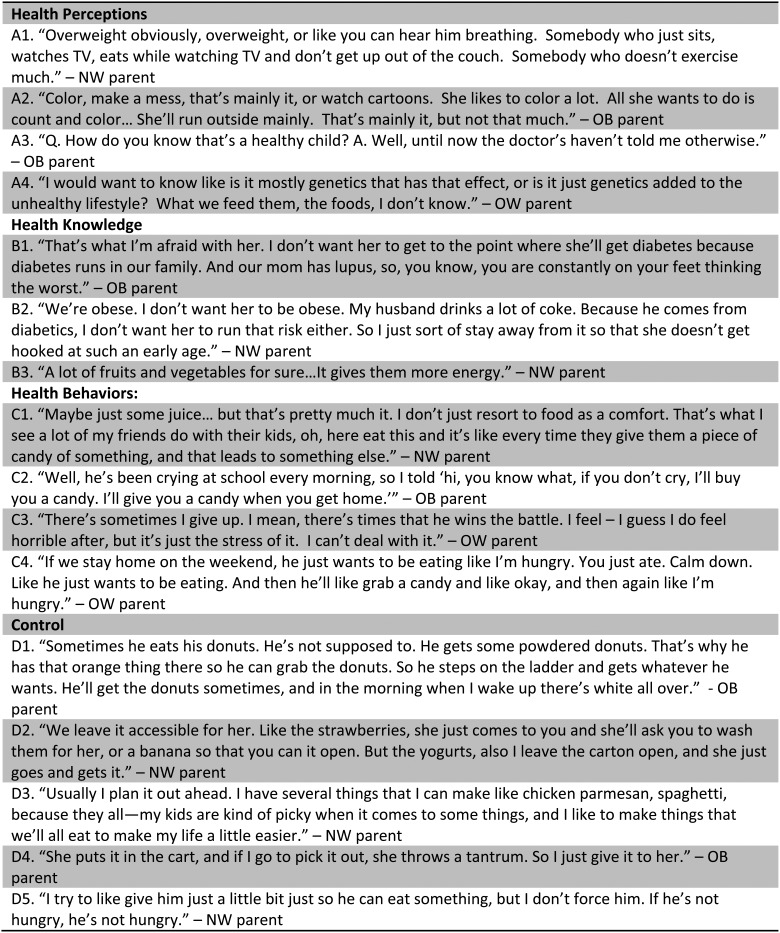
Results: Interviews were conducted in 40 homes in the lower Rio Grande Valley in Texas with a largely Hispanic (87.5%) population. Demographics, including income, education, and food assistance use, did not vary between groups. Nearly all (93.8%) parents of normal weight children perceived their child to be lower than the median weight. Group differences were observed for reported juice and yogurt consumption. Differences in both emotional feeding behaviors and parents' internalization of reasons for healthy habits were identified as different between groups.
Conclusions: We found subtle variations in reported feeding and activity practices by weight status among healthy children in a population at high risk for obesity. The behaviors and attitudes described were consistent with previous literature; however, the local strategies associated with a healthy weight are novel, potentially providing a basis for a specific intervention in this population.
Figures
References
-
- Piziak V, Morgan-Cox M, Tubbs J, et al. Elevated body mass index in Texas Head Start children: A result of heredity and economics. South Med J 2010;103:1219–1222 - PubMed
-
- Singh AS, Mulder C, Twisk JW, et al. Tracking of childhood overweight into adulthood: A systematic review of the literature. Obes Rev 2008;9:474–488 - PubMed
-
- Waters E, de Silva-Sanigorski A, Hall BJ, et al. Interventions for preventing obesity in children. Cochrane Database Syst Rev 2011;(12):CD001871. - PubMed
Publication types
MeSH terms
Grants and funding
LinkOut - more resources
Full Text Sources
Other Literature Sources
Medical
