


Candidate proteomic biomarkers for three genogroups of the swine pathogen Streptococcus suis serotype 2
- PMID: 25886383
- PMCID: PMC4450453
- DOI: 10.1186/s12866-015-0401-0
Candidate proteomic biomarkers for three genogroups of the swine pathogen Streptococcus suis serotype 2
Abstract
Background: Streptococcus suis, more specifically serotype 2, is a major swine pathogen and an emerging zoonotic agent that causes severe infections such as meningitis, endocarditis, and septicemia. In this study, surface-enhanced laser desorption/ionization time-of-flight mass spectrometry (SELDI) was used to investigate the protein expression profiles of 45 strains of S. suis serotype 2 that had previously been clustered by multilocus sequence typing (MLST) into three sequence types (ST1, ST25, and ST28) (n = 15 for each ST).
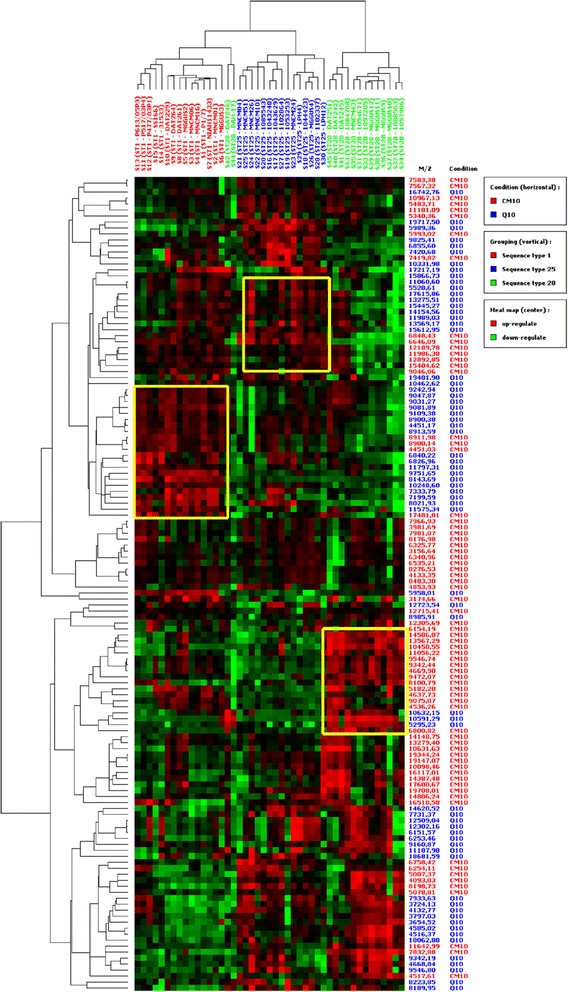
Results: The SELDI data were analyzed using the univariate Mann-Whitney and Kruskal-Wallis tests and multivariate statistical methods (heatmap/hierarchical clustering). The heatmap identified 136 cell proteins, and hierarchical clustering provided a 100% correct classification of all fifteen ST1 and ST25 strains and thirteen of the fifteen ST28 strains (87% correct). The univariate statistical analyses of the SELDI protein expression profiles identified nine significant proteins that discriminated the strains of the three STs of S. suis. Of these proteins, two were overexpressed in ST1 (5958 Da and 10249 Da), four in ST25 (5989 Da, 6646 Da, 7421 Da, and 9825 Da), and three in ST28 (4516 Da, 7833 Da, and 9342 Da). Two of the proteins associated with the ST28 strains (p4516 and p9342) were purified and were identified as a putative ABC transporter and a nucleoid-DNA-binding protein, respectively.
Conclusions: SELDI analysis of 45 strains of S. suis allowed to identify nine statistically significant proteins that can be specifically correlated with either ST1, ST25 or ST28. The possible involvement of the overexpressed proteins in the pathology of S. suis infections will require further investigation.
Figures

References
-
- Gottschalk M. Streptococcosis. In: Karriger LRA, Schwartz KJ, Stevenson G, Zimmerman J, editors. Diseases of swine. NJ, USA: Wiley Publishers; 2012. pp. 841–55.
-
- Huang YT, Teng LJ, Ho SW, Hsueh PR. Streptococcus suis infection. J Microbiol Immunol Infect. 2005;38:306–13. - PubMed
Publication types
MeSH terms
Substances
LinkOut - more resources
Full Text Sources
Other Literature Sources
