Review
. 2015 Mar 21:13:96.
doi: 10.1186/s12967-015-0439-7.

Aquaporins as diagnostic and therapeutic targets in cancer: how far we are?

Affiliations
Review

Aquaporins as diagnostic and therapeutic targets in cancer: how far we are?

Jian Wang et al. J Transl Med. .

Abstract

Aquaporins (AQPs) are a family of water channel proteins distributed in various human tissues, responsible for the transport of small solutes such as glycerol, even gas and ions. The expression of AQPs has been found in more than 20 human cancer types and is significantly correlated with the severity of histological tumors and prognosis of patients with cancer. More recent evidence showed that AQPs could also play a role in tumor-associated edema, tumor cell proliferation and migration, and tumor angiogenesis in solid and hematological tumors. Inhibitors of AQPs in tumor cells and microvessels have been suggested as new therapeutic strategies. The present review overviews AQPs structures, expression variation among normal tissues and tumors, AQPs functions and roles in the development of cancer with special focuses on lung, colorectal, liver, brain and breast cancers, and potential AQPs-target inhibitors. We call the special attention to consider AQPs important as diagnostic and therapeutic biomarkers. It may be a novel anticancer therapy by the AQPs inhibition.


Figures
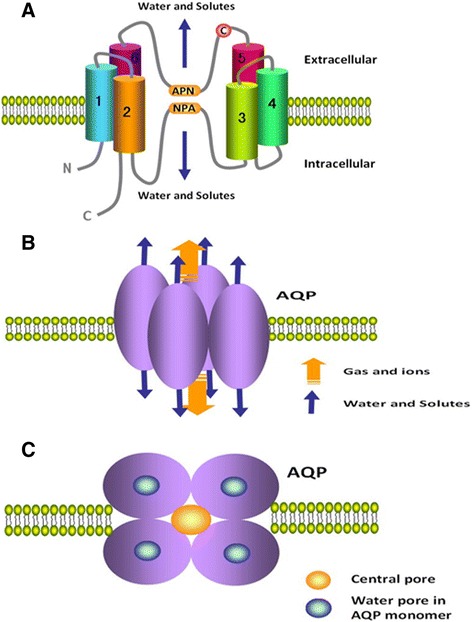
Figure 1
Figure 1
The structures of AQP monomer and homotetramers. (A) Each AQP monomer has six titled α-helical domains to form a water pore spanning plasma membrane. Conserved sequence motifs NPA on the loops bend into molecule to pair with each other and form the water channel. C, in red, represents a cysteine residue (Cys 189) that can block the AQPs function with functional sensitivity to mercury. (B) The structure of AQP homotetramers from side view. Each AQP monomer contains independently a water pore. AQP monomers assemble as homotetramers to form a central pore in homotetramers. Red arrow represents the central pore with transporting gas and ions. Blue arrow represents the water pore with transporting water and solutes. (C) The structure of AQP homotetramers from the top view. Each AQP monomer contains independently a water pore. AQP monomers assemble as homotetramers to form a central pore in homotetramers.
Figure 2
Figure 2
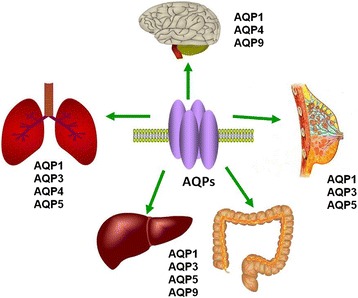
The over-expression of AQPs in cancers as elaborated in the review. The role of AQPs in lung, colorectal, liver, brain and breast cancers has been widely studied.
Figure 3
Figure 3
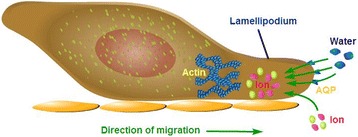
The proposed mechanism of AQP-dependent cell migration. Actin depolymerization and ion movement at the tip of a lamellipodium increase local osmolality that drives water influx to form membrane protrusion.
Figure 4
Figure 4
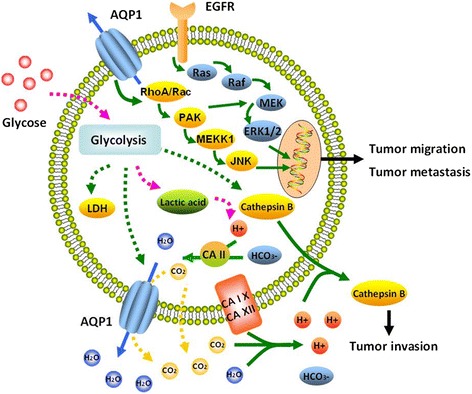
Proposed model of novel role of AQP1 in tumor biology. Tumor cells increase glycose consumption to produce lactic acid, which results in excess H+ production and intracellular acidosis. The increase in glycolytic intermediates may up-regulate AQP1, LDH, and cathepsin B through the E-box/ChoRE. Excess H+ and HCO3 - are catalyzed by intracellular CAII to produce H2O and CO2. The reaction-generated H2O is transported to extracellular space to aviod cytotoxic edema by up-regluated AQP1. CO2 may or may not leave the cells through AQP1. Membrane-bound extracellular CA IX and XII may regenerate H+ from extracellular H2O and CO2, thus leading to shutting H+ from the intracellular to the extracellular space to keep the acidification of the extracellular compartment. The acid extracellular environment promotes cells to release cathepsin B, a proteolytic enzyme involved in tumor invasion. AQP1 can induce the activity of RhoA and Rac to increase tumor migration and metastasis. The detailed role of AQP1 in this pathway need more studies.
Figure 5
Figure 5
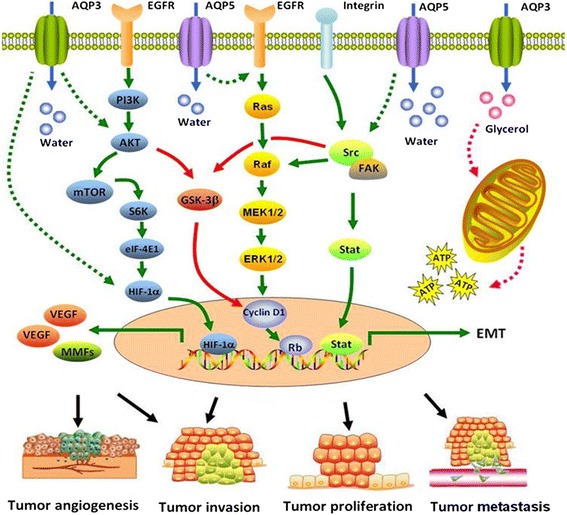
Proposed model of novel roles of AQP3 and AQP5 in tumor biology. AQP5 are exclusively selective for water while AQP3 can transport water and other small neutral solutes such as glycerol. AQP3 increases intracellular glycerol content which is transported to mitochondria to form ATP. Mitochondrial ATP formation provides energy for tumor cell proliferation. AQP3 can directly or indirectly reduce the natural degradation of HIF-1α/ HIF-2α to increase the expression of vascular endothelial growth factor (VEGF), which is a critical regulator in tumor angiogenesis and vessel maturation. AQP3 may directly or indirectly activate AKT to increase MMPs, resulting in tumor invasion. AQP5 induces activation of the epidermal growth factor receptor (EGFR), extracellular receptor kinase (ERK1/2) pathway to faciliate tumor cell proliferation and metastasis. In addition, AQP5 is phosphorylated on Ser156 and bind the the SH3 domain of Src to promote EMT activity in tumor cells. The roles of AQP3 and AQP5 in these pathways are not fully elucidated and still need further exploration.

References

    1. Verkman AS. More than just water channels: unexpected cellular roles of aquaporins. J Cell Sci. 2005;118:3225–32. - PubMed
    1. Nico B, Ribatti D. Role of aquaporins in cell migration and edema formation in human brain tumors. Exp Cell Res. 2011;317:2391–6. - PubMed
    1. Herrera M, Garvin JL. Aquaporins as gas channels. Pflugers Arch. 2011;462:623–30. - PubMed
    1. Musa-Aziz R, Chen LM, Pelletier MF, Boron WF. Relative CO2/NH3 selectivities of AQP1, AQP4, AQP5, AmtB, and RhAG. Proc Natl Acad Sci U S A. 2009;106:5406–11. - PMC - PubMed
    1. Yu J, Yool AJ, Schulten K, Tajkhorshid E. Mechanism of gating and ion conductivity of a possible tetrameric pore in aquaporin-1. Structure. 2006;14:1411–23. - PubMed