. 2015 Apr 16;16(1):80.
doi: 10.1186/s13059-015-0644-y.

Age and sun exposure-related widespread genomic blocks of hypomethylation in nonmalignant skin

Affiliations

Age and sun exposure-related widespread genomic blocks of hypomethylation in nonmalignant skin

Amy R Vandiver et al. Genome Biol. .

Abstract

Background: Aging and sun exposure are the leading causes of skin cancer. It has been shown that epigenetic changes, such as DNA methylation, are well established mechanisms for cancer, and also have emerging roles in aging and common disease. Here, we directly ask whether DNA methylation is altered following skin aging and/or chronic sun exposure in humans.

Results: We compare epidermis and dermis of both sun-protected and sun-exposed skin derived from younger subjects (under 35 years old) and older subjects (over 60 years old), using the Infinium HumanMethylation450 array and whole genome bisulfite sequencing. We observe large blocks of the genome that are hypomethylated in older, sun-exposed epidermal samples, with the degree of hypomethylation associated with clinical measures of photo-aging. We replicate these findings using whole genome bisulfite sequencing, comparing epidermis from an additional set of younger and older subjects. These blocks largely overlap known hypomethylated blocks in colon cancer and we observe that these same regions are similarly hypomethylated in squamous cell carcinoma samples.

Conclusions: These data implicate large scale epigenomic change in mediating the effects of environmental damage with photo-aging.


Figures
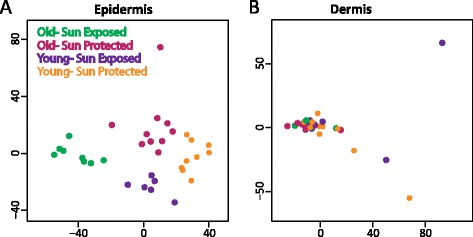
Figure 1
Figure 1
DNA methylation in epidermal but not dermal samples clusters by age and sun exposure. (A) In epidermis, DNA methylation segregates old versus young individuals, and also segregates sun-exposed and sun-protected anatomical regions, shown by multidimensional scaling of pairwise distances derived from methylation levels assayed on the HumanMethylation450 BeadChip (450k). (B) In dermis, DNA methylation does not segregate samples by age or anatomical region, shown by multidimensional scaling of pairwise distances derived from methylation levels assayed on the 450k.
Figure 2
Figure 2
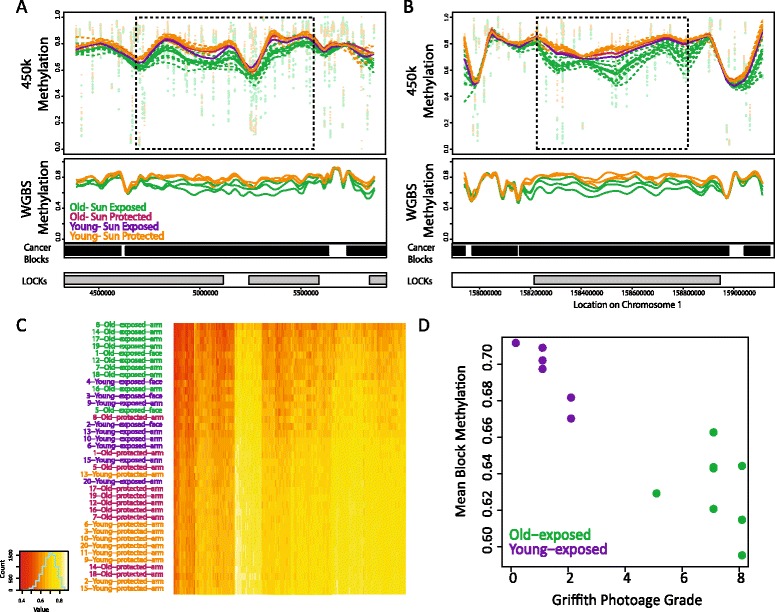
Block hypomethylation progresses from younger sun-protected to older sun-protected to younger sun-exposed to older sun-exposed tissue. (A) Example of a region identified as a block comparing older sun-exposed to younger sun-protected epidermal samples using 450k data. Top panel: methylation beta values (Methylated signal/Total signal) for 'collapsed' measurements of methylation from open sea probes in 450k data. These are methylation averages for each 1,500 bp open sea region calculated as part of the minfi’s 'block finder' algorithm. The points represent individual samples at each location, dotted lines show smoothed measurements across the region for each individual and solid lines represent the smoothed average for each group. The box demarcates the block identified using Minfi. Bottom panel: smoothed methylation beta values from WGBS data within the regions identified in 450k analysis. Horizontal bars indicate the locations of hypomethylated blocks identified previously in cancer and heterochromatin LOCKs [20]. (B) Example of a region identified as a block comparing older, sun-exposed and younger, sun-protected epidermal samples using 450k data, plotted as in (A). (C) Heatmap showing mean block methylation in all blocks identified comparing O-exp and Y-pro epidermis. Samples are ordered by mean methylation, and blocks are ordered by mean difference in methylation between O-exp and Y-pro samples. Red/yellow indicate lower/higher mean methylation levels, respectively. (D) Relationship between block methylation and Griffiths’ photoage grade. Mean methylation within all blocks identified comparing O-exp and Y-pro epidermis, versus Griffiths’ photoage grade assigned to the sample donor.
Figure 3
Figure 3
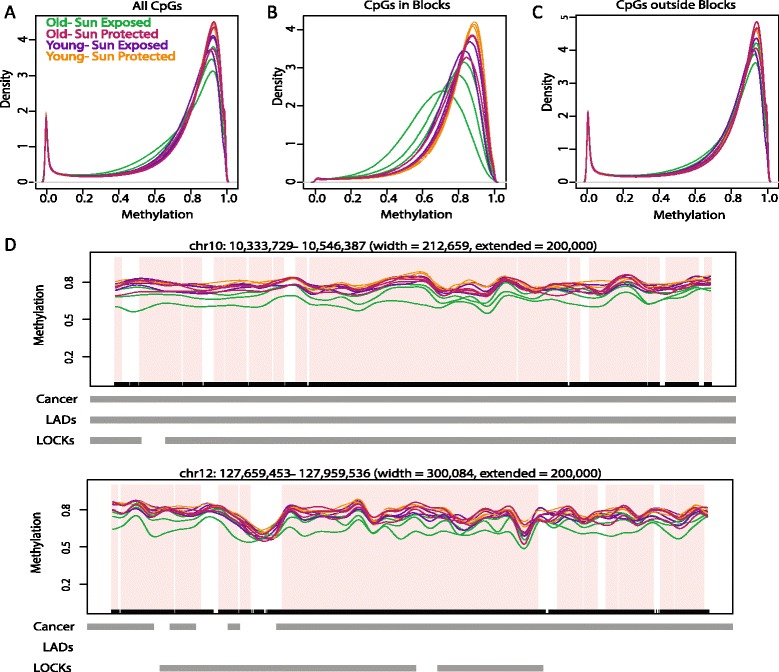
Hypomethylated blocks in O-exp samples replicated by whole genome bisulfite sequencing. (A-C) Hypomethylation is enriched in blocks. Distribution of high-frequency smoothed methylation values from CpGs with sufficient coverage from WGBS for (A) all CpGs, (B) CpGs in blocks, and (C) CpGs outside of blocks. (D) Examples of blocks identified by WGBS. Shown are smoothed methylation values within blocks identified comparing O-exp and Y-pro epidermis (pink).
Figure 4
Figure 4
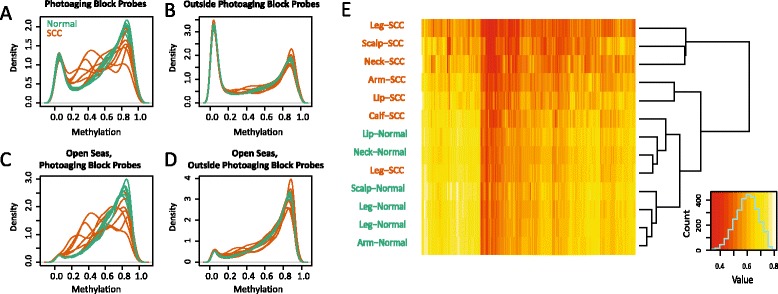
Blocks identified in photoaged skin are more hypomethylated in squamous cell cancer (SCC). (A) Distribution of methylation values in 450k probes measuring CpGs within the identified age- and sun exposure-associated blocks. (B) Distribution of methylation values in 450k probes measuring CpGs outside of the identified age- and sun exposure-associated blocks. (C) Distribution of methylation values in 450k probes measuring CpGs within open sea regions and within the identified age- and sun exposure-associated blocks. (D) Distribution of methylation values in 450k probes measuring CpGs within open sea regions and outside the identified age- and sun exposure-associated blocks. (E) Heatmap showing mean methylation in blocks identified comparing O-exp and Y-pro epidermis. Samples and blocks are ordered by hierarchal clustering. Yellow/red indicate higher/lower methylation, respectively.

References

    1. Niccoli T, Partridge L. Ageing as a risk factor for disease. Curr Biol. 2012;22:R741–R752. doi: 10.1016/j.cub.2012.07.024. - DOI - PubMed
    1. Nebel A, Kleindorp R, Caliebe A, Nothnagel M, Blanche H, Junge O, et al. A genome-wide association study confirms APOE as the major gene influencing survival in long-lived individuals. Mech Ageing Dev. 2011;132:324–330. doi: 10.1016/j.mad.2011.06.008. - DOI - PubMed
    1. Deelen J, Beekman M, Uh HW, Helmer Q, Kuningas M, Christiansen L, et al. Genome-wide association study identifies a single major locus contributing to survival into old age; the APOE locus revisited. Aging Cell. 2011;10:686–698. doi: 10.1111/j.1474-9726.2011.00705.x. - DOI - PMC - PubMed
    1. Hannum G, Guinney J, Zhao L, Zhang L, Hughes G, Sadda S, et al. Genome-wide methylation profiles reveal quantitative views of human aging rates. Mol Cell. 2013;49:359–367. doi: 10.1016/j.molcel.2012.10.016. - DOI - PMC - PubMed
    1. Heyn H, Li N, Ferreira HJ, Moran S, Pisano DG, Gomez A, et al. Distinct DNA methylomes of newborns and centenarians. Proc Natl Acad Sci U S A. 2012;109:10522–10527. doi: 10.1073/pnas.1120658109. - DOI - PMC - PubMed

Publication types

Associated data