. 2015 Apr 17;10(4):e0124521.
doi: 10.1371/journal.pone.0124521. eCollection 2015.

Using the Morris water maze to assess spatial learning and memory in weanling mice

Affiliations

Using the Morris water maze to assess spatial learning and memory in weanling mice

Christopher D Barnhart et al. PLoS One. .

Abstract

Mouse models have been indispensable for elucidating normal and pathological processes that influence learning and memory. A widely used method for assessing these cognitive processes in mice is the Morris water maze, a classic test for examining spatial learning and memory. However, Morris water maze studies with mice have principally been performed using adult animals, which preclude studies of critical neurodevelopmental periods when the cellular and molecular substrates of learning and memory are formed. While weanling rats have been successfully trained in the Morris water maze, there have been few attempts to test weanling mice in this behavioral paradigm even though mice offer significant experimental advantages because of the availability of many genetically modified strains. Here, we present experimental evidence that weanling mice can be trained in the Morris water maze beginning on postnatal day 24. Maze-trained weanling mice exhibit significant improvements in spatial learning over the training period and results of the probe trial indicate the development of spatial memory. There were no sex differences in the animals' performance in these tasks. In addition, molecular biomarkers of synaptic plasticity are upregulated in maze-trained mice at the transcript level. These findings demonstrate that the Morris water maze can be used to assess spatial learning and memory in weanling mice, providing a potentially powerful experimental approach for examining the influence of genes, environmental factors and their interactions on the development of learning and memory.


Conflict of interest statement

Competing Interests: The authors have declared that no competing interests exist.

Figures

Fig 1
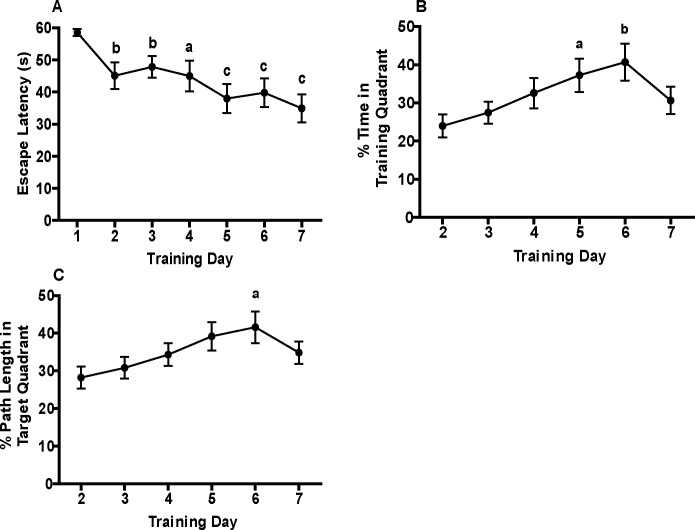
Fig 1. Weanling mice exhibit spatial learning in the Morris water maze (MWM).
Spatial learning was assessed as a function of training day with respect to the following parameters: (A) escape latency, (B) percentage of time spent in the target quadrant, and (C) percentage of total path length spent in the target quadrant. Data are presented as the mean ± SEM (n = 16 animals). Since sex differences were not identified for any of the behavioral parameters shown in this Fig., data from males and females were combined to calculate mean values. Significantly different from training d 1 (A) or d 2 (B and C) at a p < 0.05, b p < 0.01, c p < 0.001 as determined using repeated measures ANOVA with LSD post hoc test. Effect sizes: partial η2 for latency = 0.31, partial η2 for % time = 0.21; partial η2 for % path length = 0.17. Power: 99% for latency, 94% for % time, 84% for % path length. Note that escape latency was the only data collected on the first day of training because of a computer malfunction in collecting data on the first training day.
Fig 2
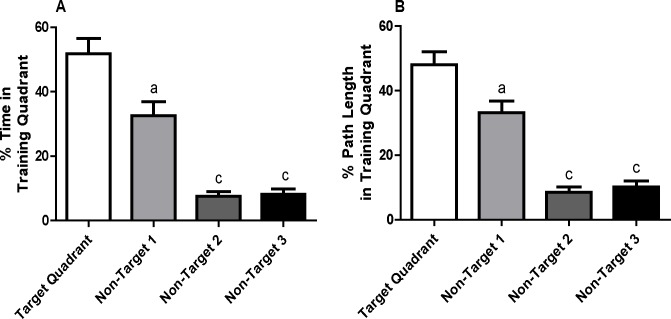
Fig 2. Weanling mice exhibit spatial memory after MWM training.
Spatial memory was assessed in a probe trial administered on training day 8 with respect to: (A) percentage of time or (B) percentage of path length spent in the target quadrant relative to non-target quadrants. Data in panels A and B are presented as the mean ± SEM (n = 16 animals). Significantly different from target quadrant at a p < 0.05, c p < 0.001 as determined by repeated measures ANOVA with the Greenhouse-Geisser correction for LSD post hoc tests. Effect sizes: partial η2 for % time = 0.66; partial η2 for % path length = 0.68. Observed power: 100% for % time; 100% for % path length.
Fig 3
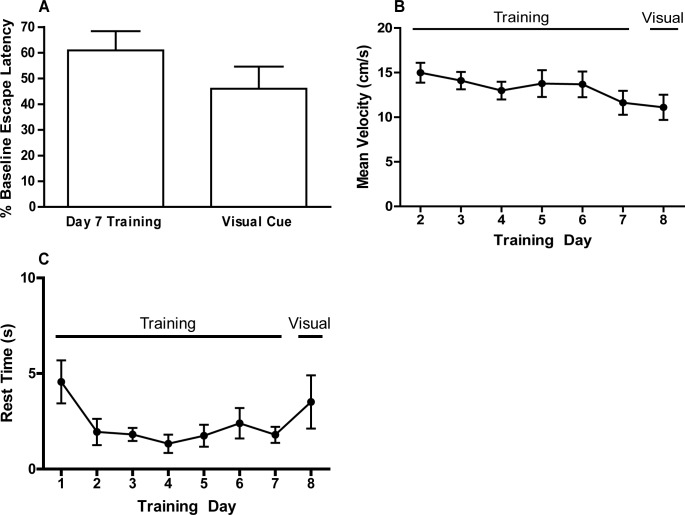
Fig 3. Results of the visual cue test.
(A) Escape latency on d 7 of training and during the visual cue test expressed as a percentage of baseline escape latency (escape latency on the first training day). Additional parameters that influence performance in the MWM were assessed during the visual cue test including: (B) mean swim velocity and (C) rest time, both of which are presented as a function of training day. No statistically significant differences were identified using paired t-test (A) or repeated measures ANOVA (B,C).
Fig 4
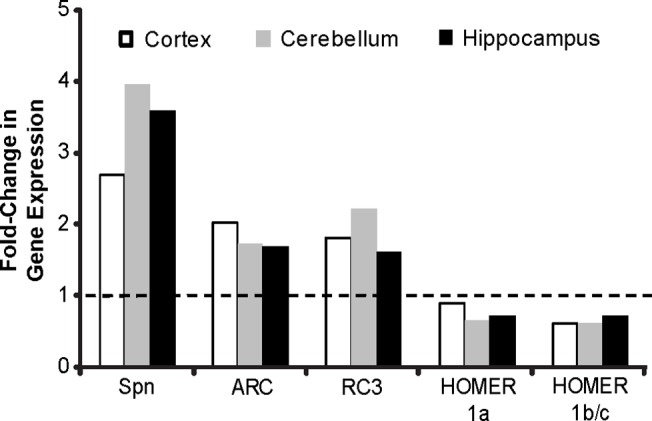
Fig 4. MWM training increases transcription of genes associated with synaptic plasticity in multiple brain regions.
Transcript levels of spinophilin (Spn), activity-regulated cytoskeleton-associated protein (ARC), neurogranin (RC3), Homer1a and Homer1b/c were analyzed in total RNA harvested from the cortex, cerebellum, and hippocampus of weanling mice after behavioral studies were completed. Data are presented as fold-change in transcript expression relative to non-maze-trained littermates as calculated by the Pfaffl equation, normalized to the housekeeping gene 18S rRNA (n = 9–12 animals per group). The dashed line represents a fold-change of 1, which indicates no difference in gene expression between MWM-trained animals and untrained littermate controls.

References

    1. Bloom B, Cohen RA, Freeman G. Summary health statistics for U.S. children: National Health Interview Survey, 2009. Vital Health Stat 10. 2010: 1–82. - PubMed
    1. Landrigan PJ, Lambertini L, Birnbaum LS. A research strategy to discover the environmental causes of autism and neurodevelopmental disabilities. Environ Health Perspect. 2012; 120: a258–260. 10.1289/ehp.1104285 - DOI - PMC - PubMed
    1. Grandjean P, Landrigan PJ. Neurobehavioural effects of developmental toxicity. Lancet Neurol. 2014; 13: 330–338. 10.1016/S1474-4422(13)70278-3 - DOI - PMC - PubMed
    1. Trasande L, Liu Y. Reducing the staggering costs of environmental disease in children, estimated at $76.6 billion in 2008. Health Aff (Millwood). 2011; 30: 863–870. 10.1377/hlthaff.2010.1239 - DOI - PubMed
    1. Bellinger DC. A strategy for comparing the contributions of environmental chemicals and other risk factors to neurodevelopment of children. Environ Health Perspect. 2012; 120: 501–507. 10.1289/ehp.1104170 - DOI - PMC - PubMed

Publication types