


Perceptions of the appropriateness of care in California adult intensive care units
- PMID: 25887104
- PMCID: PMC4344807
- DOI: 10.1186/s13054-015-0777-0
Perceptions of the appropriateness of care in California adult intensive care units
Abstract
Introduction: Increased demand for expensive intensive care unit (ICU) services may contribute to rising health-care costs. A focus on appropriate use may offer a clinically meaningful way of finding the balance. We aimed to determine the extent and characteristics of perceived inappropriate treatment among ICU doctors and nurses, defined as an imbalance between the amount or intensity of treatments being provided and the patient's expected prognosis or wishes.
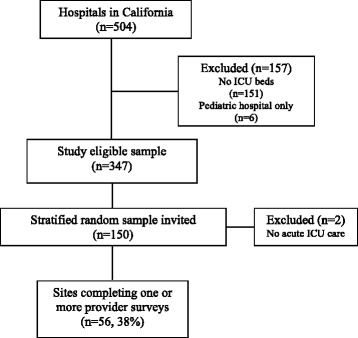
Methods: This was a cross-sectional study of doctors and nurses providing care to patients in 56 adult ICUs in California between May and August 2013. In total, 1,363 doctors and nurses completed an anonymous electronic survey.
Results: Thirty-eight percent of 1,169 respondents (95% confidence interval (CI) 35% to 41%, 51.1% of physicians and 35.8% of nurses) identified at least one patient as receiving inappropriate treatment. Respondents most commonly reported that the amount of treatment provided was disproportionate to the patient's expected prognosis or wishes-325 out of 429 (76%, 95% CI 72% to 80%)--and that treatment was 'too much' in 93% of cases. Factors associated with perceived inappropriateness of treatment were the belief that death in their ICU is seen as a failure (odds ratio (OR) 5.75, 95% CI 2.28 to 14.53, P = 0.000), profession (doctors more than nurses) (OR 2.50, 95% CI 1.58 to 3.97, P = 0.000), lack of collaboration between doctors and nurses (OR 1.84, 95% CI 1.21 to 2.80, P = 0.004), intent to leave their job (OR 1.73, 95% CI 1.18 to 2.55, P = 0.005), and the perceived responsibility to control health-care costs (OR 1.57, 95% CI 1.05 to 2.33, P = 0.026). Providers supported formal communication training (90%, 95% CI 88% to 92%) and mandatory family meetings (89%, 95% CI 87% to 91%) as potential solutions to reduce the provision of inappropriate treatment.
Conclusions: Doctors and nurses working in California ICUs frequently perceive treatment to be inappropriate. They also identified measures that could reduce the provision of inappropriate treatment.
Figures
References
-
- Yankelovich Partners: Yankelovich/Time/CNN Poll #2000–12. Public Opinion Poll. 2000.
-
- Final Chapter: Californians’ attitudes and experiences with death and dying. California HealthCare Foundation; 2012. http://www.chcf.org/Publications/2013/04/EOL-What-You-Want. Accessed 1 September 2013.
Publication types
MeSH terms
LinkOut - more resources
Full Text Sources
Other Literature Sources
