. 2015 Apr 2:10:40.
doi: 10.1186/s13023-015-0254-5.

Mutations in TTC19: expanding the molecular, clinical and biochemical phenotype

Affiliations

Mutations in TTC19: expanding the molecular, clinical and biochemical phenotype

Johannes Koch et al. Orphanet J Rare Dis. .

Abstract

Background: TTC19 deficiency is a progressive neurodegenerative disease associated with isolated mitochondrial respiratory chain (MRC) complex III deficiency and loss-of-function mutations in the TT19 gene in the few patients reported so far.

Methods: We performed exome sequencing and selective mutational analysis of TTC19, respectively, in patients from three unrelated families presenting with initially unspecific clinical signs of muscular hypotonia and global developmental delay followed by regression, ataxia, loss of speech, and rapid neurological deterioration. One patient showed severe lactic acidosis at the neonatal age and during intercurrent illness.

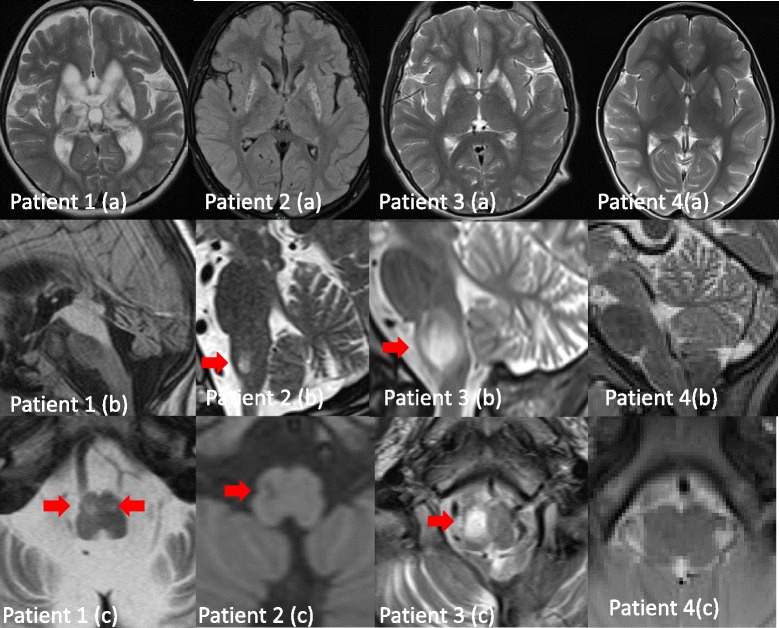
Results: We identified homozygous mutations in all three index cases, in two families novel missense mutations (c.544 T > C/p.Leu185Pro; c.917 T > C/p.Leu324Pro). The younger sister of the severely affected patient 3 showed only mild delay of motor skills and muscular hypotonia so far but is also homozygous for the same mutation. Notably, one patient revealed normal activities of MRC complex III in two independent muscle biopsies. Neuroimaging of the severely affected patients demonstrated lesions in putamen and caudate nuclei, cerebellar atrophy, and the unusual finding of hypertrophic olivary nuclei degeneration. Reviewing the literature revealed striking similarities regarding neuroimaging and clinical course in pediatric patients with TTC19 deficiency: patterns consistent with Leigh or Leigh-like syndrome were found in almost all, hypertrophic olivary nucleus degeneration in all patients reported so far. The clinical course in pediatric patients is characterized by an initially unspecific developmental delay, followed by regression, progressive signs and symptoms of cerebellar, basal ganglia and brainstem affection, especially loss of speech and ataxia. Subsequently, neurological deterioration leading to a vegetative state occurs.

Conclusions: Our findings add to the phenotypic, genetic, and biochemical spectrum of TTC19 deficiency. However, TTC19 deficient patients do show characteristic clinical and neuroimaging features, which may facilitate diagnosis of this yet rare disorder. Normal MRC complex III activity does not exclude the diagnosis.


Figures

Figure 1
Figure 1
Mutations in TTC19 and expression of TTC19. A. Novel and reported Mutations in TTC19 and their phylogenetic conservation. A schematic drawing shows the 10 exons, the mitochondrial targeting sequence (MTS), and the 5 tetratricopeptide repeats (TPR) of TTC19. The previously reported mutations are indicated in black, the two novel missense mutations reported here are highlighted in red. Sequence alignment with different species shows the affected amino acid residues to be highly conserved. B. TTC19 transcript levels in muscle of patients (P) and controls (C). Normal amounts of TTC19 transcripts compared to controls were found in patients 1 and 3 carrying missense mutations (c.971 T > C; p.Leu324Pro and c.554 T > C; p.Leu185Pro). A significant reduction of TTC19 transcripts was observed in patient 2 who carries the stop mutation c.656 T > G (p.Leu219*). A repeated measures ANOVA and a Tukey post test to compare all pairs of columns was used for statistical analysis (**p < 0.01).
Figure 2
Figure 2
Brain magnetic resonance imaging of the four patients. Hyperintensities in T2 (Flair 2a, 1b)-weighted images indicate pathology of basal ganglia (1a, 2a, 3a, 4a), thalamus (1a), and mesencephalon (1b). Cerebellar atrophy is shown on in 1b, 2b, 3b. The increased interfoliar spaces in 4b may be interpreted as early sign of cerebellar atrophy in the clinical context of patient 4. Hypertrophic degeneration of olivary nuclei are marked with red arrows in 1c, 2b and c (T1 signal hypointensity), 3b and c. It is not seen in 4b, c.
Figure 3
Figure 3
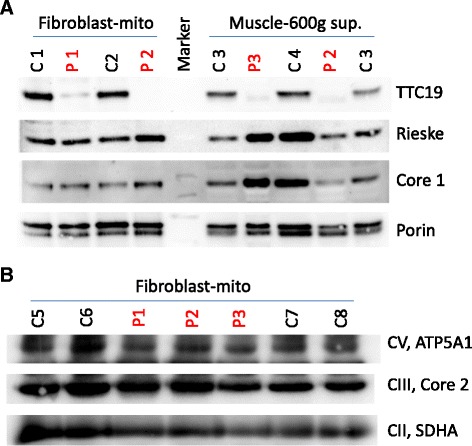
Western blot analysis of muscle homogenisates and fibroblast mitochondria of TTC19 patients (P) and controls (C). A. SDS-PAGE: TTC 19 protein in markedly reduced in patient 1 and absent in patients 2 and 3. There is no obvious reduction in core 1 and Rieske protein, both subunits of MRC complex III, in comparison to porin. Porin is a protein of the outer mitochondrial membrane and was used as a loading control. B: Blue Native-PAGE: There is no obvious reduction of complex III (CIII, core 2) in patients 1, 2, and 3 compared to controls. Complex II (CII, SDHA) and complex V (CV, ATP5A1) were used as loading controls.
Figure 4
Figure 4
Main clinical, biochemical, and MRI features in 14 patients with TTC19 deficiency. The y axis lists the main clinical symptoms, MRI and laboratory findings, the X axis indicates the frequency (%). The figure summarizes 14 patients reported in the literature [1-3,5,6]. Patient 4 of this work is not included, as she is still oligosymptomatic. Remarkably, elevated blood lactate is found in less then fifty percent of patients and isolated MRC complex III deficiency is not a constant finding in all patients.

References

    1. Ghezzi D, Arzuffi P, Zordan M, Da Re C, Lamperti C, Benna C, et al. Mutations in TTC19 cause mitochondrial complex III deficiency and neurological impairment in humans and flies. Nat Genet. 2011;43(3):259–63. doi: 10.1038/ng.761. - DOI - PubMed
    1. Morino H, Miyamoto R, Ohnishi S, Maruyama H, Kawakami H. Exome sequencing reveals a novel TTC19 mutation in an autosomal recessive spinocerebellar ataxia patient. BMC Neurol. 2014;14:5. doi: 10.1186/1471-2377-14-5. - DOI - PMC - PubMed
    1. Nogueira C, Barros J, Sa MJ, Azevedo L, Taipa R, Torraco A, et al. Novel TTC19 mutation in a family with severe psychiatric manifestations and complex III deficiency. Neurogenetics. 2013;14(2):153–60. doi: 10.1007/s10048-013-0361-1. - DOI - PubMed
    1. Kunii M, Doi H, Higashiyama Y, Kugimoto C, Ueda N, Hirata J, et al. A Japanese case of cerebellar ataxia, spastic paraparesis and deep sensory impairment associated with a novel homozygous TTC19 mutation. J Human Genet. 2015;14:43–5. - PubMed
    1. Atwal PS. Mutations in the Complex III Assembly Factor Tetratricopeptide 19 Gene TTC19 Are a Rare Cause of Leigh Syndrome. JIMD reports. 2014;14:43–5. doi: 10.1007/8904_2013_282. - DOI - PMC - PubMed

Publication types