


Parental concerns, provider response, and timeliness of autism spectrum disorder diagnosis
- PMID: 25888348
- PMCID: PMC4446243
- DOI: 10.1016/j.jpeds.2015.03.007
Parental concerns, provider response, and timeliness of autism spectrum disorder diagnosis
Abstract
Objectives: To assess differences between child age at first parental concern and age at first parental discussion of concerns with a health care provider among children with autism spectrum disorder (ASD) vs those with intellectual disability/developmental delay (ID/DD), and to assess whether provider response to parental concerns is associated with delays in ASD diagnosis.
Study design: Using nationally representative data from the 2011 Survey of Pathways to Diagnosis and Treatment, we compared child age at parent's first developmental concern with age at first discussion of concerns with a provider, and categorized provider response as proactive or reassuring/passive, among 1420 children with ASD and 2098 children with ID/DD. In the children with ASD, we tested the association between provider response type and years of diagnostic delay.
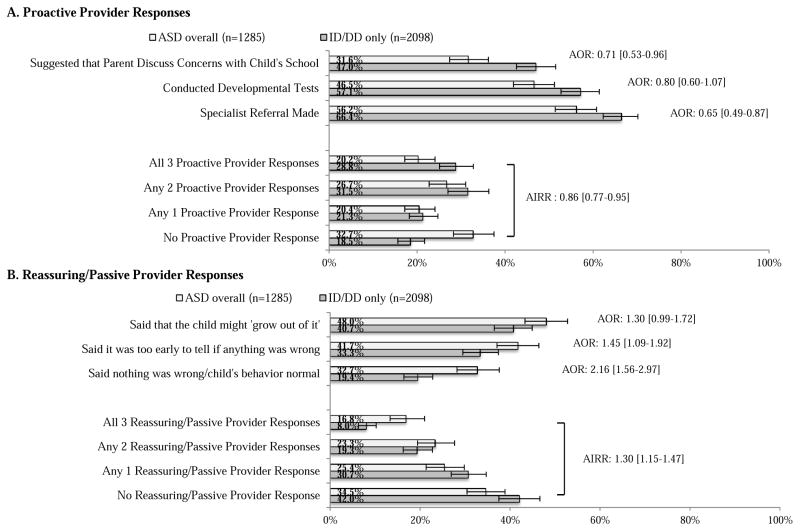
Results: Compared with children with ID/DD, children with ASD were younger when parents first had concerns and first discussed those concerns with a provider. Compared with parents of children with ID/DD, parents of children with ASD were less likely to receive proactive responses to their concerns and more likely to receive reassuring/passive responses. Among children with ASD, those with more proactive provider responses to concerns had shorter delays in ASD diagnosis compared with those with passive/reassuring provider responses.
Conclusion: Although parents of children with ASD have early concerns, delays in diagnosis are common, particularly when providers' responses are reassuring or passive, highlighting the need for targeted improvements in primary care.
Copyright © 2015 Elsevier Inc. All rights reserved.
Conflict of interest statement
The authors declare no conflicts of interest.
Figures
References
-
- American Psychological Association. Diagnostic and statistical manual of mental disorders. 5. Arlington, VA: American Psychiatric Publishing; 2013.
-
- Developmental Disabilities Monitoring Network Surveillance Year 2010 Principal Investigators. Prevalence of autism spectrum disorder among children aged 8 years - autism and developmental disabilities monitoring network, 11 sites, United States, 2010. MMWR Surveill Summ. 2014 Mar 28;63( Suppl 2):1–21. - PubMed
-
- Blumberg SJ, Bramlett MD, Kogan M, Schieve LA, Jones JR, Lu MC. Changes in parent-reported prevalence of autism spectrum disorder in school-aged U.S. children: 2007 to 2011–12. 2013. Nat Health Stat Rep. 2013;65 - PubMed
-
- Autism and Developmental Disabilities Monitoring Network Surveillance Year 2008 Principal Investigators. Prevalence of autism spectrum disorders - autism and developmental disabilities monitoring network, 14 sites, United States, 2008. MMWR Surveill Summ. 2012 Mar 30;61:1–19. - PubMed
-
- Johnson CP, Myers SM American Academy of Pediatrics Council on Children with Disabilities. Identification and evaluation of children with autism spectrum disorders. Pediatrics. 2007 Nov;120:1183–1215. - PubMed
Publication types
MeSH terms
Grants and funding
LinkOut - more resources
Full Text Sources
Other Literature Sources
Medical
