. 2015 Jun;168(2):490-501.
doi: 10.1104/pp.15.00354. Epub 2015 Apr 17.

The SLOW GROWTH3 Pentatricopeptide Repeat Protein Is Required for the Splicing of Mitochondrial NADH Dehydrogenase Subunit7 Intron 2 in Arabidopsis

Affiliations

The SLOW GROWTH3 Pentatricopeptide Repeat Protein Is Required for the Splicing of Mitochondrial NADH Dehydrogenase Subunit7 Intron 2 in Arabidopsis

Wei-Yu Hsieh et al. Plant Physiol. 2015 Jun.

Abstract

Mitochondria play an important role in maintaining metabolic and energy homeostasis in the cell. In plants, impairment in mitochondrial functions usually has detrimental effects on growth and development. To study genes that are important for plant growth, we have isolated a collection of slow growth (slo) mutants in Arabidopsis (Arabidopsis thaliana). One of the slo mutants, slo3, has a significant reduction in mitochondrial complex I activity. The slo3 mutant has a four-nucleotide deletion in At3g61360 that encodes a pentatricopeptide repeat (PPR) protein. The SLO3 protein contains nine classic PPR domains belonging to the P subfamily. The small deletion in the slo3 mutant changes the reading frame and creates a premature stop codon in the first PPR domain. We demonstrated that the SLO3-GFP is localized to the mitochondrion. Further analysis of mitochondrial RNA metabolism revealed that the slo3 mutant was defective in splicing of NADH dehydrogenase subunit7 (nad7) intron 2. This specific splicing defect led to a dramatic reduction in complex I activity in the mutant as revealed by blue native gel analysis. Complementation of slo3 by 35S:SLO3 or 35S:SLO3-GFP restored the splicing of nad7 intron 2, the complex I activity, and the growth defects of the mutant. Together, these results indicate that the SLO3 PPR protein is a splicing factor of nad7 intron 2 in Arabidopsis mitochondria.


Figures

Figure 1.
Figure 1.
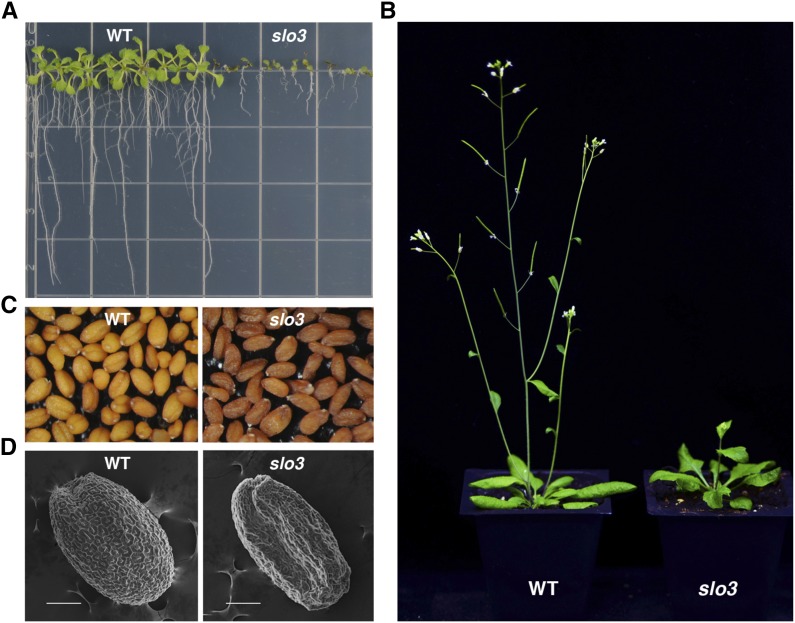
Phenotypic analysis of Arabidopsis slo3 mutants. A, Ten-day-old Arabidopsis wild-type (WT) and slo3 seedlings grown on tissue culture medium. B, Six-week-old Arabidopsis wild-type and slo3 plants grown in soil. C, Morphology of wild-type and slo3 seeds under light microscope. The mutant seeds are darker and shrunken compared with the wild type. D, Scanning electron micrographs of wild-type and slo3 seeds. Scale bars = 100 μm.
Figure 2.
Figure 2.
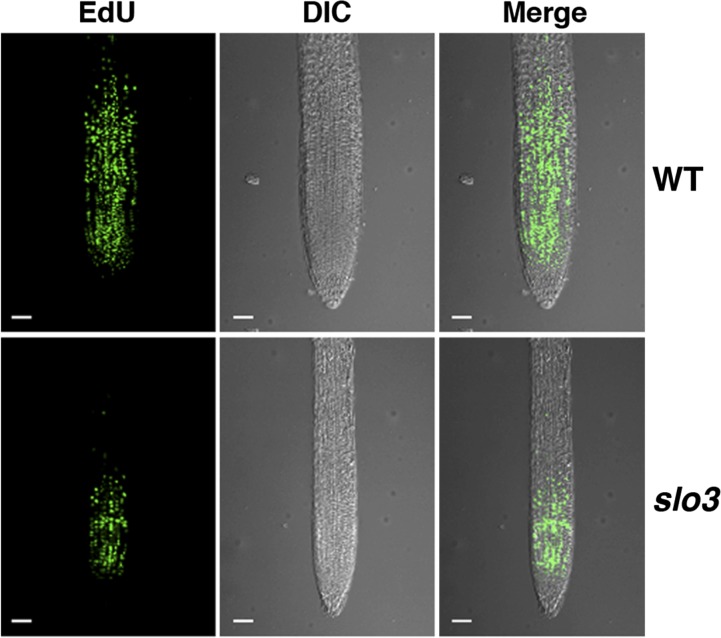
EdU staining of primary roots from 7-d-old wild-type (WT) and slo3 seedlings. The green fluorescent signals represent newly synthesized DNA during the period (30 min) of EdU staining. The results indicate that the slo3 mutant root has significantly fewer proliferating cells than that of the wild type. Scale bars = 50 μm. DIC, Differential interference contrast.
Figure 3.
Figure 3.
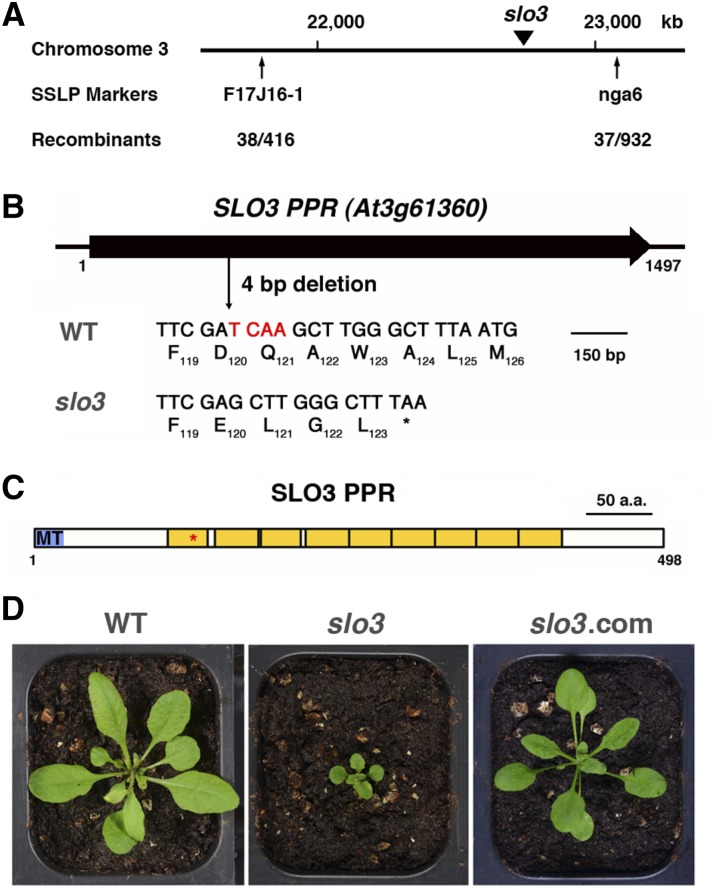
Molecular characterization of Arabidopsis slo3. A, The slo3 mutation was mapped to the bottom arm of chromosome 3 between SSLP markers F17J16-1 and nga6. B, The slo3 mutant has a four-nucleotide deletion in the coding region of At3g61360. The deletion changes the amino acid codons 120 to 123 and generates a stop codon at the 124th position. The At3g61360 gene encodes a PPR protein of the P subfamily. C, Schematic diagram of Arabidopsis SLO3 PPR protein. MT, Mitochondrial targeting sequence; yellow boxes, PPR domains. The asterisk indicates the position of a premature stop codon derived from the slo3 mutant transcript. D, Complementation of slo3 by 35S:SLO3 complementary DNA (cDNA). Plants shown are 24-d-old wild type (WT), slo3, and slo3 complemented by 35S:SLO3 (slo3.com) grown in soil.
Figure 4.
Figure 4.
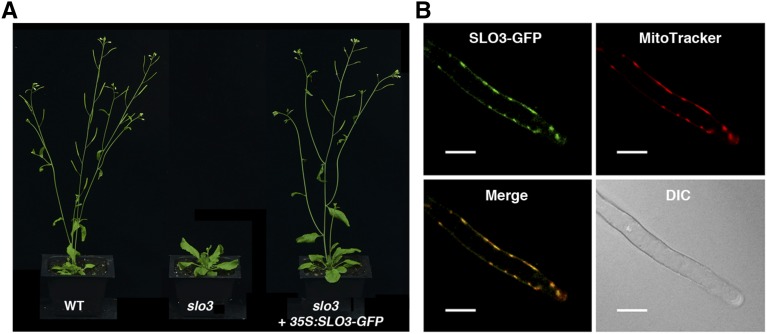
Arabidopsis SLO3-GFP is localized to the mitochondrion. A, Six-week-old Arabidopsis wild type (WT), slo3, and slo3 complemented by 35S:SLO3-GFP grown in soil. B, Subcellular localization of SLO3-GFP in the root hair of a 35S:SLO3-GFP transgenic plant. Mitochondria were visualized by MitoTracker orange staining. The green fluorescent signals of SLO3-GFP colocalized with the orange fluorescent signals of MitoTracker. DIC, Differential interference contrast. Scale bars = 20 μm.
Figure 5.
Figure 5.
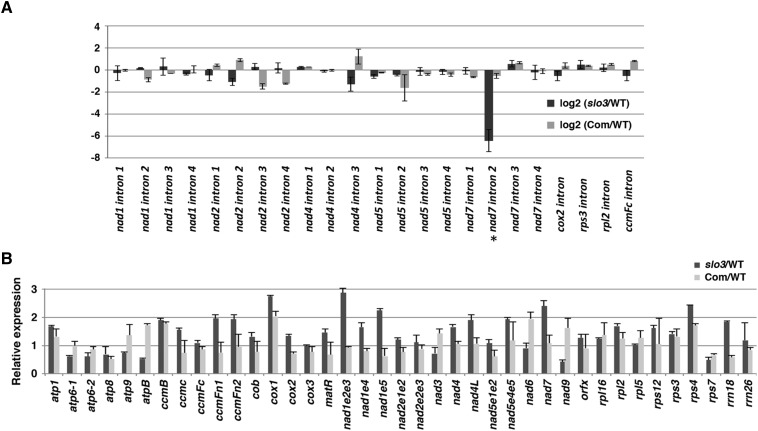
Splicing efficiency and abundance of mitochondrial transcripts in the slo3 mutant. A, Quantitative RT-PCR analysis of intron-containing mitochondrial transcripts. The histogram shows the log2 ratio of spliced to unspliced RNA in slo3 and complemented plants (Com) as compared with the corresponding wild type (WT). The splicing efficiency of nad7 intron 2 (indicated by asterisk) was dramatically reduced in the slo3 mutant. This specific splicing defect was restored in the complemented plants. B, Quantitative RT-PCR analysis of mitochondrial transcripts. The histogram shows the relative fold change of mitochondrial transcripts in slo3 and complemented plants as compared with the corresponding wild type. All of the quantifications were normalized to the nuclear gene Actin2 (ACT2). atp1, ATP synthase subunit1; cob, cytochrome c biogenesis; orfx, open reading frame x.
Figure 6.
Figure 6.
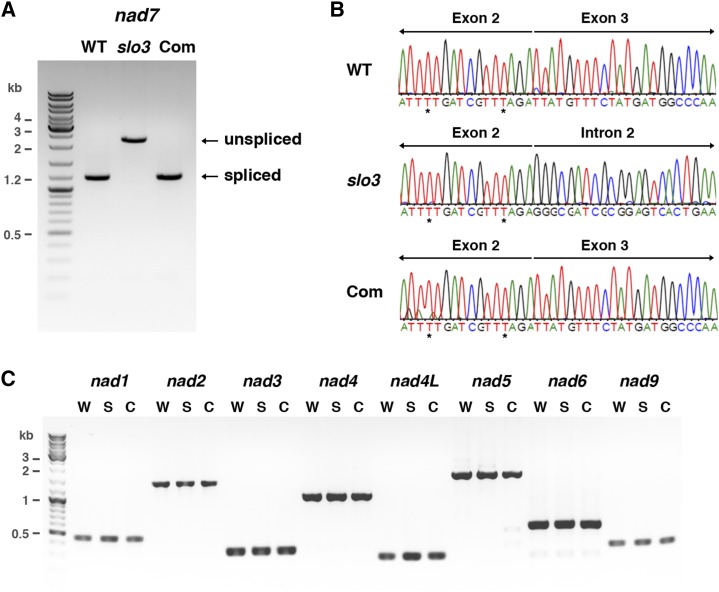
RT-PCR and sequence analysis of nad7 transcripts in the slo3 mutant. A, Detection of fully processed nad7 transcripts by RT-PCR. The primers used for this experiment were located in exons 1 and 5, which would generate the 1,185-bp RT-PCR products for fully processed nad7 transcripts. Instead of 1,185 bp, the majority of the RT-PCR products in slo3 were the 2,248-bp unspliced form. Fully processed nad7 transcripts were restored in complemented plants (Com). B, Sequence histograms of RT-PCR products showing the junctions of spliced (exon 2-exon 3) and unspliced (exon 2-intron 2) nad7 transcripts from wild-type (WT), slo3, and complemented plants. Sequence analysis of the RT-PCR products confirmed that the 2,248-bp unspliced form contained exons 1 to 5 and the entire intron 2 of nad7 in the slo3 mutant. Asterisks indicate RNA editing sites. C, RT-PCR analysis of nad1, nad2, nad3, nad4, nad4L, nad5, nad6, and nad9 transcripts in wild type (W), slo3 (S), and complemented (C) plants. The primers used for this experiment were designed to amplify full-length or fully processed nad transcripts. These results confirmed that the splicing of nad7 intron 2 was specifically affected in slo3, whereas other mitochondrial nad transcripts were processed and accumulated normally in the mutant.
Figure 7.
Figure 7.
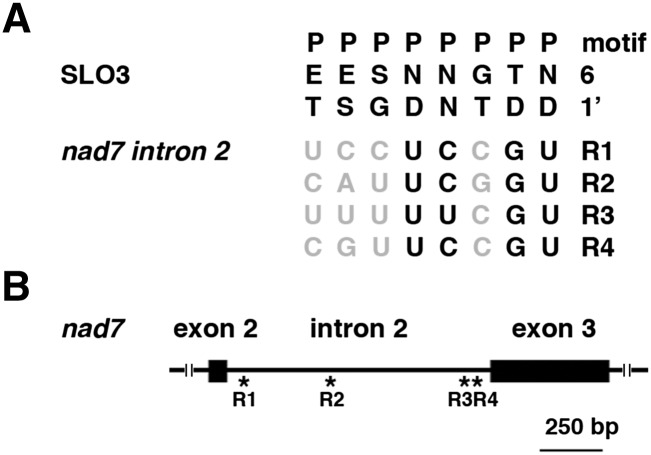
Predictions of SLO3 PPR binding sites in nad7 intron 2. A, The 6/1′ amino acid combinations for each PPR (P) motif were aligned to four RNA sequences (R1 to R4) in nad7 intron 2 that SLO3 might bind. Nucleotides that match the expectation with high correlations are shown in black (Barkan et al., 2012). The nad7 intron 2 has 1,063 nucleotides, and R1 to R4 encompass nucleotides 28 to 35, 391 to 398, 1,039 to 1,046, and 1,044 to 1,051 of the intron, respectively. B, Schematic diagram of nad7 intron 2. Asterisks indicate the relative positions of R1 to R4 in the intron.
Figure 8.
Figure 8.
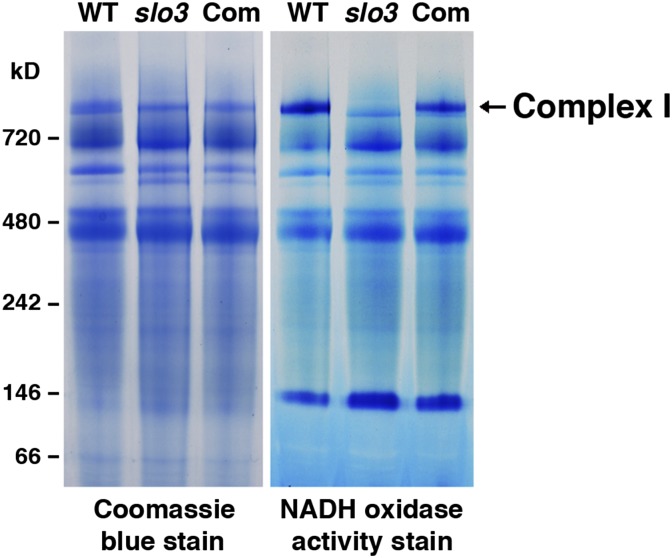
The activity of complex I is significantly reduced in the slo3 mutant. Crude membrane extracts isolated from wild-type (WT), slo3, and slo3-complemented (Com) plants were separated by BN-PAGE followed by Coomassie Blue staining (left) or an in-gel activity stain for NADH dehydrogenase (right).

References

    1. Barkan A, Rojas M, Fujii S, Yap A, Chong YS, Bond CS, Small I (2012) A combinatorial amino acid code for RNA recognition by pentatricopeptide repeat proteins. PLoS Genet 8: e1002910. - PMC - PubMed
    1. Barkan A, Small I (2014) Pentatricopeptide repeat proteins in plants. Annu Rev Plant Biol 65: 415–442 - PubMed
    1. Benková E, Hejátko J (2009) Hormone interactions at the root apical meristem. Plant Mol Biol 69: 383–396 - PubMed
    1. Binder S, Brennicke A (2003) Gene expression in plant mitochondria: transcriptional and post-transcriptional control. Philos Trans R Soc Lond B Biol Sci 358: 181–188, discussion 188–189 - PMC - PubMed
    1. Bonen L. (2008) Cis- and trans-splicing of group II introns in plant mitochondria. Mitochondrion 8: 26–34 - PubMed

Publication types

MeSH terms

Associated data