. 2015 Aug 1;61(3):305-12.
doi: 10.1093/cid/civ318. Epub 2015 Apr 17.

Whole-genome sequencing for national surveillance of Shiga toxin-producing Escherichia coli O157

Affiliations

Whole-genome sequencing for national surveillance of Shiga toxin-producing Escherichia coli O157

Timothy J Dallman et al. Clin Infect Dis. .

Abstract

Background: National surveillance of gastrointestinal pathogens, such as Shiga toxin-producing Escherichia coli O157 (STEC O157), is key to rapidly identifying linked cases in the distributed food network to facilitate public health interventions. In this study, we used whole-genome sequencing (WGS) as a tool to inform national surveillance of STEC O157 in terms of identifying linked cases and clusters and guiding epidemiological investigation.

Methods: We retrospectively analyzed 334 isolates randomly sampled from 1002 strains of STEC O157 received by the Gastrointestinal Bacteria Reference Unit at Public Health England, Colindale, in 2012. The genetic distance between each isolate, as estimated by WGS, was calculated and phylogenetic methods were used to place strains in an evolutionary context.

Results: Estimates of linked clusters representing STEC O157 outbreaks in England and Wales increased by 2-fold when WGS was used instead of traditional typing techniques. The previously unidentified clusters were often widely geographically distributed and small in size. Phylogenetic analysis facilitated identification of temporally distinct cases sharing common exposures and delineating those that shared epidemiological and temporal links. Comparison with multi locus variable number tandem repeat analysis (MLVA) showed that although MLVA is as sensitive as WGS, WGS provides a more timely resolution to outbreak clustering.

Conclusions: WGS has come of age as a molecular typing tool to inform national surveillance of STEC O157; it can be used in real time to provide the highest strain-level resolution for outbreak investigation. WGS allows linked cases to be identified with unprecedented specificity and sensitivity that will facilitate targeted and appropriate public health investigations.

Keywords: Shiga toxin–producing Escherichia coli O157; national surveillance; public health; whole-genome sequencing.


Figures

Figure 1.
Figure 1.
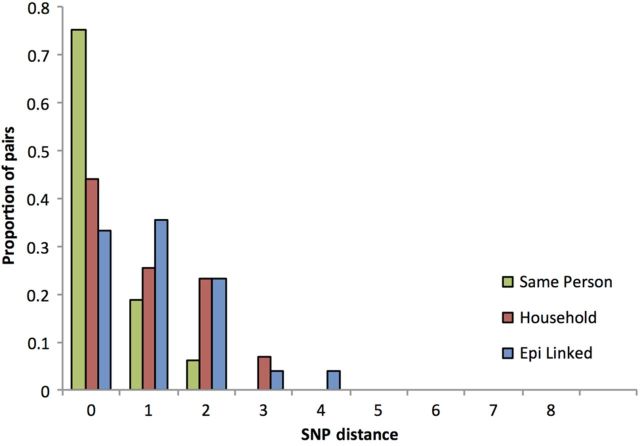
Histogram showing proportion of pairs against single-nucleotide polymorphism (SNP) distance of cases with a known epidemiological link.
Figure 2.
Figure 2.
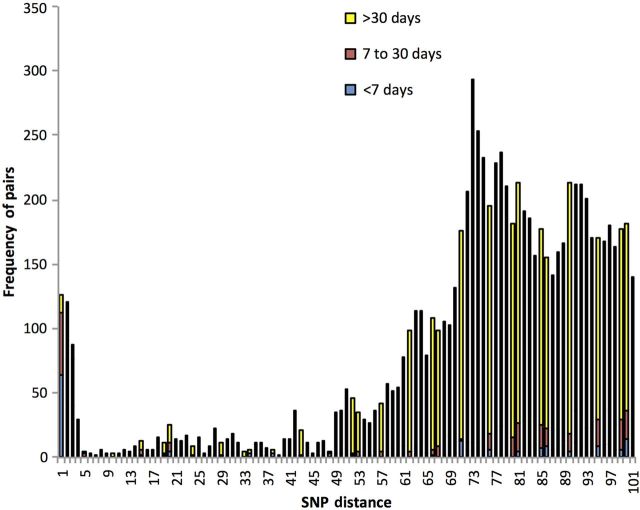
Histogram showing frequency of pairs against single-nucleotide polymorphism (SNP) distance. Each bar is colored as a proportion of pairs isolated within <7 days, 7–30 days, and >30 days.
Figure 3.
Figure 3.
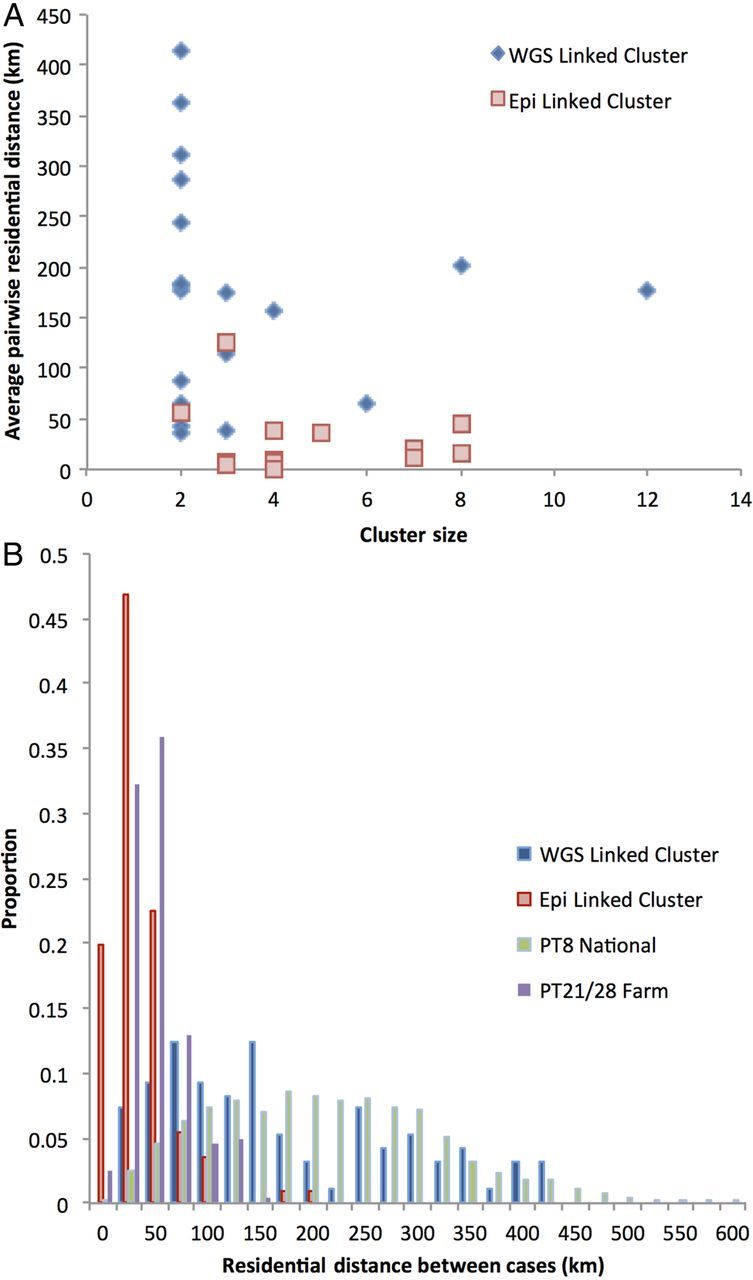
A, Scatter diagram showing the average pairwise residential distance of each close contact cluster against the size in number of cases. The coloring represents whether the cluster was already identified through epidemiological investigation or if identified by whole-genome sequencing (WGS) alone. B, Histogram showing the distribution of residential distance for WGS linked clusters and epidemiologically linked clusters. PT8 National and PT21/28 Farm represent distributed foodborne and point source outbreaks, respectively.
Figure 4.
Figure 4.
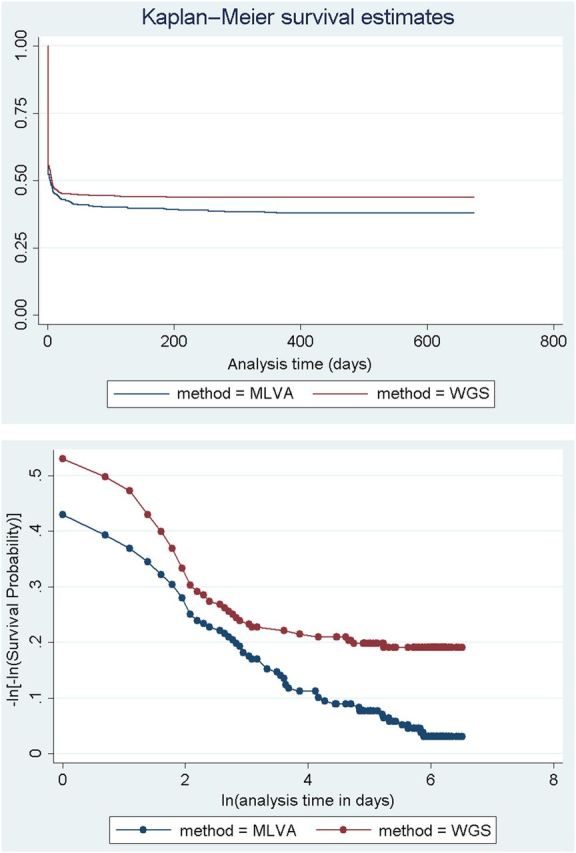
Kaplan–Meier failure estimates and proportional hazards assumption test showing that there is no difference in timeliness of clustering between whole-genome sequencing (WGS) and multi locus variable number tandem repeat analysis (MLVA).
Figure 5.
Figure 5.
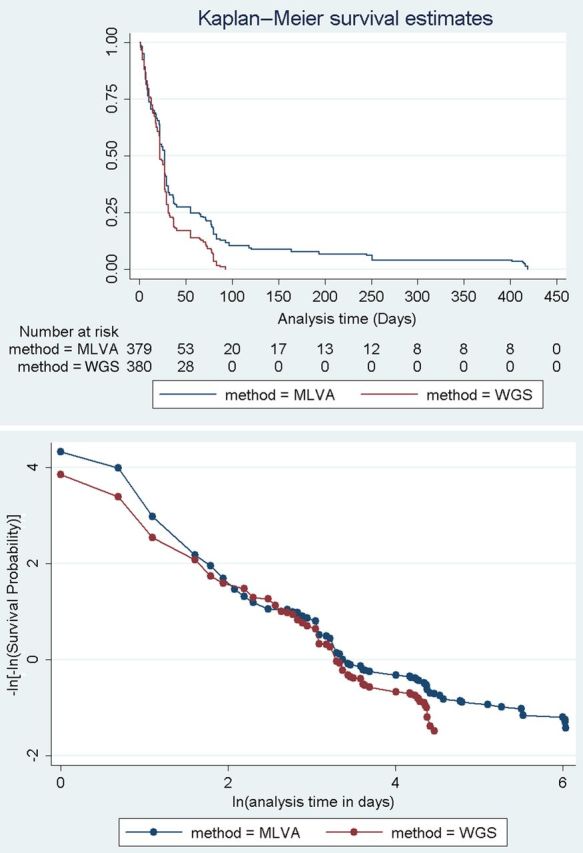
Kaplan–Meier survival estimates and proportional hazards assumption test showing that after isolates have clustered, time to completion of that cluster is significantly faster with whole-genome sequencing (WGS) than with multi locus variable number tandem repeat analysis (MLVA).
Figure 6.
Figure 6.
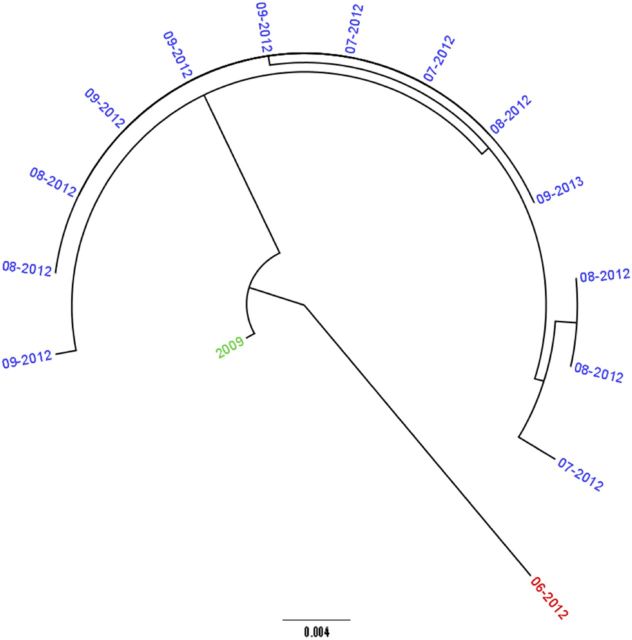
Maximum likelihood phylogeny of 15 isolates representing 27 single-nucleotide polymorphisms (SNPs) across 25 coding DNA sequence (2 noncoding SNPs) with a total core genome size of 4 915 463 bp associated with cases that visited the same national park. The clusters represent 3 different common source threshold clusters, colored red, blue, and green within a single phylogenetic cluster. The level of resolution allows the delineation of strains from different years. The strain in red was temporally related to the strains in blue but significantly different genomically to suggest a different source of Shiga toxin–producing Escherichia coli exposure.
Figure 7.
Figure 7.
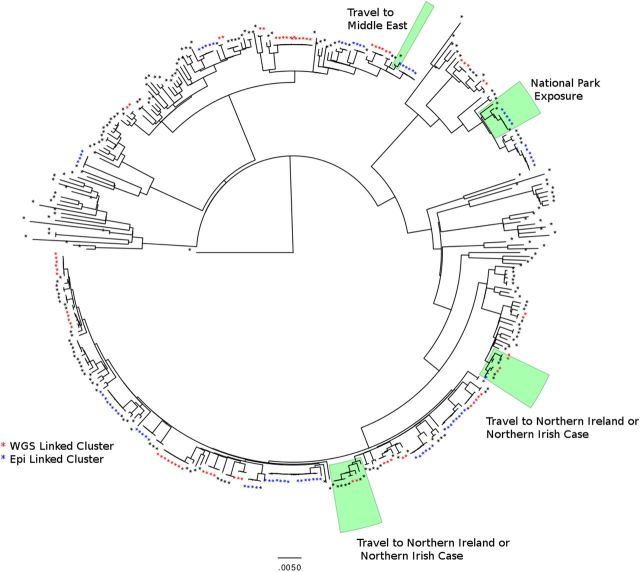
Maximum likelihood phylogeny of 374 isolates, representing 7756 single-nucleotide polymorphisms (SNPs), across 2902 coding DNA sequence (1166 noncoding SNPs) with a total core genome size of 3 808 948 bp. Common source threshold clusters identified through whole-genome sequencing (WGS) alone are colored red, and those identified through traditional methods are colored blue. Phylogenetic clusters that contained strains with related exposures are shaded green.

References

    1. Wheeler JG, Sethi D, Cowden JM, et al. Study of infectious intestinal disease in England: rates in the community, presenting to general practice, and reported to national surveillance. The Infectious Intestinal Disease Study Executive. BMJ 1999; 318:1046–50. - PMC - PubMed
    1. Jenkins C, Lawson A, Cheasty T, Bolton E, Smith G. Assessment of a real-time PCR for the detection and characterisation of verocytotoxigenic Escherichia coli. J Med Microbiol 2012; 61:1082–5. - PubMed
    1. Lynn RM, O'Brien SJ, Taylor CM, et al. Childhood hemolytic uremic syndrome, United Kingdom and Ireland. Emerg Infect Dis 2005; 11:590–6. - PMC - PubMed
    1. Pennington H. Escherichia coli O157. Lancet 2010; 376:1428–35. - PubMed
    1. Ferens WA, Hovde CJ. Escherichia coli O157:H7: animal reservoir and sources of human infection. Foodborne Pathog Dis 2011; 8:465–87. - PMC - PubMed

Publication types

MeSH terms