


Serological differentiation of antibodies against Rickettsia helvetica, R. raoultii, R. slovaca, R. monacensis and R. felis in dogs from Germany by a micro-immunofluorescent antibody test
- PMID: 25889200
- PMCID: PMC4369902
- DOI: 10.1186/s13071-015-0745-1
Serological differentiation of antibodies against Rickettsia helvetica, R. raoultii, R. slovaca, R. monacensis and R. felis in dogs from Germany by a micro-immunofluorescent antibody test
Abstract
Background: Spotted Fever Group (SFG) Rickettsiae can cause febrile diseases with or without rash in humans worldwide. In Germany only limited data are available about their medical significance. Serological screening tests for antibodies against rickettsiae usually only distinguish between SFG and Typhus Group (TG) Rickettsiae due to the strong cross reactivities within the groups. Seroprevalence rates in dogs, as possible sentinels for tick-borne diseases, could serve as an indicator for the distribution of different Rickettsia species.
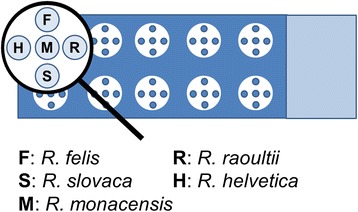
Methods: In this study, a micro-immunofluorescence assay (micro-IFA) was established for detection and differentiation of antibodies against five Rickettsia species in dogs (R. helvetica, R. raoultii, R. slovaca, R. monacensis and R. felis). Dogs that never left Germany (n = 605) previously investigated with an SFG-ELISA were included in this study and screened at a 1:128 dilution. Endpoint titres of fifty randomly selected seropositive samples of each of the five investigated regions in Germany were determined in order to allow a differentiation of the causative Rickettsia species. Sensitivity and specificity of the micro-IFA were compared with ELISA results of the previous study.
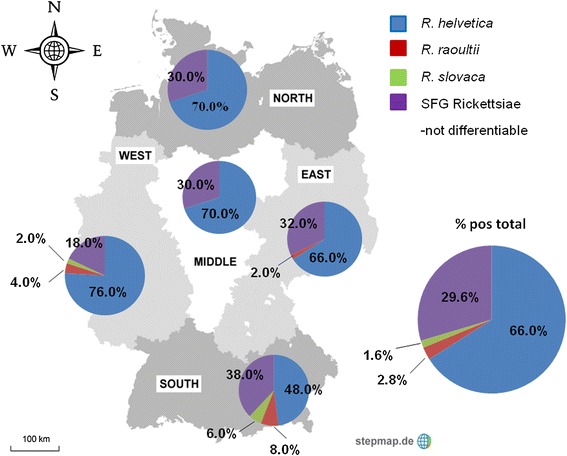
Results: A total of 93.9% of the dogs were positive for antibodies of the SFG Rickettsiae at the screening titer of 1:128. Differentiation of SFG Rickettsiae with the micro-IFA was possible in 70.4%, but in 29.6% of the cases the detected antibodies were not differentiable. Considering a clear differentiation by a twofold titre difference between observed reactions, the seroprevalence rates were 66.0% for R. helvetica, 2.8% for R. raoultii, 1.6% for R. slovaca, but no serological reaction could be clearly attributed to R. monacensis or R. felis. No statistically significant regional differences were found for R. helvetica, R. slovaca and R. raoultii comparing the five regions of Germany. Comparison of micro-IFA with ELISA revealed a sensitivity of 82.0% and a specificity of 83.8% for the Rickettsia SFG ELISA.
Conclusions: The micro-IFA is a useful serological tool to differentiate antibodies against different Rickettsia species in dogs. Seroprevalence rates in dogs correspond to the prevalence rates and distribution of Rickettsia-carrying tick species.
Figures
References
-
- Dumler JS, Barbet AF, Bekker CP, Dasch GA, Palmer GH, Ray SC, et al. Reorganization of genera in the families Rickettsiaceae and Anaplasmataceae in the order Rickettsiales: unification of some species of Ehrlichia with Anaplasma, Cowdria with Ehrlichia and Ehrlichia with Neorickettsia, descriptions of six new species combinations and designation of Ehrlichia equi and ‘HGE agent’ as subjective synonyms of Ehrlichia phagocytophila. Int J Syst Evol Microbiol. 2001;51:2145–65. doi: 10.1099/00207713-51-6-2145. - DOI - PubMed
Publication types
MeSH terms
Substances
LinkOut - more resources
Full Text Sources
Other Literature Sources
Medical
Miscellaneous
